
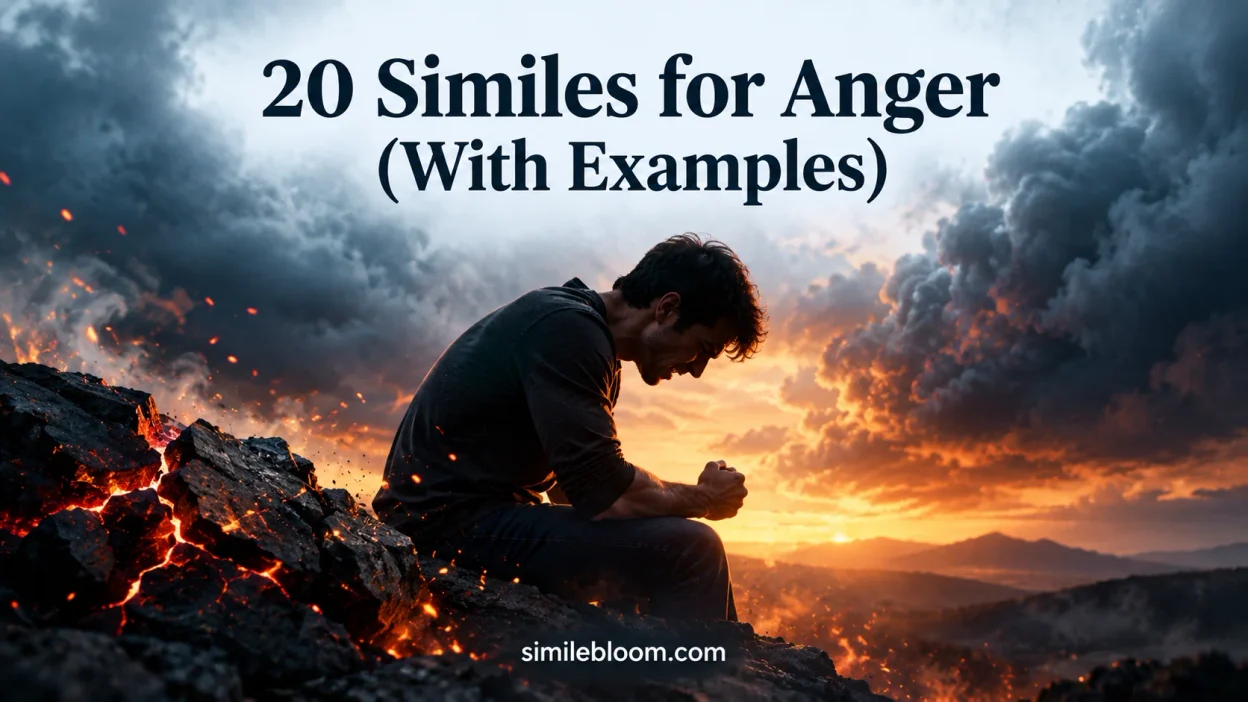
Have you ever felt anger rising so quickly that ordinary words could not capture it? The right simile can turn that intense emotion into a vivid picture readers immediately understand. In this guide, 20 Similes for Anger With Real Examples will help you describe frustration, rage, irritation, and emotional intensity with clarity.
Each comparison connects anger with a familiar image, making your writing more expressive and memorable. These examples can also strengthen English usage, grammar, and everyday expression.Strong figurative language can make emotions easier to understand and more engaging to describe. An anger simile can show whether someone feels mildly irritated, deeply frustrated, or intensely furious.
You might use these expressions in creative writing, essays, stories, speeches, or formal writing. Understanding the meaning and emotional tone behind each comparison also helps you use similes naturally. Rather than simply memorizing expressions, you can learn how each one works in context.In this article, you will explore 20 vivid similes for anger alongside real examples that demonstrate how each comparison works.
We will explain the meaning, emotional intensity, and appropriate context of every expression. You will also discover how these similes can make descriptions more powerful without sounding forced or repetitive. From quiet irritation to explosive rage, these examples offer practical ways to express anger clearly and creatively. The goal is to help you choose the right simile and make your English writing more vivid.
What Is a Simile?
A simile is a figure of speech that compares two different things to highlight a shared quality or characteristic.
Similes commonly use comparison words such as “like” and “as.”
For example:
- “The baby slept like a log.”
- “Her hands were as cold as ice.”
These sentences are not meant literally. A baby is not actually a piece of wood, and the hands are not made of frozen water. The comparisons create a figurative meaning that helps the reader imagine the situation.
A simile can make ordinary language more vivid, expressive, and memorable.
Simile vs. Metaphor
A simile usually signals its comparison with a word such as “like” or “as.” A metaphor, however, makes a direct comparison without using those comparison words.
For example:
- Simile: “His anger was like a storm.”
- Metaphor: “His anger was a storm.”
Both expressions create a mental picture, but the grammatical structure is different. The first clearly presents a comparison, while the second directly identifies one thing with another for figurative effect.
Understanding this distinction helps you use figurative language accurately.
Why Use Similes for Anger?
Anger can range from a small irritation to overwhelming fury. Simply writing “She was angry” tells the reader the emotion, but it does not show its intensity, movement, or character.
Similes give anger a shape that readers can picture.
They can help you:
- Express feelings without relying on the same basic adjectives.
- Create strong mental images.
- Show whether anger is controlled, growing, sudden, or explosive.
- Add personality to dialogue and storytelling.
- Make emotional descriptions more memorable.
- Add depth to creative writing and poetry.
- Make personal messages more expressive.
- Describe difficult emotions without overexplaining them.
- Show the difference between quiet frustration and intense rage.
The best simile is not necessarily the most dramatic one. It is the one that accurately fits the emotion and situation.
Quick List of 20 Similes
- Like a pot left boiling too long
- Like a storm trapped behind a window
- As hot as a furnace
- Like sparks flying from a struck match
- Like a volcano ready to erupt
- As tense as a drawn bow
- Like thunder shaking the sky
- Like fire racing through dry grass
- As sharp as a blade
- Like a pressure cooker with no release
- As red as a warning light
- Like a kettle screaming on the stove
- Like a wild river breaking its banks
- As restless as a caged tiger
- Like a dark cloud following every step
- As fierce as a flame in a strong wind
- Like a hornet trapped in a jar
- As cold as iron left in winter
- Like an earthquake beneath calm ground
- As explosive as fireworks in a closed room
Like a Pot Left Boiling Too Long
Meaning
This simile describes anger that has built up gradually and is now close to spilling over. It suggests that someone has tolerated frustration for a while and may soon lose patience.
Detailed Explanation
A pot that continues boiling eventually reaches a point where its contents spill over. Comparing anger to a pot left boiling too long creates an image of pressure building with time. The comparison works especially well when small annoyances have accumulated into one major emotional reaction. It can describe someone who appears calm but is actually close to reaching their limit. The tone is usually serious but conversational, making it useful in everyday descriptions and storytelling.
Example in a Sentence
- After weeks of dealing with the same problem, Marcus was like a pot left boiling too long.
- She had stayed patient for hours, but by the end of the meeting, she was like a pot left boiling too long.
3 Other Ways to Say It
- Her patience was nearly exhausted.
- Frustration had been building for a long time.
- He was close to losing his temper.
Like a Storm Trapped Behind a Window
Meaning
This simile describes powerful anger that is being held inside rather than openly expressed.
Detailed Explanation
A storm outside a window can look violent while the glass keeps it physically separated from the people indoors. That image works for someone who feels intense anger but is trying hard not to show it. The comparison suggests contained emotional energy rather than an immediate outburst. It is particularly effective in fiction, reflective writing, and descriptions of tense conversations.
Example in a Sentence
- He sat silently at the table, like a storm trapped behind a window.
- Her face remained calm, but inside she felt like a storm trapped behind a window.
3 Other Ways to Say It
- Anger was raging beneath the surface.
- He was holding back his fury.
- Her frustration was hidden behind a calm expression.
As Hot as a Furnace
Meaning
This simile describes anger that feels intensely heated and overwhelming.
Detailed Explanation
A furnace produces extreme heat, so comparing anger to one emphasizes the physical sensation often associated with intense emotion. The comparison suggests that the person feels burning anger rather than mild irritation. It can also suggest that the emotion has become difficult to ignore. This expression has a dramatic and vivid quality and works especially well in descriptive writing.
Example in a Sentence
- By the time he heard the accusation, his temper was as hot as a furnace.
- She walked away with a face as hot as a furnace, struggling to calm herself.
3 Other Ways to Say It
- His anger was burning fiercely.
- She was filled with intense fury.
- His temper was running extremely hot.
Like Sparks Flying from a Struck Match
Meaning
This simile describes anger that appears suddenly and intensely, often after a small trigger.
Detailed Explanation
When a match is struck, sparks appear almost instantly. That makes the image useful for anger that does not take long to surface. A small comment, insult, or unexpected problem can create an immediate emotional reaction. The comparison is particularly useful when you want to emphasize speed and suddenness rather than long-term resentment. It can work well in storytelling and everyday descriptions.
Example in a Sentence
- Her temper flashed like sparks flying from a struck match when she heard the accusation.
- His anger appeared like sparks flying from a struck match, surprising everyone in the room.
3 Other Ways to Say It
- His temper flared instantly.
- She reacted with sudden fury.
- Anger flashed across his face.
Like a Volcano Ready to Erupt
Meaning
This simile describes intense anger that has been building beneath the surface and may soon burst out.
Detailed Explanation
A volcano can remain quiet while enormous pressure develops beneath it. That makes it a strong image for anger that has been suppressed or ignored for a long time. The comparison suggests that the person is still in control, but that control may not last. It creates a dramatic, powerful image and is especially effective in stories, speeches, and emotional descriptions.
Example in a Sentence
- After months of being ignored, she was like a volcano ready to erupt.
- He stood in the doorway like a volcano ready to erupt, barely containing his frustration.
3 Other Ways to Say It
- Anger was building beneath the surface.
- He was on the verge of exploding.
- Her patience was about to run out.
As Tense as a Drawn Bow
Meaning
This simile describes someone whose anger has created extreme emotional tension and readiness to react.
Detailed Explanation
A drawn bow is stretched tightly and holds potential energy until the string is released. Comparing an angry person to a drawn bow suggests that they are under pressure and ready to respond. Unlike a simile focused only on heat or noise, this one emphasizes restraint and tension. It works particularly well when someone has not yet acted but appears close to doing so. The tone is serious and slightly poetic.
Example in a Sentence
- He stood there as tense as a drawn bow, waiting for someone to challenge him.
- By the end of the argument, everyone seemed as tense as a drawn bow.
3 Other Ways to Say It
- He was wound tightly with frustration.
- She was ready to snap.
- The tension was almost unbearable.
Like Thunder Shaking the Sky
Meaning
This simile describes anger that is loud, powerful, and impossible to ignore.
Detailed Explanation
Thunder can fill an entire sky with a deep, forceful sound. Comparing anger to thunder gives the emotion a sense of power and presence. It works especially well when someone expresses anger loudly or when their words affect everyone around them. The image is more about the force of the emotional expression than about quiet resentment. It suits dramatic storytelling, speeches, and vivid descriptions.
Example in a Sentence
- His voice rolled through the hallway like thunder shaking the sky.
- Her angry words struck the room like thunder shaking the sky.
3 Other Ways to Say It
- His voice boomed with anger.
- Her fury was impossible to ignore.
- The room echoed with his rage.
Like Fire Racing Through Dry Grass
Meaning
This simile describes anger that spreads rapidly and becomes stronger within moments.
Detailed Explanation
Fire can move quickly through dry grass, especially when conditions allow it to spread. This creates a useful comparison for anger that begins with one small incident and quickly affects an entire situation. It can describe one person’s temper or anger spreading through a group. The image emphasizes speed, danger, and loss of control. It works especially well in storytelling and dramatic writing.
Example in a Sentence
- His frustration spread through the conversation like fire racing through dry grass.
- One careless remark sent her anger like fire racing through dry grass.
3 Other Ways to Say It
- The anger spread quickly.
- Frustration grew from one comment into a major conflict.
- His temper escalated rapidly.
As Sharp as a Blade
Meaning
This simile describes anger expressed through cutting words, harsh remarks, or an unforgiving attitude.
Detailed Explanation
A blade is sharp enough to cut, so it creates a strong image for words that can hurt emotionally. This comparison does not necessarily describe loud anger. Instead, it focuses on the precision and harshness of an angry person’s speech. A calm voice can still sound sharp, which makes this simile useful for describing restrained hostility. It works well in personal writing, stories, and descriptions of difficult conversations.
Example in a Sentence
- Her reply was as sharp as a blade, and the room immediately went quiet.
- His angry criticism was as sharp as a blade, leaving everyone uncomfortable.
3 Other Ways to Say It
- Her words were cutting.
- His response was bitingly harsh.
- She spoke with cold hostility.
Like a Pressure Cooker with No Release
Meaning
This simile describes anger that is trapped inside and becoming increasingly difficult to control.
Detailed Explanation
A pressure cooker contains pressure as it heats, making it a useful image for emotions that continue building without an outlet. The phrase suggests that a person has been holding back frustration instead of addressing it. The longer the pressure remains, the more difficult the situation becomes. It works naturally in conversations about stress, conflict, relationships, and emotional restraint.
Example in a Sentence
- After keeping quiet for so long, he felt like a pressure cooker with no release.
- She had been swallowing every complaint and felt like a pressure cooker with no release.
3 Other Ways to Say It
- Frustration was piling up inside.
- He was bottling up his anger.
- She felt ready to break under the pressure.
As Red as a Warning Light
Meaning
This simile describes visible anger, especially when someone’s face becomes red with emotion.
Detailed Explanation
A warning light immediately tells us that something needs attention. A flushed face can similarly signal that someone is experiencing strong anger. The comparison combines a visual detail with the idea of danger or emotional urgency. It is useful when you want to show anger rather than simply naming it. The expression can work in casual descriptions, storytelling, and dialogue.
Example in a Sentence
- His face became as red as a warning light when he realized what had happened.
- She stood there as red as a warning light, struggling to remain calm.
3 Other Ways to Say It
- His face flushed with anger.
- She looked visibly furious.
- His cheeks burned with frustration.
Like a Kettle Screaming on the Stove
Meaning
This simile describes anger that has become high-pitched, noisy, and difficult to contain.
Detailed Explanation
A kettle can produce a loud whistle when water reaches boiling point. That sound creates an amusing but recognizable image for someone whose frustration has reached its limit. Unlike the quieter comparisons in this article, this one can add a touch of humor or playfulness to an angry situation. It works best in informal storytelling or light descriptions rather than serious emotional scenes.
Example in a Sentence
- By lunchtime, he was like a kettle screaming on the stove, complaining about everything.
- She sounded like a kettle screaming on the stove after the third interruption.
3 Other Ways to Say It
- He was making his frustration very obvious.
- She was fuming loudly.
- His temper was boiling over.
Like a Wild River Breaking Its Banks
Meaning
This simile describes anger that overflows its normal boundaries and becomes difficult to contain.
Detailed Explanation
A river normally stays within its banks, but heavy water can force it beyond those boundaries. That makes the image effective for emotions that have grown too strong to remain controlled. The comparison focuses on overflow rather than sudden explosion. It suggests that the person may have tried to stay calm but eventually could no longer contain the accumulated emotion. This is a strong choice for creative writing and emotional storytelling.
Example in a Sentence
- Years of resentment finally came out like a wild river breaking its banks.
- Her anger poured into the conversation like a wild river breaking its banks.
3 Other Ways to Say It
- Her emotions spilled over.
- He could no longer contain his frustration.
- Years of anger finally came pouring out.
As Restless as a Caged Tiger
Meaning
This simile describes anger combined with restlessness, agitation, and a strong desire to act.
Detailed Explanation
A caged tiger has energy and strength but cannot move freely. Comparing an angry person to one suggests that the person feels trapped, frustrated, and increasingly agitated. It is especially useful when someone keeps pacing, moving, or struggling to remain still. The comparison creates a powerful and dramatic mental picture without requiring an angry outburst.
Example in a Sentence
- He paced around the office as restless as a caged tiger.
- Waiting for the explanation left her as restless as a caged tiger.
3 Other Ways to Say It
- He was pacing with frustration.
- She was too agitated to sit still.
- His anger made him restless and uneasy.
Like a Dark Cloud Following Every Step
Meaning
This simile describes anger or resentment that lingers over a person for a long time.
Detailed Explanation
A dark cloud can follow someone through a gloomy day, affecting the atmosphere wherever they go. In the same way, unresolved anger can remain in the background even when the original argument has ended. This comparison is less about explosive rage and more about persistent emotional heaviness. It fits reflective writing, personal stories, and descriptions of unresolved conflict.
Example in a Sentence
- The argument stayed with him like a dark cloud following every step.
- Her resentment followed her like a dark cloud following every step, even after she left the room.
3 Other Ways to Say It
- Anger continued to hang over him.
- The resentment would not go away.
- She carried unresolved frustration with her.
As Fierce as a Flame in a Strong Wind
Meaning
This simile describes anger that is powerful, active, and difficult to calm.
Detailed Explanation
A flame in strong wind does not remain still. It bends, surges, and moves unpredictably while continuing to burn. That makes it a useful comparison for anger that is constantly changing or intensifying. The image suggests energy and force rather than quiet resentment. It works especially well in dramatic prose and emotional storytelling.
Example in a Sentence
- His anger burned as fierce as a flame in a strong wind.
- Her determination to confront the problem was as fierce as a flame in a strong wind.
3 Other Ways to Say It
- His anger was fierce and restless.
- She was burning with determination.
- His temper was intense and unpredictable.
Like a Hornet Trapped in a Jar
Meaning
This simile describes someone who is extremely irritated, agitated, and unable to settle down.
Detailed Explanation
A trapped hornet constantly tries to escape and may become more aggressive because it feels confined. This creates a vivid image for a person who is angry because they feel blocked, frustrated, or powerless. The comparison can add energy and even a little humor to a description. It is most suitable for informal conversation, storytelling, and light creative writing.
Example in a Sentence
- He was buzzing around the office like a hornet trapped in a jar.
- After being told he could not leave, the child became like a hornet trapped in a jar.
3 Other Ways to Say It
- He was wildly agitated.
- She was frustrated and unable to settle down.
- His irritation was impossible to hide.
As Cold as Iron Left in Winter
Meaning
This simile describes anger that has become cold, controlled, distant, and emotionally hard.
Detailed Explanation
Iron left outside in winter can feel extremely cold and unforgiving to the touch. The image works for anger that no longer appears as shouting or obvious rage. Instead, the person may become distant, restrained, and difficult to approach. This comparison is useful when anger has shifted from hot emotion to cold resentment. It suits serious fiction, reflective writing, and descriptions of strained relationships.
Example in a Sentence
- His response was as cold as iron left in winter.
- She gave him an as cold as iron left in winter stare and walked away.
3 Other Ways to Say It
- His anger had become cold and distant.
- She responded with frozen resentment.
- He showed little warmth or forgiveness.
Like an Earthquake Beneath Calm Ground
Meaning
This simile describes hidden anger that exists beneath an outwardly calm appearance.
Detailed Explanation
The ground may look perfectly still while powerful movement is taking place beneath it. That makes an earthquake a strong comparison for emotions that remain hidden. A person may speak normally while carrying deep frustration or resentment underneath. The image is especially useful when the reader needs to understand that apparent calm does not necessarily mean emotional peace. It works well in serious and dramatic writing.
Example in a Sentence
- His silence felt like an earthquake beneath calm ground.
- She smiled politely, but her anger was like an earthquake beneath calm ground.
3 Other Ways to Say It
- Anger was hidden beneath the surface.
- He looked calm but was deeply upset inside.
- Her quietness concealed powerful emotions.
As Explosive as Fireworks in a Closed Room
Meaning
This simile describes anger that is sudden, intense, noisy, and potentially overwhelming.
Detailed Explanation
Fireworks are designed for open spaces, where their light and sound can spread safely. Putting that same explosive energy into a closed room creates an image of overwhelming intensity. The comparison is therefore useful for anger that erupts suddenly and affects everyone nearby. It has a strongly dramatic tone and works best in fictional scenes, vivid storytelling, or emotional descriptions.
Example in a Sentence
- His reaction was as explosive as fireworks in a closed room.
- The argument became as explosive as fireworks in a closed room within seconds.
3 Other Ways to Say It
- His temper erupted suddenly.
- The argument escalated into chaos.
- Her anger burst out with tremendous force.
Exercise: Practice Using Similes
Test your understanding of similes for anger, figurative meaning, comparison, and natural English usage.
Question 1
Which sentence contains a simile?
A. His anger was a volcano.
B. His anger was like a volcano ready to erupt.
C. His anger erupted.
D. His anger increased.
Question 2
What does “like a pot left boiling too long” suggest?
A. Someone is cooking dinner.
B. Someone is completely relaxed.
C. Someone’s anger has been building toward an emotional overflow.
D. Someone is feeling sleepy.
Question 3
Which expression best describes anger that is being hidden beneath a calm exterior?
A. Like a storm trapped behind a window
B. As red as a warning light
C. Like thunder shaking the sky
D. As explosive as fireworks in a closed room
Question 4
Which comparison emphasizes sudden anger?
A. Like a dark cloud following every step
B. Like sparks flying from a struck match
C. As cold as iron left in winter
D. Like an earthquake beneath calm ground
Question 5
What two things are compared in “as tense as a drawn bow”?
A. Anger and water
B. A person and a storm
C. Emotional tension and a tightly stretched bow
D. A person and a flame
Question 6
Which sentence uses figurative language rather than literal language?
A. The kettle was on the stove.
B. The window was open.
C. He felt like a pressure cooker with no release.
D. The river crossed the road.
Question 7
Which simile best fits someone whose anger is expressed through cutting words?
A. As sharp as a blade
B. Like a wild river breaking its banks
C. As restless as a caged tiger
D. Like a dark cloud following every step
Question 8
Which sentence uses the simile naturally?
A. She was like a dark cloud following every step because she bought a new book.
B. His anger was like fire racing through dry grass after one careless remark.
C. The chair was like a storm trapped behind a window because it was wooden.
D. He ate lunch like an earthquake beneath calm ground.
Question 9
Which statement correctly describes the difference between a simile and a metaphor?
A. A simile must always be humorous.
B. A metaphor cannot describe emotions.
C. A simile usually uses comparison words such as “like” or “as,” while a metaphor makes a direct comparison.
D. A metaphor always uses the word “like.”
Question 10
What does “as red as a warning light” mainly emphasize?
A. A person’s visible anger or flushed face
B. A person’s quiet happiness
C. A person’s physical strength
D. A person’s sense of humor
Question 11
Which simile best describes anger that lingers over time?
A. Like sparks flying from a struck match
B. Like a dark cloud following every step
C. As explosive as fireworks in a closed room
D. Like a kettle screaming on the stove
Question 12
Which expression best describes someone who is angry, trapped, and unable to settle down?
A. As cold as iron left in winter
B. Like a hornet trapped in a jar
C. Like a dark cloud following every step
D. As sharp as a blade
Question 13
Which sentence contains a metaphor rather than a simile?
A. Her anger was like a storm.
B. His temper was as hot as a furnace.
C. Her anger was a storm.
D. He shook like a drawn bow.
Question 14
Which simile best communicates cold resentment rather than explosive anger?
A. Like fire racing through dry grass
B. As explosive as fireworks in a closed room
C. As cold as iron left in winter
D. Like thunder shaking the sky
Question 15
Which simile would best describe anger that is hidden beneath an apparently peaceful exterior?
A. Like an earthquake beneath calm ground
B. Like a kettle screaming on the stove
C. As red as a warning light
D. Like thunder shaking the sky
Answers
- B — “Like a volcano ready to erupt” uses like to compare anger with a volcano that is about to explode, so it is a simile.
- C — The comparison suggests that frustration has been building and may soon spill over.
- A — A storm trapped behind a window represents powerful emotion being contained behind an outwardly calm appearance.
- B — Sparks appear quickly when a match is struck, making the comparison effective for sudden anger.
- C — The simile compares a person’s emotional tension with the tight pressure of a drawn bow.
- C — A person is not literally a pressure cooker. The sentence uses a figurative comparison to describe emotional pressure.
- A — A blade suggests something sharp and capable of cutting, making it a fitting image for harsh or cutting words.
- B — The sentence naturally compares anger that spreads quickly with fire moving rapidly through dry grass.
- C — A simile generally uses comparison words such as “like” or “as,” while a metaphor makes a direct comparison.
- A — The comparison focuses on the visible redness that can accompany strong anger.
- B — A dark cloud following someone represents anger or resentment that continues to linger.
- B — A trapped hornet suggests someone who is agitated, frustrated, and unable to settle down.
- C — “Her anger was a storm” directly identifies anger with a storm, making it a metaphor rather than a simile.
- C — Cold iron creates an image of controlled, distant, and hardened anger rather than an emotional explosion.
- A — An earthquake beneath calm ground represents powerful hidden emotion beneath an outwardly peaceful surface.
Read More: 20 Similes for Hurt Similes With Real Examples
FAQs
What is a simile for anger?
A simile for anger compares intense emotion to something familiar using words such as “like” or “as.” For example, “He was as angry as a raging bull” creates a vivid picture of someone experiencing powerful anger.
What is a good simile for extreme anger?
A strong example is “His anger was like a volcano ready to erupt.” It suggests that the person has built up intense emotions that may suddenly explode.
What simile describes someone who is very angry?
You could say, “She was as furious as a storm at sea.” This comparison conveys powerful, uncontrolled emotion and creates a dramatic mental image.
How do similes make anger more descriptive?
Similes turn an abstract emotion into something readers can imagine. Instead of simply saying someone is angry, a comparison such as “his face burned like fire” shows the intensity through a recognizable image.
Can I use anger similes in creative writing?
Yes. Anger similes work particularly well in stories, poems, novels, personal narratives, and descriptive essays. They can reveal a character’s emotional state without repeatedly using words such as angry, furious, or enraged.
What is a simile for controlled or quiet anger?
For restrained anger, you might write, “Her anger simmered like a pot left on low heat.” This suggests that the emotion is strong but remains controlled beneath the surface.
What is a simile for sudden anger?
A useful example is, “His anger exploded like a firecracker.” The comparison emphasizes how quickly the emotion appeared and how dramatically it affected the situation.
Are anger similes suitable for formal writing?
They can be, depending on the purpose and tone. A carefully chosen simile may add clarity to formal writing, but academic or professional writing usually benefits from restrained and precise figurative language.
What is the difference between an anger simile and an anger metaphor?
An anger simile makes a direct comparison using words such as “like” or “as.” A metaphor makes the comparison directly. For example, “Her anger was like fire” is a simile, while “Her anger was fire” is a metaphor.
How can I choose the right simile for anger?
Think about the intensity, duration, and behavior associated with the anger. Use a gentle comparison for irritation and a powerful image for rage. The best simile should match the situation and make the emotion easier for readers to visualize.
Conclusion
Anger can be difficult to describe with ordinary words, especially when the emotion feels intense or overwhelming. These 20 similes for anger give you creative ways to show frustration, irritation, fury, and rage through vivid comparisons. Each simile creates a clearer emotional image and helps readers understand what a character or person is experiencing.
The key to using anger similes effectively is choosing a comparison that matches the situation. A quiet simmering feeling may need a softer image, while explosive rage calls for something much stronger. Pay attention to context, tone, and meaning rather than adding figurative language simply for effect. This approach makes your writing sound natural and purposeful.
Whether you are writing a story, essay, poem, or personal description, the right simile can make your words more memorable. Use these examples as inspiration, then adapt them to fit your own sentences and ideas. With regular practice, you can use figurative language more confidently and make your English writing more expressive, precise, and engaging.

James Anderson is an English teacher and educational writer interested in helping learners develop confident communication skills. He specializes in explaining literary devices and expressive English in straightforward language. His contributions to SimileBloom focus on useful simile examples, explanations, and learning resources that readers can apply in writing and conversation.

[…] Read More: 20 Similes for Anger With Real Examples […]