
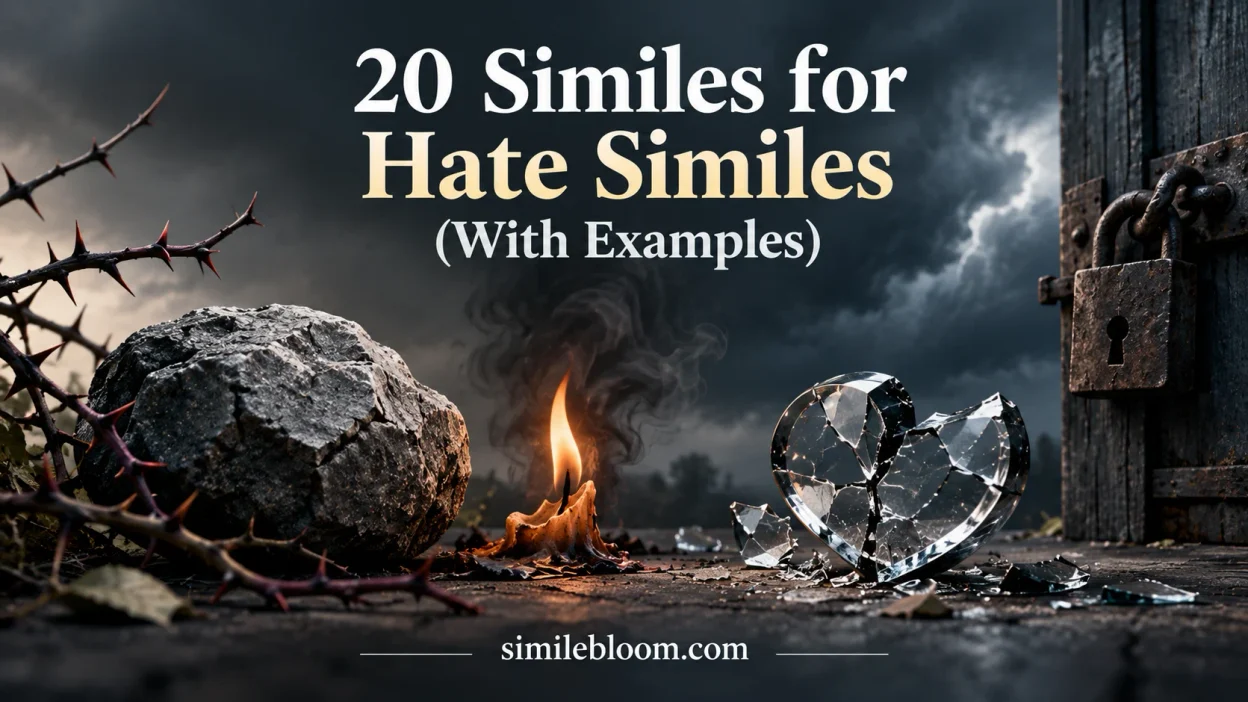
Have you ever felt so strongly about someone or something that simply saying “I hate it” feels too weak? 20 Similes for Hate Similes With Real Examples explores creative ways to express hatred, dislike, anger, resentment, and deep aversion through vivid comparisons. A well-crafted simile can turn a simple statement into an image readers can immediately understand.
For example, describing hatred as being “like a fire that refuses to die” creates a stronger emotional picture than the word hate alone.In this article, you’ll discover 20 similes for hate with clear, realistic examples that show how each comparison works in context. We’ll explore expressions that can describe intense hatred, bitter resentment, strong dislike, emotional hostility, and lasting anger.
Each example focuses on natural English usage and practical grammar, helping you understand when a particular simile sounds appropriate. Whether you are writing formal writing, creative work, essays, stories, or everyday conversations, these examples can help you choose more expressive language.
Clear language also depends on consistency and understanding the purpose of your words. Unlike terms used in scheduling, time management, business communication, online booking, broadcasting, meetings, calendar planning, or project management, figurative language gives emotions a memorable shape.
You’ll learn how these hate similes can add depth without making your writing sound forced. By the end, you’ll have practical expressions you can confidently use in creative writing, personal communication, academic work, and everyday English.
What Is a Simile?
A simile is a figure of speech that compares two different things using comparison words such as “like” or “as.” It helps readers understand an idea by connecting it with something more familiar or vivid.
For example:
- “The baby’s skin was as soft as cotton.”
- “The old house stood like a silent guardian.”
The comparisons are not meant literally. A baby’s skin is not actually cotton, and a house is not literally a guardian. These expressions create a figurative meaning that gives the reader a clearer mental picture.
Simile vs. Metaphor
A simile usually signals a comparison with words such as like or as.
- Simile: “His anger burned like a wildfire.”
- Metaphor: “His anger was a wildfire.”
Both expressions create imagery, but they work differently. The simile openly compares two things, while the metaphor directly identifies one thing with another for figurative effect.
This distinction matters when learning figurative language because not every imaginative comparison is a simile.
Why Use Similes for Hate Similes?
Hate is an intense and complicated emotion. A simile can show how that emotion feels, rather than simply naming it.
A carefully chosen comparison can:
- Express strong feelings without repeating the word hate.
- Create a vivid mental picture.
- Show whether the emotion is cold, explosive, bitter, persistent, or defensive.
- Add personality and emotional depth to writing.
- Make a personal message more expressive.
- Strengthen creative writing and storytelling.
- Help readers understand an emotional situation more clearly.
- Make descriptions more memorable and precise.
The key is choosing a comparison that matches the type of hatred you want to describe.
Quick List of 20 Similes
- As cold as winter stone
- Like a fire that refuses to die
- As bitter as burnt coffee
- Like a storm trapped in a bottle
- As sharp as broken glass
- Like a thorn buried under the skin
- As dark as a moonless night
- Like ice spreading across a window
- As fierce as a cornered wolf
- Like a shadow that follows everywhere
- As heavy as a sack of stones
- Like poison slowly entering the blood
- As relentless as waves against a cliff
- Like a locked door between two hearts
- As sour as spoiled fruit
- Like smoke filling an empty room
- As deep as an old scar
- Like a match waiting for friction
- As hard as iron
- Like a wall built brick by brick
As cold as winter stone
Meaning
This simile describes hate that feels emotionally cold, distant, and unforgiving. It suggests a person who has become detached rather than openly explosive.
Detailed Explanation
Winter stone creates an image of something hard, cold, and unpleasant to touch. Comparing hatred to it suggests that the feeling has lost warmth or affection completely. The emotion may be controlled on the surface but still very real underneath. This comparison works particularly well when describing quiet resentment or emotional separation.
Example in a Sentence
- After years of betrayal, his feelings toward his former friend became as cold as winter stone.
- Her response was as cold as winter stone, leaving no room for reconciliation.
3 Other Ways to Say It
- Completely devoid of warmth
- Filled with icy resentment
- Emotionally distant and unforgiving
Tone and context: Serious, emotional, and poetic. It works especially well in fiction, personal writing, poetry, and reflective descriptions.
Like a fire that refuses to die
Meaning
This simile describes persistent and intense hate that continues despite time or attempts to suppress it.
Detailed Explanation
A fire that refuses to die suggests an emotion that keeps burning even when someone tries to extinguish it. The comparison emphasizes persistence rather than sudden anger. It can describe resentment that survives for years or hostility that repeatedly returns after conflict. The image is energetic and dramatic.
Example in a Sentence
- His resentment burned like a fire that refused to die after the unfair treatment he had received.
- Her hatred remained like a fire that refused to die, even after many years apart.
3 Other Ways to Say It
- A resentment that never fades
- An anger that keeps burning
- A feeling that refuses to disappear
Tone and context: Dramatic, emotional, and poetic. It suits storytelling, poetry, speeches, and creative writing.
As bitter as burnt coffee
Meaning
This simile describes hate mixed with bitterness, disappointment, or unpleasant memories.
Detailed Explanation
Burnt coffee has a harsh and unpleasant taste. Comparing hate to it suggests an emotion that leaves an equally unpleasant impression. The comparison is especially useful when hatred develops from disappointment, betrayal, or repeated frustration rather than sudden rage. It has a familiar everyday image, making the expression accessible.
Example in a Sentence
- Years of disappointment left a bitterness as strong as burnt coffee.
- His words carried a resentment as bitter as burnt coffee.
3 Other Ways to Say It
- Thick with bitterness
- Sharp with resentment
- Tainted by disappointment
Tone and context: Serious but conversational. It can work in essays, personal writing, dialogue, and storytelling.
Like a storm trapped in a bottle
Meaning
This simile describes powerful hatred or anger that is being contained.
Detailed Explanation
A storm represents turbulence, noise, and uncontrollable energy. Putting that storm inside a bottle creates the image of enormous emotional force being held in a very small space. The comparison suggests that someone may appear calm while experiencing intense hostility internally. It is particularly effective when describing suppressed anger or hidden resentment.
Example in a Sentence
- He looked calm, but his resentment was like a storm trapped in a bottle.
- Her silence felt like a storm trapped in a bottle, waiting for an opportunity to break free.
3 Other Ways to Say It
- Anger held tightly inside
- A volcano beneath a calm surface
- Explosive resentment kept under control
Tone and context: Dramatic and emotional. It works well in novels, speeches, poetry, and character descriptions.
As sharp as broken glass
Meaning
This simile describes hate that feels painful, cutting, and capable of hurting others.
Detailed Explanation
Broken glass has sharp edges that can easily cause injury. Comparing hateful words or feelings to broken glass emphasizes their ability to cut emotionally. It can describe cruel remarks, hostile behavior, or resentment that makes every interaction painful. The image is particularly strong when hate is expressed through language.
Example in a Sentence
- His accusations were as sharp as broken glass.
- Every conversation became as sharp as broken glass after the argument.
3 Other Ways to Say It
- Cutting and cruel
- Painfully hostile
- Full of hurtful words
Tone and context: Serious, dramatic, and emotional. It fits creative writing, personal narratives, and descriptions of conflict.
Like a thorn buried under the skin
Meaning
This simile describes hate that causes persistent irritation and emotional discomfort.
Detailed Explanation
A thorn under the skin is difficult to ignore because it keeps causing pain even when nothing appears wrong from the outside. This makes it a useful comparison for resentment that remains hidden but continues to affect someone. The image suggests ongoing emotional irritation rather than explosive anger. It can also imply that the person has never fully dealt with the original hurt.
Example in a Sentence
- The old betrayal remained like a thorn buried under the skin.
- His resentment stayed like a thorn buried under the skin, quietly affecting every relationship.
3 Other Ways to Say It
- A constant source of irritation
- An old wound that still hurts
- Pain hidden beneath the surface
Tone and context: Reflective, emotional, and serious. It works well in personal essays, stories, and poetry.
As dark as a moonless night
Meaning
This simile describes hate as deep, gloomy, frightening, or emotionally heavy.
Detailed Explanation
A moonless night provides very little natural light, making everything harder to see. Comparing hatred to such darkness suggests an emotion that feels overwhelming or difficult to escape. It does not necessarily describe loud anger. Instead, it emphasizes the dark emotional atmosphere surrounding the feeling. This can be effective when describing hatred that has become psychologically or emotionally consuming.
Example in a Sentence
- The hatred between the two families became as dark as a moonless night.
- His thoughts grew as dark as a moonless night after years of resentment.
3 Other Ways to Say It
- Deeply shadowed by resentment
- Filled with emotional darkness
- Heavy with hostility
Tone and context: Poetic, serious, and dramatic. It is suitable for fiction, poetry, storytelling, and reflective writing.
Like ice spreading across a window
Meaning
This simile describes hate that gradually develops and slowly blocks emotional connection.
Detailed Explanation
Ice spreading across a window begins in one place and gradually covers more of the surface. This makes it a useful image for resentment that starts small but grows over time. As the ice expands, the view becomes less clear, just as hatred can make understanding another person more difficult. The comparison emphasizes slow emotional change rather than sudden hostility.
Example in a Sentence
- Distrust grew between them like ice spreading across a window.
- Her resentment developed like ice spreading across a window, slowly shutting out affection.
3 Other Ways to Say It
- Resentment that gradually takes over
- A growing emotional barrier
- Affection slowly replaced by bitterness
Tone and context: Reflective and poetic. It works especially well in fiction, personal essays, and relationship writing.
As fierce as a cornered wolf
Meaning
This simile describes hate that is intense, defensive, and potentially aggressive.
Detailed Explanation
A cornered wolf may respond fiercely because it feels threatened and has limited ways to escape. The comparison can therefore suggest hatred that comes from fear, pressure, betrayal, or self-protection. It focuses on the intensity of the reaction rather than simply labeling someone as hateful. Use it carefully when the emotional situation involves confrontation or perceived danger.
Example in a Sentence
- His hostility became as fierce as a cornered wolf when he felt betrayed.
- Her determination to defend herself was as fierce as a cornered wolf protecting its territory.
3 Other Ways to Say It
- Fiercely defensive
- Ready to fight back
- Driven by intense hostility
Tone and context: Dramatic and intense. It is most natural in fiction, storytelling, and vivid descriptions.
Like a shadow that follows everywhere
Meaning
This simile describes hate or resentment that continues to affect someone wherever they go.
Detailed Explanation
A shadow follows a person without needing to be invited. Comparing hatred to a shadow suggests an emotion that remains present even when someone tries to move on. It can represent memories, resentment, or unresolved conflict that keeps returning. The image emphasizes persistence and emotional burden.
Example in a Sentence
- His resentment followed him like a shadow that went everywhere.
- The memory of the betrayal stayed with her like a shadow that followed everywhere.
3 Other Ways to Say It
- A feeling that never leaves
- A constant emotional burden
- An unwanted reminder
Tone and context: Emotional and reflective. It fits personal writing, stories, poetry, and discussions of unresolved feelings.
As heavy as a sack of stones
Meaning
This simile describes hate as an emotional burden that becomes difficult to carry.
Detailed Explanation
A sack full of stones is physically heavy and tiring to carry. Comparing hatred to it suggests that holding onto resentment can feel exhausting. The focus here is not the sharpness or intensity of hatred but its weight and emotional cost. This makes the simile useful when discussing long-term resentment.
Example in a Sentence
- Carrying that hatred felt as heavy as a sack of stones.
- After years of resentment, the anger became as heavy as a sack of stones on his conscience.
3 Other Ways to Say It
- A crushing emotional burden
- A weight carried for too long
- Exhausting resentment
Tone and context: Serious and reflective. It works well in essays, personal messages, stories, and speeches.
Like poison slowly entering the blood
Meaning
This simile describes hate that gradually spreads and affects a person from within.
Detailed Explanation
Poison entering the blood suggests something harmful that begins subtly and gradually affects the whole system. Comparing resentment to this process highlights the way unresolved hostility can spread into thoughts, relationships, and behavior. The comparison is about corrosive influence, not literal poisoning. It is therefore best used in serious or figurative contexts.
Example in a Sentence
- His resentment spread through his life like poison slowly entering the blood.
- Distrust moved through the family like poison slowly entering the blood.
3 Other Ways to Say It
- Slowly becoming corrosive
- Spreading through every part of life
- A destructive feeling taking root
Tone and context: Serious, dramatic, and literary. It suits fiction, essays, speeches, and reflective writing.
As relentless as waves against a cliff
Meaning
This simile describes hate or hostility that keeps returning with persistent force.
Detailed Explanation
Waves repeatedly strike a cliff without stopping. The comparison captures a feeling that may not always be explosive but remains persistent and difficult to escape. It can describe repeated criticism, ongoing hostility, or resentment that keeps resurfacing. The image also suggests gradual emotional erosion.
Example in a Sentence
- His resentment was as relentless as waves against a cliff.
- Their hostility continued as relentlessly as waves against a cliff, despite several attempts at peace.
3 Other Ways to Say It
- Constantly returning resentment
- Relentless hostility
- A feeling that keeps wearing someone down
Tone and context: Serious, poetic, and dramatic. It works well in creative writing, speeches, and emotional narratives.
Like a locked door between two hearts
Meaning
This simile describes hate as an emotional barrier that prevents closeness and understanding.
Detailed Explanation
A locked door separates people physically, while a locked emotional door can separate them psychologically. Comparing hatred to such a door suggests that affection, trust, and communication have been shut out. It is especially appropriate when resentment develops between friends, family members, or romantic partners. The comparison focuses on separation rather than aggression.
Example in a Sentence
- Years of resentment stood like a locked door between their hearts.
- Their unresolved conflict became like a locked door between two hearts.
3 Other Ways to Say It
- A barrier between two people
- Emotional distance
- A wall blocking connection
Tone and context: Emotional, romantic, and poetic. It works particularly well in relationship writing, poetry, stories, and personal messages.
As sour as spoiled fruit
Meaning
This simile describes hate that feels unpleasant, bitter, and emotionally unpleasant.
Detailed Explanation
Spoiled fruit loses the fresh sweetness people expect and develops an unpleasant taste or smell. Comparing resentment to spoiled fruit suggests that something that may once have been positive has become corrupted by bitterness. It works especially well when describing friendships or relationships that have deteriorated over time. The comparison is simple enough for everyday writing.
Example in a Sentence
- Their once-close friendship had become as sour as spoiled fruit.
- The conversation turned as sour as spoiled fruit when old accusations returned.
3 Other Ways to Say It
- Turned bitter over time
- Tainted by resentment
- No longer sweet or welcoming
Tone and context: Conversational, descriptive, and mildly poetic. It can work in stories, essays, dialogue, and informal writing.
Like smoke filling an empty room
Meaning
This simile describes hate that slowly spreads until it dominates the atmosphere.
Detailed Explanation
Smoke can begin as a small cloud and gradually fill an entire room. Comparing hatred to smoke emphasizes how hostility can spread through an environment and affect everyone present. It also creates a sense of discomfort and reduced clarity, since smoke makes it harder to see clearly. This makes the simile useful for describing tense environments.
Example in a Sentence
- Resentment filled the office like smoke filling an empty room.
- The hatred between them spread like smoke filling an empty room, affecting everyone around them.
3 Other Ways to Say It
- Hostility filled the atmosphere
- Resentment spread through the room
- Tension became impossible to ignore
Tone and context: Serious and atmospheric. It works well in storytelling, workplace narratives, fiction, and descriptive essays.
As deep as an old scar
Meaning
This simile describes hate that is deeply rooted in past pain or an unresolved experience.
Detailed Explanation
An old scar is evidence that something painful happened in the past. Comparing hatred to an old scar suggests that the feeling has developed from an earlier wound and remains visible emotionally even after time has passed. The comparison does not mean the feeling is necessarily constant. Instead, it highlights depth, history, and lasting impact.
Example in a Sentence
- His hatred ran as deep as an old scar from years of betrayal.
- The resentment between the families was as deep as an old scar.
3 Other Ways to Say It
- Deeply rooted resentment
- Pain that has lasted for years
- An old wound that still affects the present
Tone and context: Reflective, emotional, and poetic. It is useful in stories, essays, memoir-style writing, and poetry.
Like a match waiting for friction
Meaning
This simile describes hate that is easily triggered and ready to become explosive.
Detailed Explanation
A match does not necessarily ignite without the right friction. Comparing hostility to a match suggests that a person may be carrying strong resentment beneath a calm surface. A small disagreement or reminder can provide the trigger that releases the emotion. The comparison is particularly effective for volatile relationships and unresolved conflict.
Example in a Sentence
- Their resentment was like a match waiting for friction.
- Every conversation felt like a match waiting for friction, with one careless remark capable of starting another argument.
3 Other Ways to Say It
- Ready to flare up
- Easily triggered hostility
- Anger waiting for an excuse
Tone and context: Dramatic and tense. It suits fiction, dialogue, storytelling, and conflict descriptions.
As hard as iron
Meaning
This simile describes hate that has become firm, stubborn, and difficult to change.
Detailed Explanation
Iron is known for its strength and hardness. Comparing hatred to iron suggests that the feeling has become firmly established and resistant to change. Unlike comparisons involving fire or storms, this image emphasizes rigidity rather than emotional movement. It can describe someone who has made a firm emotional decision after prolonged conflict.
Example in a Sentence
- After years of conflict, his resentment became as hard as iron.
- Her refusal to forgive seemed as hard as iron.
3 Other Ways to Say It
- Firmly held resentment
- Emotionally unyielding
- Resistant to change
Tone and context: Serious and direct. It works well in essays, stories, speeches, and character descriptions.
Like a wall built brick by brick
Meaning
This simile describes hate that develops gradually through repeated hurt, disappointment, or resentment.
Detailed Explanation
A wall is not usually built in a single moment. Brick by brick, it becomes a barrier that separates one side from another. Comparing hatred to such a wall shows how small conflicts can accumulate until emotional connection becomes difficult. The image emphasizes gradual development and separation rather than sudden anger.
Example in a Sentence
- Years of small betrayals built their hatred like a wall built brick by brick.
- Distrust grew like a wall built brick by brick, leaving little space for honest conversation.
3 Other Ways to Say It
- A barrier formed over time
- Resentment built up gradually
- Emotional distance created piece by piece
Tone and context: Reflective, serious, and poetic. It works well in essays, relationship writing, storytelling, and speeches.
Exercise: Practice Using Similes
Question 1
Which sentence contains a simile?
A. His anger was a wildfire.
B. Her anger burned like a wildfire.
C. Her anger caused an argument.
D. His anger disappeared quickly.
Question 2
What does “as cold as winter stone” suggest?
A. Physical illness
B. Emotional warmth
C. Emotional distance and unforgiving feelings
D. Happiness during winter
Question 3
Which expression best describes resentment that continues for years?
A. Like a fire that refuses to die
B. Like a clean window
C. As soft as cotton
D. Like a quiet garden
Question 4
Which sentence uses “like” to create a figurative comparison?
A. She likes reading novels.
B. She walked home after dinner.
C. Her resentment spread like smoke filling a room.
D. She opened the window.
Question 5
What does “like a thorn buried under the skin” emphasize?
A. A pleasant memory
B. Persistent emotional irritation
C. Physical strength
D. Sudden happiness
Question 6
Which option is a metaphor, not a simile?
A. His resentment was like a storm.
B. His resentment felt as cold as ice.
C. His resentment was a storm.
D. His resentment moved like a wave.
Question 7
What mental image does “like a locked door between two hearts” create?
A. Two people becoming emotionally separated
B. Two people traveling together
C. A physical door being painted
D. Two people celebrating
Question 8
Which simile best fits hatred that feels like a heavy emotional burden?
A. Like a locked door
B. As heavy as a sack of stones
C. Like a bright star
D. As light as a feather
Question 9
What does “like ice spreading across a window” suggest?
A. Resentment developing gradually
B. Happiness arriving suddenly
C. A person becoming physically cold
D. A window becoming cleaner
Question 10
Which sentence uses a simile naturally?
A. His resentment was a wall.
B. His resentment like a wall.
C. His resentment grew like a wall built brick by brick.
D. His resentment built the wall literally.
Question 11
Which comparison best communicates hatred that is ready to erupt after a small trigger?
A. Like a match waiting for friction
B. As soft as wool
C. Like a sleeping flower
D. As clear as glass
Question 12
What does “as deep as an old scar” mainly communicate?
A. A temporary mood
B. A shallow disagreement
C. A deeply rooted feeling connected with past pain
D. A joyful memory
Question 13
Which statement correctly describes a simile?
A. It always uses a proverb.
B. It directly says one thing is another.
C. It commonly uses “like” or “as” to make a comparison.
D. It must describe something literally.
Question 14
Which option describes figurative rather than literal meaning?
A. The stone was cold to the touch.
B. The stone was as cold as winter stone.
C. She placed the stone on the table.
D. The stone fell from her hand.
Question 15
Which simile best describes hostility that repeatedly returns with persistent force?
A. Like a locked diary
B. As relentless as waves against a cliff
C. Like a quiet candle
D. As soft as a cloud
Answers
- B — “Like a wildfire” directly compares anger with a wildfire, making it a simile.
- C — “As cold as winter stone” describes emotional coldness, distance, and unforgiving feelings.
- A — A fire that refuses to die represents a feeling that continues despite attempts to extinguish it.
- C — The sentence uses “like” to create a figurative comparison between resentment and smoke.
- B — A thorn under the skin represents something that causes ongoing irritation or pain.
- C — “His resentment was a storm” directly identifies resentment with a storm, making it a metaphor.
- A — A locked door suggests that emotional connection has been blocked between two people.
- B — A sack of stones represents something heavy and exhausting to carry, making it suitable for emotional burden.
- A — Ice spreading across glass suggests resentment that grows slowly over time.
- C — This sentence makes a clear comparison and uses the simile naturally in context.
- A — A match waiting for friction suggests that a small trigger could release a strong emotional reaction.
- C — An old scar represents a past wound, so the comparison suggests deep, lasting resentment connected to earlier pain.
- C — A simile commonly uses comparison words such as “like” and “as.”
- B — The sentence uses a comparison to create figurative imagery rather than simply stating a literal temperature.
- B — Waves repeatedly striking a cliff create a strong image of persistent and returning hostility.
Read More: 20 Similes And Metaphors For Stress With Real Examples
FAQs
What is a simile for hate?
A simile for hate compares intense dislike or resentment to something familiar using “like” or “as.” For example, “Her hatred burned like a wildfire” compares strong hatred to a destructive fire.
What are some creative similes for hate?
Creative examples include “hate like a raging fire,” “hate like a poisonous snake,” and “hate like a storm that never passes.” The best choice depends on the emotion and context you want to communicate.
How can I describe intense hatred with a simile?
You can describe intense hatred by comparing it with something powerful, destructive, or overwhelming. For example, “His hatred spread like wildfire” suggests that the feeling grew quickly and became difficult to control.
What is a good simile for deep hatred?
A strong option is “deep hatred like a wound that never heals.” This comparison suggests that the negative feeling remains painful and continues for a long time.
Can similes for hate be used in creative writing?
Yes. Hate similes can make characters’ emotions more vivid in stories, poems, novels, and personal narratives. They help readers visualize feelings instead of simply being told that a character hates something.
What is a simile for strong dislike?
A useful example is “Her dislike was like a cold shadow following him everywhere.” This creates the impression that the negative feeling is persistent and difficult to escape.
How are hate similes different from metaphors?
A simile makes a comparison using words such as like or as, while a metaphor makes a direct comparison. For example, “His hatred was like fire” is a simile, while “His hatred was fire” is a metaphor.
Can I use hate similes in essays?
Yes, but choose them carefully. In academic or formal writing, a simple and precise comparison may work better than an overly dramatic expression. Creative essays and literary analysis usually provide more room for figurative language.
Why do writers use similes to describe hate?
Writers use similes because hatred is an abstract emotion that can be difficult to visualize. Comparing it to fire, poison, darkness, storms, or other familiar things gives readers a clearer sense of its intensity and character.
What makes a hate simile effective?
An effective hate simile should create a clear emotional image, fit the context, and strengthen the writer’s message. It should feel natural rather than forced, while accurately conveying the intensity or type of hatred being described.
Conclusion
Finding the right words for hate can make your writing far more vivid and emotionally powerful. The 20 similes for hate in this article show how comparisons can turn an abstract emotion into something readers can picture and feel. Whether hatred resembles a raging fire, a dark shadow, or a poisonous force, each comparison adds a different shade of meaning.
The key is to choose a simile that matches the emotion, intensity, and context of your sentence. A dramatic comparison may work beautifully in a story or poem, while a simpler expression may suit an essay or everyday conversation. Pay attention to English usage, grammar, tone, and clarity so your figurative language strengthens the message instead of distracting from it.
Ultimately, effective writing is not about using the most complicated expression. It is about choosing words that communicate your meaning clearly and naturally. Use these hate similes as inspiration, adapt them to your own sentences, and experiment with different comparisons. With practice, you can describe difficult emotions with greater precision, creativity, and confidence.

Sophia Bennett is a language writer who focuses on English grammar, vocabulary, and figurative expressions. She believes that learning English becomes easier when explanations are connected to familiar situations and meaningful examples. At SimileBloom, Sophia helps readers discover how similes can make writing clearer, more vivid, and more engaging.

[…] Read More: 20 Similes for Hate Similes With Real Examples […]