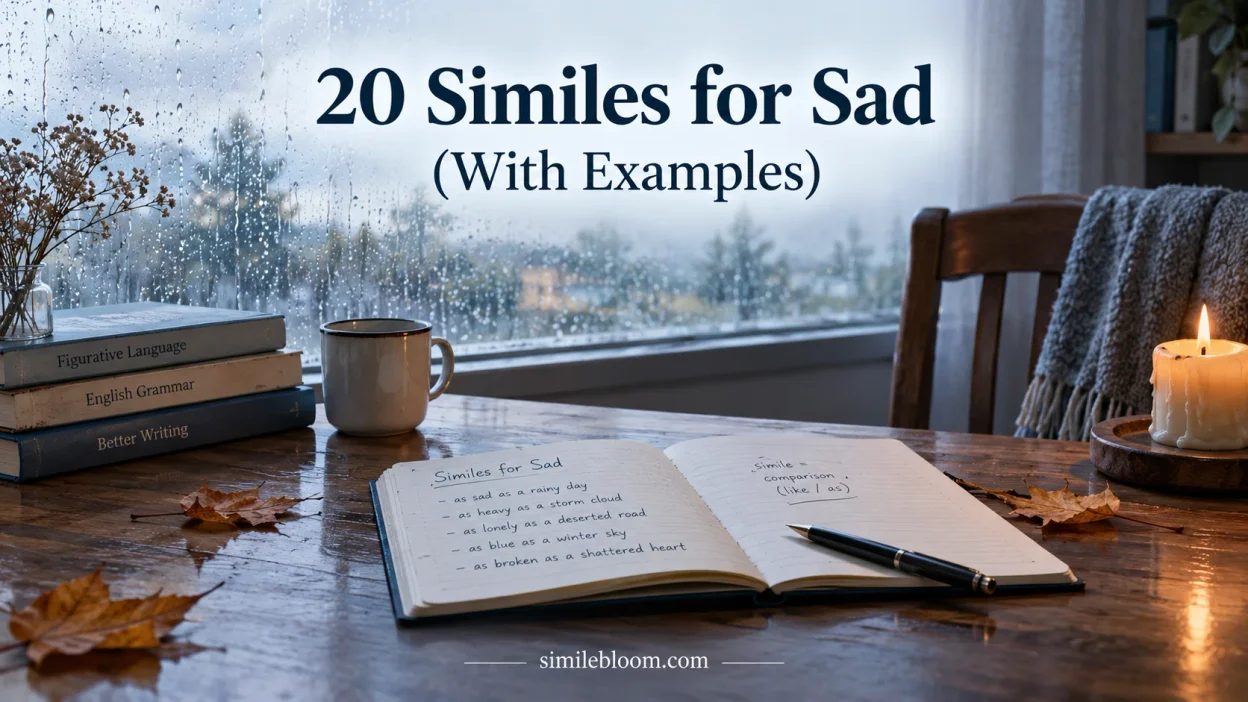
Have you ever felt so sad that ordinary words could not capture what was happening inside? 20 Similes for Sad With Real Examples explores vivid comparisons that make sadness, emotional expression, and difficult feelings easier to describe.
Instead of simply saying someone feels sad, similes can create a clear image that readers immediately understand. These comparisons also strengthen English usage, grammar, and expressive writing by showing how figurative language works naturally in context.
In this guide, you’ll discover carefully crafted similes for sad situations, along with real examples that show how each comparison works. Whether you are writing a story, poem, personal reflection, or piece of formal writing, these examples can help you choose words with greater precision and emotional depth.
We’ll also consider how context, tone, and consistency affect the way a simile communicates sadness, making each expression more meaningful rather than merely decorative.
Although topics such as scheduling, time management, business communication, online booking, broadcasting, meetings, calendar planning, and project management may seem unrelated, clear language matters in every setting.
Knowing how to express emotions precisely improves communication across both creative and practical writing. By the end of this article, you’ll have a useful collection of sadness similes, practical examples, and a stronger understanding of how figurative language can make your writing more vivid, natural, and memorable.
What Is a Simile?
A simile is a figure of speech that compares two different things to make an idea clearer, more vivid, or more expressive. Similes commonly use comparison words such as “like” or “as.”
For example:
- “The baby’s skin was as soft as silk.”
- “The old house stood like a silent guardian over the valley.”
In the first example, the skin is not literally silk. The comparison creates a figurative meaning by emphasizing softness. Likewise, the house is not actually a guardian; the comparison suggests that it appears protective or watchful.
A simile therefore helps readers create a mental image while understanding the quality being described.
Simile vs. Metaphor
A simile makes a comparison openly, usually with words such as like or as.
- Simile: “Her sadness felt like a heavy blanket.”
- Metaphor: “Her sadness was a heavy blanket.”
Both sentences communicate a similar emotional idea, but they use different structures.
A simile tells the reader that two things are being compared. A metaphor presents one thing as another to create a direct comparison. Neither form is automatically better; the choice depends on the tone and effect you want.
Why Use Similes for Sad?
Sadness can be quiet, overwhelming, temporary, lonely, reflective, or deeply emotional. A single word such as “sad” cannot always communicate those differences.
Similes allow you to show what sadness feels like rather than simply naming it. A comparison with rain may suggest gloom and loneliness, while a comparison with an empty room can suggest absence or isolation.
Using similes for sadness can help you:
- Express feelings with greater precision.
- Create vivid mental pictures.
- Add warmth and personality to personal communication.
- Make creative writing more memorable and expressive.
- Describe complicated emotions in simple language.
- Give readers a stronger sense of atmosphere.
- Add emotional depth to stories and poetry.
- Choose wording that fits a particular tone or situation.
Quick List of 20 Similes
- Sad as a rain-soaked window
- Like a song playing in an empty room
- As heavy as a stone in the chest
- Like a candle fading at dawn
- As quiet as an abandoned garden
- Like a letter that was never answered
- As lonely as a single boat on a wide lake
- Like autumn leaves drifting from a bare tree
- As cold as a room after someone leaves
- Like a photograph of a moment that cannot return
- As fragile as a raindrop on glass
- Like a shadow stretching across a sunny day
- As deep as a well with no visible bottom
- Like a clock moving through an empty house
- As distant as a star behind thick clouds
- Like a door closing on a familiar voice
- As dull as a sky before a winter storm
- Like a book missing its final chapter
- As tender as an old wound touched by memory
- Like a quiet tide pulling warmth from the shore
Sad as a Rain-Soaked Window
Meaning
This simile describes sadness as gloomy, quiet, and difficult to escape. A rain-covered window creates a blurred view and often gives a room a reflective atmosphere.
Detailed Explanation
A rain-soaked window becomes a visual representation of sadness because the outside world appears distant and unclear through the water. The rain also suggests tears without saying that someone is crying. This comparison works particularly well for quiet or reflective sadness rather than sudden anger or dramatic grief. It creates a soft, melancholic image that suits personal writing and poetry.
Example in a Sentence
- After hearing the news, he felt sad as a rain-soaked window, unable to see beyond the moment.
- Her mood was sad as a rain-soaked window while she watched the storm outside.
3 Other Ways to Say It
- Wrapped in quiet sadness
- Clouded by sorrow
- Lost in a gloomy mood
Tone: Poetic, emotional, reflective.
Best for: Creative writing, poetry, personal messages, and storytelling.
Like a Song Playing in an Empty Room
Meaning
This simile describes sadness as the feeling of something meaningful existing without anyone there to share it.
Detailed Explanation
A song can carry emotion, but hearing it in an empty room makes the experience feel especially lonely. The comparison suggests that the sadness is not necessarily loud; instead, it echoes through silence. It works well when sadness comes from loneliness, separation, or missing someone. The image combines sound with emptiness, giving the emotion a strong sense of space.
Example in a Sentence
- His laughter after she left sounded like a song playing in an empty room.
- The celebration felt like a song playing in an empty room without the people they had expected.
3 Other Ways to Say It
- Emotion echoing through silence
- A lonely feeling with nowhere to go
- Joy surrounded by emptiness
Tone: Emotional, poetic, serious.
Best for: Stories, reflective essays, poetry, and personal writing.
As Heavy as a Stone in the Chest
Meaning
This simile presents sadness as emotional weight or pressure that feels difficult to carry.
Detailed Explanation
A stone has physical weight, so comparing sadness to a stone helps readers imagine an emotion that seems to press down on someone. The chest is an especially effective location because people often describe intense emotions as something they physically feel there. This comparison suits deep or overwhelming sadness. It communicates heaviness without suggesting that the feeling must last forever.
Example in a Sentence
- The disappointment sat inside him as heavy as a stone in the chest.
- By evening, her sadness felt as heavy as a stone in the chest.
3 Other Ways to Say It
- Carrying a weight of sorrow
- Burdened by sadness
- Feeling emotionally weighed down
Tone: Serious, emotional, dramatic.
Best for: Personal writing, fiction, poetry, and emotional storytelling.
Like a Candle Fading at Dawn
Meaning
This simile describes sadness as a quiet fading of warmth, hope, or emotional energy.
Detailed Explanation
A candle slowly loses its importance when daylight arrives, making it a useful image for a feeling that gradually becomes dimmer. The comparison does not describe explosive sadness; instead, it suggests a gentle emotional withdrawal. It can also express the end of a joyful period or the fading of hope. The image has a peaceful quality even though its underlying emotion is sad.
Example in a Sentence
- Her excitement disappeared like a candle fading at dawn.
- His smile grew weaker, like a candle fading at dawn.
3 Other Ways to Say It
- Slowly losing emotional warmth
- Watching hope grow dim
- Fading into quiet sorrow
Tone: Poetic, gentle, reflective.
Best for: Poetry, fiction, reflective writing, and speeches.
As Quiet as an Abandoned Garden
Meaning
This simile describes sadness through silence, stillness, and emotional neglect.
Detailed Explanation
An abandoned garden may once have been full of life, but without care, it becomes still and overgrown. That contrast makes the image especially useful for describing sadness connected with loss or neglect. The silence suggests an emotion that is deeply felt but not openly expressed. It can work particularly well when you want sadness to feel peaceful yet lonely.
Example in a Sentence
- After everyone left, the house felt as quiet as an abandoned garden.
- Her heart seemed as quiet as an abandoned garden after the friendship ended.
3 Other Ways to Say It
- Filled with lonely silence
- Still and emotionally empty
- Quiet with unspoken sorrow
Tone: Reflective, poetic, serious.
Best for: Descriptive writing, fiction, poetry, and personal reflections.
Like a Letter That Was Never Answered
Meaning
This simile describes sadness as waiting, uncertainty, and unfulfilled connection.
Detailed Explanation
An unanswered letter represents communication that was sent but never returned. The comparison therefore captures the emotional pain of waiting for acknowledgment, affection, closure, or a response. It works particularly well when sadness comes from distance or unresolved relationships. Unlike a comparison based only on darkness, this one suggests that the person still hoped for something.
Example in a Sentence
- His silence felt like a letter that was never answered.
- Their unfinished conversation remained like a letter that was never answered.
3 Other Ways to Say It
- Waiting for a response that never comes
- Carrying an unanswered question
- Left without emotional closure
Tone: Emotional, intimate, reflective.
Best for: Personal messages, poetry, stories, and relationship writing.
As Lonely as a Single Boat on a Wide Lake
Meaning
This simile describes sadness as isolation surrounded by a vast amount of empty space.
Detailed Explanation
A single boat floating across a wide lake creates an immediate image of separation. There may be water in every direction, yet the boat remains alone. This makes the comparison useful for sadness caused by loneliness, distance, or feeling disconnected. The wide lake also suggests that the emotional distance may seem difficult to cross.
Example in a Sentence
- After moving to the new city, he felt as lonely as a single boat on a wide lake.
- She sat quietly, as lonely as a single boat on a wide lake.
3 Other Ways to Say It
- Alone in a vast silence
- Isolated from everyone around you
- Drifting through loneliness
Tone: Poetic, serious, contemplative.
Best for: Creative writing, poetry, storytelling, and personal reflections.
Like Autumn Leaves Drifting From a Bare Tree
Meaning
This simile describes sadness as letting go, change, and the gradual loss of something familiar.
Detailed Explanation
Autumn leaves falling from a tree naturally suggest transition and separation. The image can represent friendships changing, memories fading, or people moving into different stages of life. Unlike comparisons that focus on intense sorrow, this one carries a sense of acceptance mixed with sadness. The drifting motion also gives the emotion a gentle, almost peaceful quality.
Example in a Sentence
- Their old memories faded like autumn leaves drifting from a bare tree.
- She watched her childhood disappear like autumn leaves drifting from a bare tree.
3 Other Ways to Say It
- Slowly letting go of the past
- Watching familiar things disappear
- Feeling the sadness of change
Tone: Poetic, nostalgic, reflective.
Best for: Poetry, memoir-style writing, stories, and reflective essays.
As Cold as a Room After Someone Leaves
Meaning
This simile describes sadness as emotional emptiness following someone’s absence.
Detailed Explanation
A room can feel noticeably different after a familiar person leaves, especially when their presence previously made it warm and lively. The comparison connects physical temperature with emotional absence. It is particularly effective when sadness comes from separation, loss, or missing someone. The simplicity of the image makes it easy to understand and use naturally.
Example in a Sentence
- The house felt as cold as a room after someone leaves.
- Her voice sounded as cold as a room after someone leaves when she talked about the goodbye.
3 Other Ways to Say It
- Empty after someone’s departure
- Missing the warmth of someone’s presence
- Filled with the chill of absence
Tone: Emotional, intimate, serious.
Best for: Personal writing, stories, messages, and reflective essays.
Like a Photograph of a Moment That Cannot Return
Meaning
This simile describes sadness connected with nostalgia, memory, and irreversible change.
Detailed Explanation
A photograph preserves an image of something that happened in the past, but it cannot bring that moment back. That makes it a strong comparison for sadness caused by remembering happier times. The image focuses less on immediate pain and more on the realization that some moments cannot be repeated. It can therefore express bittersweet sadness with warmth rather than despair.
Example in a Sentence
- The old house felt like a photograph of a moment that cannot return.
- Their childhood friendship became like a photograph of a moment that cannot return.
3 Other Ways to Say It
- A memory frozen in time
- A reminder of what has passed
- Holding onto a vanished moment
Tone: Nostalgic, tender, reflective.
Best for: Memoirs, essays, poetry, storytelling, and personal posts.
As Fragile as a Raindrop on Glass
Meaning
This simile describes sadness as delicate, vulnerable, and easily disturbed.
Detailed Explanation
A raindrop resting on glass can appear beautiful but unstable. It may slide away or disappear with a small change. Comparing sadness to it suggests an emotion that is tender rather than overwhelming. This expression works especially well when someone is trying to protect a vulnerable feeling or is close to tears.
Example in a Sentence
- Her happiness seemed as fragile as a raindrop on glass after the difficult conversation.
- His voice sounded as fragile as a raindrop on glass when he remembered his grandfather.
3 Other Ways to Say It
- Emotionally delicate
- Close to breaking down
- Carrying a tender sadness
Tone: Gentle, emotional, caring.
Best for: Poetry, personal messages, fiction, and sensitive descriptions.
Like a Shadow Stretching Across a Sunny Day
Meaning
This simile describes sadness as an unexpected dark feeling entering an otherwise happy moment.
Detailed Explanation
A shadow crossing a sunny landscape does not necessarily remove the sunlight; it temporarily changes the way the scene feels. This makes the comparison useful for mixed emotions. Someone can be surrounded by happiness while still carrying sadness inside. The contrast between brightness and darkness gives the expression a particularly vivid emotional image.
Example in a Sentence
- Her worry followed her like a shadow stretching across a sunny day.
- Even during the celebration, sadness lingered like a shadow stretching across a sunny day.
3 Other Ways to Say It
- A dark feeling beneath a happy moment
- Sadness interrupting the joy
- Carrying sorrow through a bright day
Tone: Reflective, emotional, poetic.
Best for: Stories, essays, poetry, and social media writing.
As Deep as a Well With No Visible Bottom
Meaning
This simile describes sadness that feels deep, difficult to understand, or difficult to measure.
Detailed Explanation
A well whose bottom cannot be seen creates a powerful sense of depth and uncertainty. Comparing sadness with that image suggests an emotion that reaches far beneath the surface. It can be useful when someone cannot easily explain why they feel the way they do. The comparison emphasizes emotional depth rather than outward expression.
Example in a Sentence
- His sadness felt as deep as a well with no visible bottom.
- The grief she carried seemed as deep as a well with no visible bottom.
3 Other Ways to Say It
- Deeply rooted sorrow
- An emotion that reaches far beneath the surface
- A sadness difficult to measure
Tone: Serious, dramatic, introspective.
Best for: Poetry, fiction, essays, and emotional storytelling.
Like a Clock Moving Through an Empty House
Meaning
This simile describes sadness as time continuing while everything around you feels unusually still.
Detailed Explanation
A clock continues ticking whether a house is full or empty. In an empty home, that ordinary sound can suddenly seem much louder and more meaningful. The comparison captures the strange experience of moving through daily life while feeling emotionally alone. It is especially effective for quiet loneliness and absence.
Example in a Sentence
- The evening passed like a clock moving through an empty house.
- After everyone went home, the hours felt like a clock moving through an empty house.
3 Other Ways to Say It
- Time passing through silence
- Moving through an empty routine
- Feeling alone while life continues
Tone: Quiet, serious, reflective.
Best for: Fiction, poetry, personal essays, and storytelling.
As Distant as a Star Behind Thick Clouds
Meaning
This simile describes sadness as emotional distance from something that still exists but cannot easily be reached.
Detailed Explanation
A star remains in the sky even when clouds hide it from view. The comparison therefore suggests that hope, happiness, or connection may not have disappeared completely, but it currently feels inaccessible. This gives the expression a subtle layer of sadness mixed with possibility. It works well when you want an emotional image that is not entirely hopeless.
Example in a Sentence
- Happiness seemed as distant as a star behind thick clouds.
- His old confidence felt as distant as a star behind thick clouds.
3 Other Ways to Say It
- Feeling far from happiness
- Hope hidden from view
- Emotionally out of reach
Tone: Poetic, reflective, quietly hopeful.
Best for: Creative writing, poetry, personal reflection, and storytelling.
Like a Door Closing on a Familiar Voice
Meaning
This simile describes sadness as the painful ending of connection or familiarity.
Detailed Explanation
A familiar voice can represent comfort, friendship, family, or emotional security. A door closing on that voice creates an image of separation that feels immediate and personal. The comparison is particularly suitable for moments when someone leaves or a relationship reaches an ending. It emphasizes the feeling of connection suddenly becoming distant.
Example in a Sentence
- Saying goodbye felt like a door closing on a familiar voice.
- Her departure was like a door closing on a familiar voice I had heard for years.
3 Other Ways to Say It
- Losing a familiar source of comfort
- Hearing connection fade away
- Feeling a relationship close
Tone: Emotional, intimate, dramatic.
Best for: Stories, farewell messages, poetry, and reflective writing.
As Dull as a Sky Before a Winter Storm
Meaning
This simile describes sadness as gloomy, heavy, and lacking brightness.
Detailed Explanation
A sky before a winter storm can appear gray, muted, and unusually still. The image creates a strong atmosphere without describing a specific event. It works well for a mood that is low and gloomy rather than intensely painful. The weather-based comparison is familiar, making the figurative meaning easy to understand.
Example in a Sentence
- His mood was as dull as a sky before a winter storm.
- The room felt as dull as a sky before a winter storm after the argument.
3 Other Ways to Say It
- Gray with sadness
- Surrounded by a gloomy mood
- Lacking its usual brightness
Tone: Gloomy, descriptive, reflective.
Best for: Creative writing, storytelling, essays, and everyday descriptions.
Like a Book Missing Its Final Chapter
Meaning
This simile describes sadness caused by unfinished stories, unanswered questions, or a lack of closure.
Detailed Explanation
A book without its final chapter leaves the reader wondering how everything was supposed to end. In the same way, an unfinished relationship or unresolved situation can leave emotional uncertainty. This comparison is particularly useful when sadness comes from not knowing what might have happened. It combines curiosity, loss, and incompleteness in one image.
Example in a Sentence
- Their friendship felt like a book missing its final chapter.
- The unanswered goodbye left her with a sadness like a book missing its final chapter.
3 Other Ways to Say It
- Left without closure
- An unfinished emotional story
- Living with unanswered questions
Tone: Reflective, emotional, literary.
Best for: Essays, fiction, poetry, and personal writing.
As Tender as an Old Wound Touched by Memory
Meaning
This simile describes sadness that remains sensitive because an old memory can bring it back.
Detailed Explanation
An old wound may appear healed but can still feel tender when touched. Memories can work in a similar way, bringing old emotions back unexpectedly. This comparison is useful for sadness connected with past experiences, loss, regret, or nostalgia. It suggests vulnerability without saying that the person is permanently trapped in the past.
Example in a Sentence
- The memory felt as tender as an old wound touched by memory.
- His childhood home remained as tender as an old wound touched by memory whenever he returned.
3 Other Ways to Say It
- An old sadness brought back to life
- A memory that still hurts
- A sensitive emotional reminder
Tone: Deeply emotional, reflective, serious.
Best for: Poetry, memoirs, personal essays, and emotional fiction.
Like a Quiet Tide Pulling Warmth From the Shore
Meaning
This simile describes sadness as a gradual emotional withdrawal that quietly takes warmth away.
Detailed Explanation
A tide moves steadily without needing to make a dramatic sound, yet it can completely change the shoreline. The comparison presents sadness as something that slowly removes comfort, energy, or closeness. It is especially useful when the emotion develops gradually rather than arriving suddenly. The movement of the tide also creates a feeling of change that is difficult to stop.
Example in a Sentence
- Her enthusiasm disappeared like a quiet tide pulling warmth from the shore.
- The distance between them grew like a quiet tide pulling warmth from the shore.
3 Other Ways to Say It
- Slowly losing emotional warmth
- Drifting away from comfort
- Feeling warmth gradually disappear
Tone: Poetic, gentle, melancholic.
Best for: Poetry, creative writing, reflective essays, and storytelling.
Exercise: Practice Using Similes
Choose the best answer for each question.
Which sentence contains a simile?
A. The room was silent.
B. Her sadness was a heavy stone.
C. Her sadness felt like a heavy stone.
D. She felt sad after the news.
What does “sad as a rain-soaked window” mainly suggest?
A. Excitement
B. Quiet gloom and reflection
C. Anger and confidence
D. Physical tiredness
Which sentence uses a metaphor rather than a simile?
A. His sadness was like a dark cloud.
B. His sadness felt as heavy as a stone.
C. His sadness was a dark cloud.
D. His sadness seemed like winter rain.
What does “like a letter that was never answered” suggest?
A. Successful communication
B. Waiting without receiving a response
C. A joyful surprise
D. A finished conversation
Which comparison best expresses loneliness?
A. Like a song playing in an empty room
B. Like a bright flower in spring
C. As a child laughing at a party
D. Like sunlight through an open window
What makes a simile different from a direct metaphor?
A. A simile always describes sadness.
B. A simile usually uses comparison words such as like or as.
C. A simile can never be poetic.
D. A simile must contain an adjective.
Which sentence uses “as” to form a simile?
A. The night was darkness.
B. Her sadness became a cloud.
C. He was as lonely as a single boat on a wide lake.
D. She carried sorrow.
What does “like autumn leaves drifting from a bare tree” communicate most strongly?
A. Sudden excitement
B. Competition
C. Letting go and change
D. Physical strength
Which sentence uses figurative rather than literal language?
A. Rain fell against the window.
B. The glass was wet.
C. The room had two windows.
D. Her sadness was like rain on the glass.
Which simile best suits a feeling that is vulnerable and delicate?
A. As fragile as a raindrop on glass
B. As loud as a thunderclap
C. Like a racing engine
D. As bright as a summer sun
What does “like a photograph of a moment that cannot return” emphasize?
A. Future success
B. Physical speed
C. Nostalgia and an unrepeatable past
D. Immediate excitement
Which sentence uses a simile naturally?
A. He was like sadness.
B. Her mood was as dull as a sky before a winter storm.
C. Sadness is like sad.
D. The sadness was sadness-like.
Which comparison suggests sadness caused by a lack of closure?
A. a book missing its final chapter
B. Like a bright morning
C. As a full glass of water
D. Like a running child
What is the literal meaning of “a stone in the chest” in the simile “as heavy as a stone in the chest”?
A. A person literally has a stone inside the chest.
B. The person is carrying a rock.
C. The phrase figuratively represents emotional heaviness.
D. The person is exercising.
Which sentence correctly distinguishes a simile from a metaphor?
A. A simile says one thing is another without comparison words.
B. A metaphor normally uses “like” or “as.”
C. A simile openly compares things, while a metaphor makes a direct comparison.
D. Similes and metaphors are exactly the same.
Answers
- C — “Like a heavy stone” openly compares sadness with a stone, making it a simile.
- B — A rain-soaked window creates an image of quiet gloom, blurred surroundings, and reflection.
- C — “Her sadness was a dark cloud” directly identifies sadness with a cloud, making it a metaphor.
- B — An unanswered letter represents communication or a response that never arrived.
- A — A song in an empty room creates a strong image of loneliness and emotional emptiness.
- B — Similes commonly use comparison words such as like and as.
- C — “As lonely as a single boat on a wide lake” uses as … as to create a simile.
- C — Falling autumn leaves can symbolize change, separation, and letting go.
- D — “Her sadness was like rain on the glass” uses a physical image to communicate an emotional state figuratively.
- A — A raindrop on glass suggests something delicate, unstable, and vulnerable.
- C — A photograph preserves a past moment that cannot physically be repeated, making it an image of nostalgia.
- B — The sentence uses a natural as … as comparison to describe a gloomy emotional state.
- A — A book without its final chapter represents something unfinished and lacking closure.
- C — The stone represents emotional weight, not a literal object inside someone’s chest.
- C — A simile makes an explicit comparison, while a metaphor makes a direct comparison.
Read More: 20 Similes for Sad With Real Examples
FAQs
What is a simile for sad?
A simile for sad compares sadness with another image or experience using words such as “like” or “as.” For example, “She felt as lonely as a single boat on a wide lake” compares loneliness with a solitary boat surrounded by water.
What makes a simile effective?
An effective simile creates a clear mental image and connects that image to the intended emotion or idea. It should feel natural, understandable, and appropriate for the context rather than sounding forced.
How do I use a simile in a sentence?
Place the comparison where it naturally explains a feeling, action, or situation. For example, instead of simply writing “He felt lonely,” you could write, “He felt like a song playing in an empty room.”
What is the difference between a simile and a metaphor?
A simile usually uses like or as to make an explicit comparison. A metaphor makes a direct comparison by saying one thing is another. For example, “Her sadness was like rain” is a simile, while “Her sadness was rain” is a metaphor.
Can I create my own similes?
Yes. You can create original similes by thinking about the specific quality of sadness you want to express. Consider whether the feeling is lonely, heavy, fragile, distant, nostalgic, or temporary, then find an image that naturally communicates that quality.
Conclusion
Similes can make the simple word sad much more expressive. Instead of merely naming an emotion, a thoughtful comparison can show its weight, silence, loneliness, tenderness, or connection to memory.
The 20 examples in this article demonstrate how different images can communicate different kinds of sadness, from the quiet mood of a rain-soaked window to the incompleteness of a book missing its final chapter. When choosing a simile, focus on the exact feeling you want your reader to understand.
A natural comparison should add meaning rather than simply decorate a sentence. Whether you are writing a poem, story, personal message, essay, or caption, the right figurative language can help your sadness feel clearer and more human. Sometimes, one carefully chosen image can express what ordinary words cannot.

Olivia Parker is an English content writer passionate about vocabulary, creative writing, and figurative language. She creates reader-friendly resources that explain how expressions work and when to use them naturally. At SimileBloom, Olivia provides examples and explanations designed to help learners use similes with greater clarity and confidence.