Have you ever faced a difficult moment and found the strength to keep going? Resilience helps you recover from setbacks, adapt to change, and move forward when life feels overwhelming. 20 Similes for Resilience With Real Examples explores creative comparisons that bring this powerful quality to life.
These expressions help you describe courage, determination, patience, and inner strength in ways readers can easily understand and remember.From standing firm like a mountain to bending like a flexible tree in a storm, similes for resilience make abstract feelings more vivid and relatable. Each expression includes a clear meaning and practical sentence examples to show how it works in context.
Whether you are writing a personal story, crafting an essay, improving your English usage, or strengthening your formal writing, these comparisons can help you communicate emotions with greater clarity and impact. You will also discover how grammar, word choice, and consistency shape effective figurative language.
Resilience appears in everyday challenges, from managing unexpected changes to rebuilding confidence after disappointment. Learning to describe it effectively can strengthen storytelling, personal reflections, and even business communication when perseverance matters.
Although concepts such as scheduling, time management, online booking, broadcasting, meetings, calendar planning, and project management involve different contexts, clear language and consistency remain valuable across them all. Explore these 20 original and meaningful similes to find the right words for resilience and express the strength to rise again.
What Is a Simile?
A simile is a figure of speech that compares two different things using words such as “like” or “as.” It helps readers understand an idea by connecting it to something familiar.
For example:
- Her smile was like sunshine after a rainy day.
- The baby slept as peacefully as a kitten.
These comparisons are not meant to be taken literally. A smile does not produce sunlight, and a baby does not become a kitten. Instead, the comparisons create figurative meaning by helping readers picture warmth and peacefulness.
Simile vs. Metaphor
A simile compares two things using comparison words, while a metaphor describes one thing as another without using those words.
- Simile: His determination was like an anchor in a storm.
- Metaphor: His determination was an anchor in a storm.
Both examples communicate stability during difficulty. However, the simile makes the comparison explicit with “like,” while the metaphor states it directly.
Understanding this difference helps you choose the right form of figurative language for poems, stories, essays, speeches, and personal messages.
Why Use Similes for Resilience?
Resilience can be difficult to explain because it often involves invisible qualities such as courage, patience, and emotional strength. A thoughtful comparison makes these qualities easier to picture.
Similes can help you:
- Express emotions: Describe the determination to continue despite disappointment.
- Create vivid imagery: Show how someone recovers after a difficult experience.
- Communicate hope: Compare personal growth to a seed emerging from the soil.
- Add warmth: Encourage someone who feels overwhelmed or discouraged.
- Improve descriptive writing: Give characters believable struggles and meaningful progress.
- Make messages memorable: Turn an abstract idea into an image readers can remember.
- Describe different kinds of strength: Show that resilience can be quiet, flexible, patient, or courageous.
The most effective comparison depends on the situation. Sometimes resilience resembles a tree surviving strong winds; at other times, it feels more like a traveler taking one careful step through unfamiliar territory.
Quick List of 20 Similes for Resilience
- As resilient as a willow bending in the wind
- Like a seed pushing through hard soil
- As steady as a lighthouse in a storm
- Like a river finding its way around a rock
- As persistent as rain wearing down stone
- Like a spring returning after winter
- As tough as a mountain trail under heavy boots
- Like a candle glowing in a dark room
- As adaptable as a sail changing with the wind
- Like a bridge carrying weight across a deep valley
- As patient as a tree growing from a sapling
- Like a phoenix rising from its ashes
- As determined as a climber facing a steep slope
- Like a compass guiding travelers through fog
- As enduring as roots holding firm through a drought
- Like a stitched seam holding torn fabric together
- As resourceful as a bird building a nest after a storm
- Like a drumbeat continuing through the noise
- As courageous as a small boat crossing rough water
- Like a path reappearing beneath fallen leaves
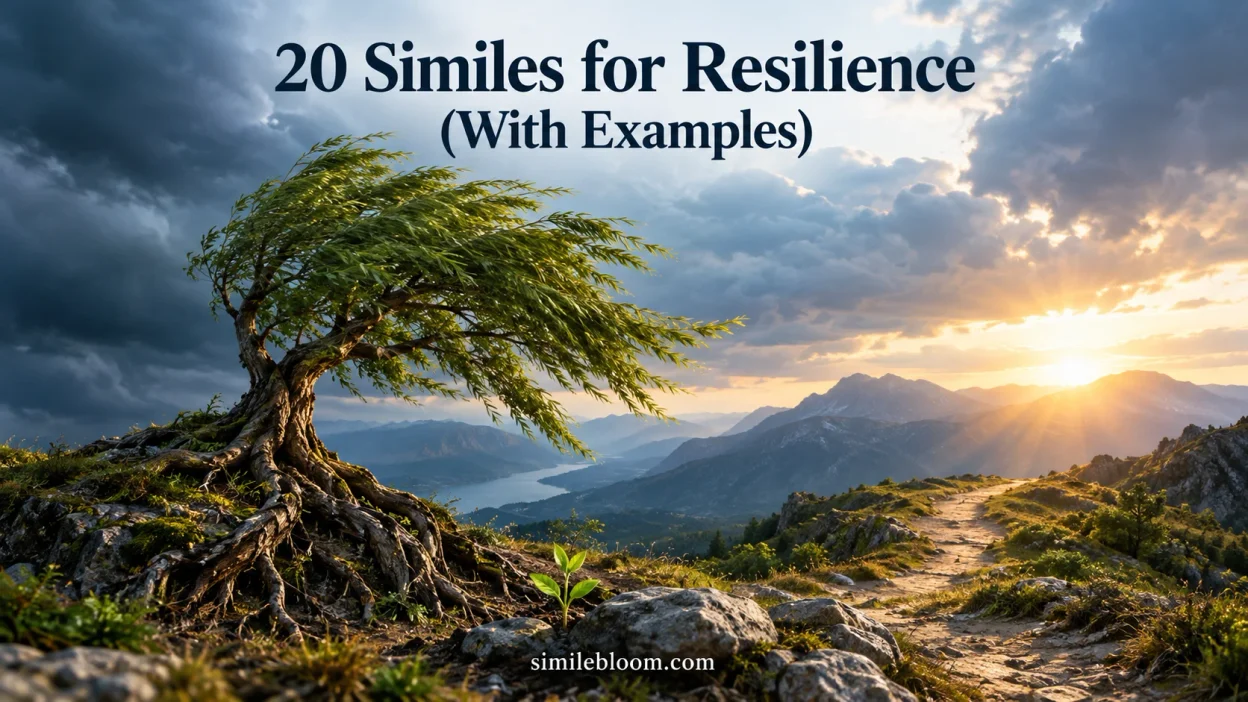
As resilient as a willow bending in the wind
Meaning
This simile describes flexibility under pressure. Like a willow that bends without snapping, a resilient person adjusts to difficulties without losing their essential strength.
Detailed Explanation
A willow’s flexible branches move with the wind instead of resisting every gust. This image suggests that resilience does not always mean standing firm or refusing to change. Sometimes, the wisest response is to adapt, rest, and regain your balance. Use this comparison when describing someone who faces emotional pressure while remaining open to change.
Example in a Sentence
- Even after several disappointments, Maya was as resilient as a willow bending in the wind.
- He adjusted to his unexpected career change, as resilient as a willow bending in the wind.
3 Other Ways to Say It
- Flexible under pressure
- Strong enough to adapt
- Able to bend without breaking
Like a seed pushing through hard soil
Meaning
This simile represents growth despite difficult circumstances. It compares a person’s determination to a seed that struggles through compact soil to reach the surface.
Detailed Explanation
A seed begins its growth in darkness, surrounded by earth that may seem impossible to penetrate. Yet it continues growing when conditions allow, gradually finding its way upward. The comparison captures the small, often invisible efforts that help people recover and improve their lives. It works especially well for stories about overcoming hardship, learning from failure, and starting over.
Example in a Sentence
- After months of rejection, he kept working toward his dream, like a seed pushing through hard soil.
- Her confidence grew slowly, like a seed pushing through hard soil, until she finally believed in herself.
3 Other Ways to Say It
- Growing through adversity
- Finding strength in difficult circumstances
- Making progress against the odds
As steady as a lighthouse in a storm
Meaning
This simile describes calmness and reliability during uncertainty. It compares a resilient person to a lighthouse that continues shining while rough weather surrounds it.
Detailed Explanation
A lighthouse does not stop a storm, but its light offers direction to ships navigating dangerous waters. Similarly, a resilient person may not control a crisis but can remain focused on what matters. The image conveys emotional steadiness without suggesting that someone must feel fearless all the time. It suits inspirational speeches, leadership writing, and messages of support.
Example in a Sentence
- During the family crisis, Grandma remained as steady as a lighthouse in a storm.
- Everyone looked to Daniel for reassurance because he was as steady as a lighthouse in a storm.
3 Other Ways to Say It
- Calm in the face of trouble
- A dependable source of strength
- Steady when everything feels uncertain
Like a river finding its way around a rock
Meaning
This simile expresses problem-solving through adaptation. It compares resilience to a river that changes direction when an obstacle blocks its path.
Detailed Explanation
A river does not always travel in a straight line. When a rock stands in its way, the water may flow around it and continue toward its destination. This creates an image of determination guided by flexibility rather than stubbornness. Use it when describing someone who changes their approach without abandoning their goal.
Example in a Sentence
- When her original plan failed, she found another solution, like a river finding its way around a rock.
- We had to adjust our project timeline, like a river finding its way around a rock, instead of giving up.
3 Other Ways to Say It
- Finding another route forward
- Solving problems with flexibility
- Adapting without losing direction
As persistent as rain wearing down stone
Meaning
This simile describes the power of consistent effort. It compares resilience to rainfall that gradually changes even a hard surface through repeated contact.
Detailed Explanation
A single raindrop may seem insignificant against solid stone, but repeated drops can gradually wear it down. The comparison shows how patience and steady effort can accomplish what sudden force cannot. It is especially suitable for describing long-term goals, recovery, education, or difficult projects. The emphasis falls on persistence rather than speed.
Example in a Sentence
- She practiced every evening, as persistent as rain wearing down stone, until the difficult passage became manageable.
- His patient efforts to rebuild trust were as persistent as rain wearing down stone.
3 Other Ways to Say It
- Consistent despite slow progress
- Determined to keep trying
- Making small efforts that add up
Like a spring returning after winter
Meaning
This simile represents renewal after a difficult period. It compares emotional recovery to the return of spring after the cold and quiet of winter.
Detailed Explanation
Winter can make a landscape appear lifeless, but warmer days eventually bring new leaves, flowers, and movement. In the same way, a person who has experienced sadness or disappointment may gradually rediscover hope. The comparison acknowledges that recovery takes time rather than happening all at once. It works beautifully in reflective writing, personal letters, and stories about new beginnings.
Example in a Sentence
- After a painful year, her enthusiasm returned like a spring returning after winter.
- The community began rebuilding its confidence like a spring returning after winter.
3 Other Ways to Say It
- Finding hope after hardship
- Beginning to feel alive again
- Recovering with renewed energy
As tough as a mountain trail under heavy boots
Meaning
This simile suggests endurance through repeated challenges. It compares resilience to a rugged mountain trail that remains a demanding route even under heavy footsteps.
Detailed Explanation
A mountain trail may be rough, steep, and difficult to cross, yet it remains a route toward the summit. The image emphasizes the ability to endure discomfort while continuing toward a meaningful destination. Unlike comparisons based on gentleness or flexibility, this one feels rugged and determined. Use it in adventure stories, motivational writing, or descriptions of demanding personal journeys.
Example in a Sentence
- The final months of training tested her, but she stayed as tough as a mountain trail under heavy boots.
- His determination was as tough as a mountain trail under heavy boots during the long recovery.
3 Other Ways to Say It
- Strong enough to endure hardship
- Able to withstand repeated pressure
- Unshaken by a demanding journey
Like a candle glowing in a dark room
Meaning
This simile describes hope that survives in difficult circumstances. It compares a resilient person to a small candle whose light remains visible even when darkness surrounds it.
Detailed Explanation
A candle cannot brighten an entire world, but it can illuminate the space immediately around it. That limited light can still provide comfort and help someone take the next step. The comparison reminds readers that resilience does not require dramatic victories or enormous displays of strength. It works particularly well in comforting messages, reflective essays, and emotional storytelling.
Example in a Sentence
- Her kindness remained like a candle glowing in a dark room during the family’s hardest days.
- Even when his plans fell apart, a little hope stayed with him like a candle glowing in a dark room.
3 Other Ways to Say It
- Keeping hope alive
- Finding a little light in hardship
- Offering comfort in dark times
As adaptable as a sail changing with the wind
Meaning
This simile communicates the ability to adjust to changing circumstances. It compares a resilient person to a sail that changes position to work with shifting winds.
Detailed Explanation
A sailboat cannot command the wind, but its sails can be adjusted to use the available conditions. This comparison shows that resilience often depends on making practical changes rather than wishing circumstances were different. It suggests resourcefulness, awareness, and purposeful action. Use it when writing about career changes, shifting plans, or people who respond thoughtfully to uncertainty.
Example in a Sentence
- She approached each unexpected challenge as adaptable as a sail changing with the wind.
- Our team stayed as adaptable as a sail changing with the wind when the project requirements changed.
3 Other Ways to Say It
- Flexible when circumstances change
- Ready to adjust the plan
- Using change to move forward
Like a bridge carrying weight across a deep valley
Meaning
This simile expresses strength under responsibility. It compares a resilient person to a bridge that supports a heavy load while spanning a difficult gap.
Detailed Explanation
A bridge connects two sides that would otherwise remain separated, even while carrying the weight placed upon it. The image suggests dependable strength during demanding circumstances. It can also describe someone who helps others through a difficult transition while managing their own responsibilities. This comparison is especially useful in writing about caregivers, community leaders, and trusted friends.
Example in a Sentence
- Throughout the difficult transition, her patience held the family together like a bridge carrying weight across a deep valley.
- He supported his colleagues like a bridge carrying weight across a deep valley during the company’s restructuring.
3 Other Ways to Say It
- Carrying responsibility with strength
- Providing support through difficult times
- Holding people together under pressure
As patient as a tree growing from a sapling
Meaning
This simile describes long-term perseverance and gradual development. It compares a resilient person to a young tree that needs time to become strong and mature.
Detailed Explanation
A sapling does not become a towering tree overnight. It grows through changing seasons, develops deeper roots, and gradually becomes better equipped to withstand its surroundings. This image encourages patience with personal progress and recognizes that resilience develops through experience. It is useful when discussing learning, healing, confidence, and other changes that cannot be rushed.
Example in a Sentence
- She rebuilt her self-esteem as patiently as a tree growing from a sapling.
- Becoming a confident speaker took years, and he accepted the process as patiently as a tree growing from a sapling.
3 Other Ways to Say It
- Growing stronger over time
- Allowing progress to happen gradually
- Building strength through experience
Like a phoenix rising from its ashes
Meaning
This simile symbolizes rebuilding after major loss or failure. It compares resilience to the legendary phoenix, which rises anew from its ashes.
Detailed Explanation
The phoenix is a mythical bird associated with renewal after destruction. Its image gives resilience a dramatic, powerful quality because it focuses on a new beginning after an apparent ending. This does not mean every setback produces an immediate transformation; real recovery can be painful and uneven. Use this poetic comparison when describing a remarkable comeback or a person who rebuilds life after a serious setback.
Example in a Sentence
- After losing his business, he started again like a phoenix rising from its ashes.
- The town rebuilt its main street like a phoenix rising from its ashes after the devastating fire.
3 Other Ways to Say It
- Rebuilding after a major setback
- Rising stronger after a fall
- Turning an ending into a new beginning
As determined as a climber facing a steep slope
Meaning
This simile conveys courage and persistence toward a challenging goal. It compares a resilient person to a climber who continues despite a difficult ascent.
Detailed Explanation
A steep slope demands careful steps, physical effort, and the willingness to keep moving even when the summit seems distant. A climber may need to pause, reconsider the route, or gather strength before continuing. That makes this comparison about thoughtful determination rather than reckless persistence. It fits descriptions of ambitious goals, difficult exams, athletic challenges, and personal achievements.
Example in a Sentence
- She prepared for her final exams as determined as a climber facing a steep slope.
- He continued learning the new skill as determined as a climber facing a steep slope, one difficult step at a time.
3 Other Ways to Say It
- Working steadily toward a difficult goal
- Facing obstacles with determination
- Taking the next step despite the struggle
Like a compass guiding travelers through fog
Meaning
This simile describes maintaining direction when the future is unclear. It compares resilience to a compass that helps travelers navigate when visibility is poor.
Detailed Explanation
Fog can hide familiar landmarks and make a journey feel confusing. A compass offers a dependable reference point, even when the surrounding landscape is difficult to see. Similarly, resilient people may rely on their values, priorities, or trusted advice when they cannot predict what will happen next. This image works well in reflective essays, guidance messages, and stories about uncertainty.
Example in a Sentence
- Her belief in fairness guided her decisions like a compass guiding travelers through fog.
- During his career change, a clear sense of purpose served him like a compass guiding travelers through fog.
3 Other Ways to Say It
- Staying guided by your values
- Finding direction during uncertainty
- Holding on to a clear sense of purpose
As enduring as roots holding firm through a drought
Meaning
This simile represents deep inner strength during prolonged hardship. It compares resilience to roots that continue anchoring a tree when water is scarce.
Detailed Explanation
A drought puts a tree under stress, and its roots must keep drawing on whatever moisture the soil can provide. Although the tree may show signs of strain, its hidden root system can help it remain anchored. The comparison suggests that resilience often depends on foundations built long before trouble begins, such as supportive relationships, learned skills, or personal values. It is particularly effective when describing someone who keeps going through an extended difficult period.
Example in a Sentence
- Their friendship remained as enduring as roots holding firm through a drought.
- She held on to her sense of purpose as enduring as roots holding firm through a drought during months of uncertainty.
3 Other Ways to Say It
- Drawing on deep inner strength
- Remaining grounded through hardship
- Holding firm during prolonged difficulty
Like a stitched seam holding torn fabric together
Meaning
This simile describes repair and recovery after emotional damage. It compares resilience to stitching that brings separated pieces of fabric together.
Detailed Explanation
A seam does not erase every tear or make damaged fabric exactly as it was before. Instead, it reconnects the pieces and helps the material serve its purpose again. This image reflects the gradual work of recovering from disappointment, grief, conflict, or broken trust. Its tone is gentle and realistic, making it suitable for personal messages and stories about healing.
Example in a Sentence
- Honest conversations helped restore their friendship like a stitched seam holding torn fabric together.
- After a difficult period, familiar routines supported her recovery like a stitched seam holding torn fabric together.
3 Other Ways to Say It
- Piecing life together again
- Healing one small part at a time
- Rebuilding what hardship has damaged
As resourceful as a bird building a nest after a storm
Meaning
This simile highlights creativity and practical problem-solving after disruption. It compares a resilient person to a bird that gathers new materials and rebuilds its nest after a storm.
Detailed Explanation
A storm may damage a nest, but a bird can search for available materials and begin building again. The comparison emphasizes using what remains instead of focusing only on what has been lost. It also suggests initiative: recovery often involves making practical decisions and accepting that the new arrangement may look different. Use it in stories about rebuilding homes, reorganizing plans, or starting a project again.
Example in a Sentence
- After the move, she reorganized the small apartment as resourcefully as a bird building a nest after a storm.
- The volunteers found creative ways to help their neighbors, like a bird building a nest after a storm.
3 Other Ways to Say It
- Making the most of what remains
- Finding practical solutions after a setback
- Rebuilding with creativity and care
Like a drumbeat continuing through the noise
Meaning
This simile expresses steady determination amid distractions and pressure. It compares a resilient person’s continued effort to a drumbeat that remains audible even when other sounds compete for attention.
Detailed Explanation
A drumbeat can provide a steady rhythm while surrounding sounds rise and fall. Similarly, a person can maintain a clear purpose despite criticism, confusion, or competing demands. The image focuses on consistency rather than force and suggests that progress can continue even when circumstances feel chaotic. It suits motivational speeches, descriptions of disciplined work, and stories about staying focused.
Example in a Sentence
- She kept advocating for the changes her community needed like a drumbeat continuing through the noise.
- Amid the distractions of a busy semester, his daily writing habit continued like a drumbeat continuing through the noise.
3 Other Ways to Say It
- Staying consistent amid distractions
- Keeping your purpose in view
- Continuing despite outside pressure
As courageous as a small boat crossing rough water
Meaning
This simile conveys the courage to face uncertainty despite feeling vulnerable. It compares a resilient person to a small boat navigating rough water.
Detailed Explanation
A small boat may seem fragile beside powerful waves, yet a careful sailor can still navigate difficult conditions. The image recognizes that courage does not require feeling invincible or having complete control. Sometimes resilience means acknowledging fear and choosing to continue with care. This comparison is effective in personal reflections, inspirational writing, and accounts of major life changes.
Example in a Sentence
- Starting over in a new country, she was as courageous as a small boat crossing rough water.
- He faced the difficult conversation as courageously as a small boat crossing rough water, even though he felt afraid.
3 Other Ways to Say It
- Moving forward despite fear
- Facing uncertainty with courage
- Taking brave steps through difficulty
Like a path reappearing beneath fallen leaves
Meaning
This simile describes rediscovering direction after confusion or loss. It compares resilience to finding a familiar path again when fallen leaves have hidden it.
Detailed Explanation
A layer of leaves can make a path difficult to recognize without removing the ground beneath it. With patience and careful attention, the route may gradually become visible again. In the same way, stress or disappointment can temporarily obscure a person’s goals without destroying them. This image suits reflective writing about recovery, self-discovery, and regaining confidence after a confusing period.
Example in a Sentence
- After weeks of uncertainty, she began to understand what she wanted, like a path reappearing beneath fallen leaves.
- His sense of direction returned like a path reappearing beneath fallen leaves once he had time to reflect.
3 Other Ways to Say It
- Finding your way forward again
- Rediscovering a sense of purpose
- Seeing possibilities after confusion
Exercise: Practice Using Similes
Test your understanding of similes, figurative meaning, and resilience. Choose the best answer for each question before checking the answer key.
Question 1: Which sentence contains a simile?
A. Her courage was a mountain.
B. She faced the challenge like a seasoned sailor.
C. She faced a difficult challenge.
D. Her courage helped her succeed.
Question 2: What does “like a seed pushing through hard soil” suggest?
A. Growing only when life is easy
B. Avoiding every challenge
C. Growing despite difficult circumstances
D. Waiting for someone else to act
Question 3: Which comparison best describes someone who adjusts when plans change?
A. As adaptable as a sail changing with the wind
B. As silent as an empty room
C. As colorful as a rainbow
D. As cold as ice
Question 4: What is the main difference between a simile and a metaphor?
A. A metaphor must describe a person.
B. A simile can only appear in poetry.
C. A metaphor always uses “as.”
D. A simile commonly uses “like” or “as,” while a metaphor makes a direct comparison.
Question 5: Which sentence uses figurative rather than literal meaning?
A. The tree grew two inches this month.
B. Her hope was like a candle in the darkness.
C. The candle melted on the table.
D. The storm began before sunrise.
Question 6: What does “as steady as a lighthouse in a storm” communicate?
A. A desire to avoid responsibility
B. A tendency to change direction constantly
C. Calmness and reliability during difficulty
D. A need to control other people
Question 7: Which simile best describes recovery after a painful period?
A. Like a spring returning after winter
B. Like a clock ticking at noon
C. Like a spoon resting on a plate
D. Like a window facing the street
Question 8: Which sentence uses a simile naturally?
A. His patience was a river.
B. Her courage became a mountain.
C. The problem was a storm.
D. He remained calm like a lighthouse during the crisis.
Question 9: What does “like a river finding its way around a rock” teach us about resilience?
A. Obstacles should always be ignored.
B. Changing your approach can help you reach your goal.
C. Every problem disappears immediately.
D. Success depends on never changing your plans.
Question 10: Which expression is a metaphor rather than a simile?
A. She stood as firm as an old tree.
B. He moved like a determined climber.
C. Her courage was an anchor in troubled waters.
D. They worked as patiently as gardeners.
Question 11: What does “as patient as a tree growing from a sapling” emphasize?
A. Progress requires time and patience.
B. Success happens instantly.
C. Difficulties should never be discussed.
D. Growth depends entirely on luck.
Question 12: Which simile best fits a person who rebuilds after a major failure?
A. Like a bird watching the clouds
B. As quiet as a library
C. Like a clock marking each hour
D. Like a phoenix rising from its ashes
Question 13: What does “like a compass guiding travelers through fog” suggest?
A. Following every opinion you hear
B. Maintaining direction when the future is unclear
C. Avoiding all unfamiliar situations
D. Knowing every detail of the future
Question 14: Which sentence describes literal meaning?
A. His determination was like a mountain.
B. Her hope shone like a candle.
C. The boat crossed the lake before sunset.
D. He was as brave as a lion.
Question 15: Which simile best expresses the ability to rebuild using available resources?
A. As quiet as falling snow
B. Like a candle glowing in darkness
C. As steady as a lighthouse in a storm
D. As resourceful as a bird building a nest after a storm
Answers
- B — The word “like” introduces a comparison between her approach and that of a seasoned sailor.
- C — The seed represents growth that continues despite difficult conditions.
- A — The sail changes with the wind, representing flexibility when circumstances shift.
- D — Similes commonly use “like” or “as,” while metaphors make direct comparisons.
- B — Hope does not literally produce light. The candle represents encouragement during hardship.
- C — The lighthouse symbolizes steadiness and dependable guidance during a storm.
- A — Spring represents renewal and the return of hope after a difficult period.
- D — The sentence uses “like” to compare his calmness with the steady guidance of a lighthouse.
- B — The river continues moving by changing its route around an obstacle.
- C — It directly describes courage as an anchor, so it is a metaphor.
- A — A sapling needs time to grow, just as personal strength develops gradually.
- D — The phoenix symbolizes renewal and rebuilding after destruction or failure.
- B — A compass represents direction when the way ahead is difficult to see.
- C — This sentence describes an event that can happen literally, without a figurative comparison.
- D — The bird represents practical creativity and rebuilding after disruption.
Read More: 20 Similes for a Beautiful Girl With Real Examples
FAQs
1. What is a simile for resilience?
A simile for resilience compares the ability to recover from difficulties to something familiar. For example, “She was as strong as an oak tree” suggests someone who remains steady during challenging times. Similes make resilience, determination, and inner strength easier to understand.
2. What is a good example of a simile for resilience?
“Like a tree bending in a storm” is a meaningful example of resilience. It shows how someone can adapt to difficult circumstances without losing their strength. This comparison highlights flexibility, perseverance, and the ability to recover after setbacks.
3. How do similes help describe resilience?
Similes turn an abstract quality into a clear, relatable image. Comparing a resilient person to a mountain, a deep-rooted tree, or a candle that keeps burning helps readers picture their determination. These comparisons also add emotion, depth, and vivid imagery to creative writing.
4. What are some short similes for resilience?
Here are five short similes that describe resilience:
- As steady as a mountain
- Like a tree in a storm
- As tough as old leather
- Like a river carving through stone
- As persistent as a rising tide
Each comparison emphasizes a different aspect of resilience, including stability, adaptability, endurance, and persistence.
5. What is a simile for someone who never gives up?
“Like a river that keeps carving through stone” describes someone who refuses to give up. A river may move slowly, but its continued flow gradually shapes even the hardest rock. This simile represents persistence, patience, and determination in the face of obstacles.
6. Can similes for resilience be used in essays and academic writing?
Yes, similes can make essays more engaging when they support the main idea. For example, “Her determination was like a lighthouse guiding ships through a storm” illustrates how resilience provides direction during difficult times. In academic writing, use figurative language thoughtfully and maintain a clear, appropriate tone.
7. What is the difference between a simile and a metaphor for resilience?
A simile compares two things using words such as like or as. For example, “He was like a tree that stood firm against the wind.” A metaphor makes a direct comparison without using those words, such as “He was an unshakable tree.” Both figures of speech can communicate strength and perseverance.
8. How can I create my own similes for resilience?
Start by identifying the quality of resilience you want to express, such as courage, flexibility, or endurance. Then choose an image that reflects that quality, such as a mountain surviving harsh weather or a seed growing through a crack in concrete. Connect the two with like or as to create an original comparison that feels natural and meaningful.
9. Are similes for resilience suitable for poems and motivational speeches?
Absolutely. Similes can make poems, speeches, personal stories, and inspirational messages more memorable. For instance, “You can be like a small flame that refuses to go out in the wind” creates a vivid image of hope and determination. Choose comparisons that match your audience and the emotion you want to convey.
10. How can I use similes for resilience in everyday conversations?
You can use similes to encourage someone, describe a difficult experience, or explain how you overcame a challenge. For example, you might say, “After losing her job, she bounced back like a ball hitting the ground.” Such expressions make everyday communication more colorful while emphasizing adaptability, hope, and the strength to keep moving forward.
Conclusion
Resilience is more than the ability to face difficulties; it is the strength to recover, adapt, and keep moving forward. These 20 similes for resilience with real examples show how figurative language can turn powerful emotions into vivid, memorable images. From a tree bending in a storm to a river slowly shaping stone, each comparison offers a different way to express courage, patience, and determination.
Choosing the right simile depends on the message you want to share. Some comparisons emphasize inner strength, while others highlight flexibility, hope, or the courage to begin again after failure. Whether you are writing a poem, developing a personal essay, preparing a speech, or improving your English, these expressions can make your words more engaging and meaningful. Use the examples as inspiration, and adapt them to suit your own voice and writing style.
Remember, resilience does not mean avoiding every struggle or pretending that everything is easy. It means finding the strength to continue, even when progress feels slow. The right simile can help readers understand that journey and connect with its deeper meaning. Keep exploring figurative language, experiment with original comparisons, and let your words reflect the quiet power of never giving up.

Sophia Bennett is a language writer who focuses on English grammar, vocabulary, and figurative expressions. She believes that learning English becomes easier when explanations are connected to familiar situations and meaningful examples. At SimileBloom, Sophia helps readers discover how similes can make writing clearer, more vivid, and more engaging.