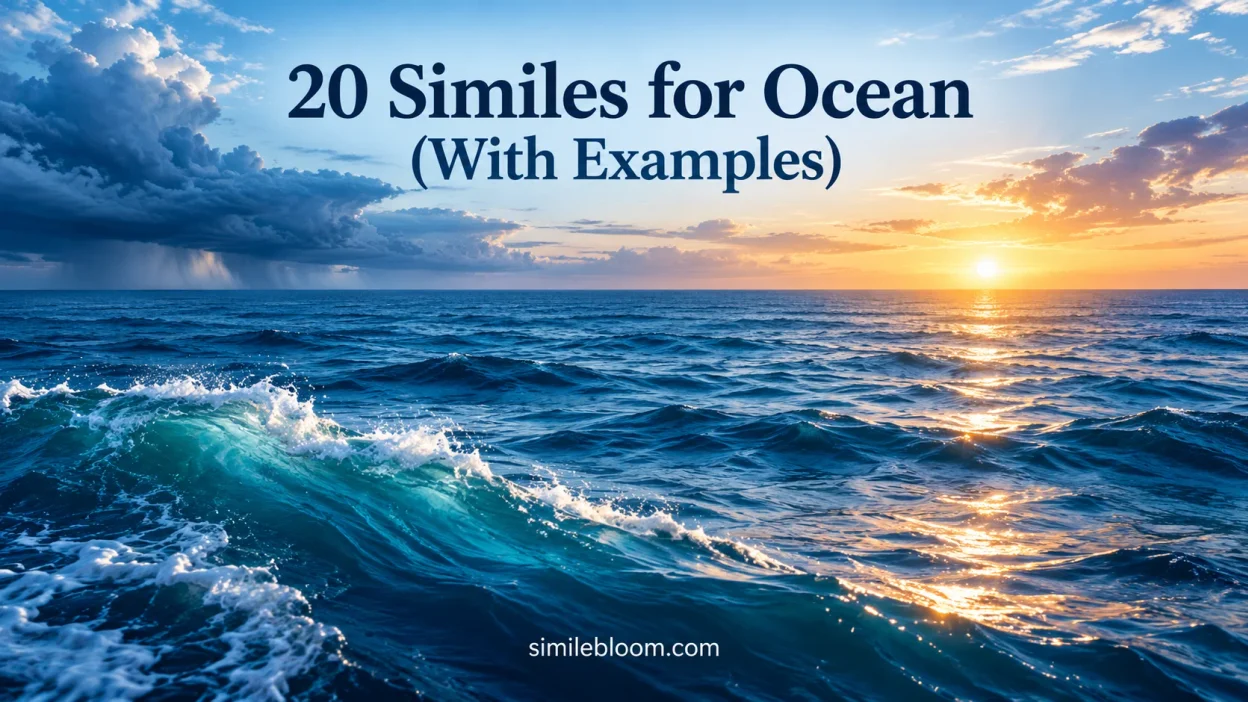
Have you ever watched the ocean and struggled to capture its beauty in words? The 20 Similes for Ocean With Real Examples in this guide will help you describe its vastness, movement, color, and mood with vivid comparisons.
From waves rolling like silver ribbons to deep waters appearing like an endless blue sky, these expressions make descriptions more memorable. They also show how similes can bring ordinary sentences to life.You’ll discover creative comparisons that work across creative writing, storytelling, poetry, essays, and everyday English usage.
Each example explains the meaning clearly, helping you understand how figurative language creates stronger mental images. Although terms such as scheduling, time management, business communication, online booking, broadcasting, meetings, calendar, and project management belong to practical communication, expressive language still has a place in many of these settings.
A well-chosen comparison can add personality without sacrificing clarity, grammar, or consistency.This guide focuses on practical examples rather than complicated literary theory. You’ll learn how to use ocean similes naturally in formal writing, personal descriptions, school assignments, and creative work. Whether you need a phrase for a calm sea, crashing waves, or a seemingly endless horizon, these examples give you useful options.
By the end, you’ll have a clearer sense of English usage, figurative meaning, and how thoughtful comparisons can make your writing more vivid and engaging.
What Is a Simile?
A simile is a figure of speech that compares two different things to highlight a shared quality. It commonly uses comparison words such as “like” or “as.”
For example:
- Her smile was like sunshine after a storm.
- The child was as quiet as a mouse.
These sentences are not meant literally. A smile is not actually sunshine, and a child is not a mouse. The comparisons create a figurative meaning that helps readers imagine the idea more clearly.
A strong simile connects two things in a way that feels understandable and meaningful. The comparison should add an image, feeling, or quality rather than simply decorate a sentence.
Simile vs. Metaphor
A simile makes a comparison openly, usually with like or as.
For example:
The ocean moved like a restless animal.
A metaphor, however, makes the comparison directly without using like or as.
For example:
The ocean was a restless animal.
Both sentences create a similar image, but their grammatical structures are different. The first is a simile, while the second is a metaphor.
Remember the simple distinction: a simile says one thing is like another, while a metaphor says one thing is another in a figurative sense.
Why Use Similes for Ocean?
The ocean offers countless qualities to describe: movement, color, sound, depth, strength, mystery, calmness, and emotion.
A well-chosen simile can make those qualities easier to picture. Instead of saying the water moved quickly, you can compare it to something energetic and familiar.
Similes can also help you:
- Express feelings and moods.
- Create strong mental pictures.
- Make descriptive writing more vivid.
- Add poetic or emotional depth.
- Give a personal message more personality.
- Make storytelling more memorable.
- Describe an ocean scene without relying on plain adjectives.
- Connect a physical scene with an emotional experience.
For example, comparing the ocean to a sleeping giant creates a very different mood from comparing it to silk. The comparison itself guides the reader toward a particular interpretation.
Quick List of 20 Similes
- The ocean was like a restless giant.
- The ocean was as calm as a sleeping child.
- The waves rolled like hills in motion.
- The sea glittered like scattered diamonds.
- The ocean stretched like an endless blue road.
- The waves crashed like drums in a distant battle.
- The sea whispered like a secret shared at midnight.
- The ocean was as deep as an unanswered question.
- The waves danced like ribbons in the wind.
- The sea shimmered like polished glass.
- The ocean breathed like a living creature.
- The waves chased one another like playful children.
- The sea looked like a blue blanket beneath the sky.
- The ocean roared like thunder trapped beneath the clouds.
- The waves curled like silver claws along the shore.
- The sea was as vast as the open sky.
- The ocean moved like a giant heartbeat.
- The waves scattered like wild horses across the shore.
- The sea glowed like a mirror holding the sunset.
- The ocean stood before us like a doorway to another world.
1. The Ocean Was Like a Restless Giant
Meaning
This simile compares the ocean’s enormous size and powerful movement to a giant that cannot stay still. It suggests strength, energy, and unpredictability.
Detailed Explanation
The ocean can appear peaceful from a distance, yet its waves may carry tremendous force. Comparing it to a restless giant captures that mixture of size and constant movement. The image makes the sea seem almost alive, as though it possesses its own powerful temperament. This simile works especially well in dramatic descriptions, adventure writing, and scenes where the weather is changing.
Tone: Dramatic, powerful, serious.
Best for: Creative writing, storytelling, descriptive essays, poetry.
Example in a Sentence
The ocean was like a restless giant, rising and falling beneath the darkening sky.
From the cliff, we watched the restless giant churn below us.
3 Other Ways to Say It
- The sea moved like a powerful creature unable to sleep.
- The waves seemed to stir beneath the horizon.
- The ocean carried an untamed, restless energy.
2. The Ocean Was as Calm as a Sleeping Child
Meaning
This simile describes an ocean that is quiet, gentle, and peaceful. It compares still water to the peaceful appearance of a sleeping child.
Detailed Explanation
When the wind disappears and the waves become gentle, the ocean can look remarkably serene. The comparison to a sleeping child gives the scene a soft and comforting quality rather than simply calling it calm. It suggests stillness without making the sea seem lifeless. This expression fits peaceful mornings, quiet evenings, reflective moments, and comforting descriptions.
Tone: Warm, gentle, peaceful.
Best for: Personal writing, poetry, storytelling, reflective descriptions.
Example in a Sentence
At sunrise, the ocean was as calm as a sleeping child.
The beach felt wonderfully quiet while the sea rested as peacefully as a sleeping child.
3 Other Ways to Say It
- The sea lay quiet beneath the morning light.
- The water rested in perfect stillness.
- The ocean seemed to sleep beneath the sky.
3. The Waves Rolled Like Hills in Motion
Meaning
This simile compares the shape and movement of waves to hills that appear to travel across the water.
Detailed Explanation
Large waves rise into rounded shapes before moving forward and breaking. Comparing them to hills helps readers visualize their height, curves, and steady movement. The comparison is particularly useful because hills normally seem fixed, while these imaginary hills are moving. That contrast creates a vivid picture of the ocean’s constantly changing surface.
Tone: Visual, descriptive, expansive.
Best for: Essays, travel writing, stories, nature descriptions.
Example in a Sentence
From the boat, the waves rolled like hills in motion.
Beyond the harbor, enormous swells rose and fell like moving hills.
3 Other Ways to Say It
- The waves rose in long, rolling ridges.
- The sea formed moving blue slopes.
- Swells traveled across the water like slow-moving landforms.
4. The Sea Glittered Like Scattered Diamonds
Meaning
This simile describes sunlight or moonlight reflecting across the water as bright, sparkling points.
Detailed Explanation
When sunlight strikes small moving waves, countless reflections can appear across the surface. Comparing those flashes to scattered diamonds emphasizes their brightness and beauty. The image works especially well when the ocean is viewed during a sunny afternoon or beneath a bright moon. It creates an elegant visual impression without suggesting that the water is literally made of jewels.
Tone: Beautiful, poetic, bright.
Best for: Poetry, creative writing, captions, descriptive essays.
Example in a Sentence
Under the afternoon sun, the sea glittered like scattered diamonds.
From the balcony, we watched the water sparkle like scattered diamonds.
3 Other Ways to Say It
- The water sparkled beneath the sunlight.
- Bright reflections danced across the waves.
- The sea shone with countless points of light.
5. The Ocean Stretched Like an Endless Blue Road
Meaning
This simile compares the ocean to a long road without a visible end, emphasizing distance and openness.
Detailed Explanation
A road usually suggests travel and a destination, while the ocean often seems to continue beyond the horizon. This comparison gives the sea a feeling of infinite possibility and movement. It can also suggest a journey across unfamiliar places. The image works beautifully when writing about travel, exploration, freedom, or the desire to discover what lies beyond the horizon.
Tone: Inspirational, adventurous, expansive.
Best for: Travel writing, stories, essays, poetry.
Example in a Sentence
Ahead of the boat, the ocean stretched like an endless blue road.
The open sea looked like a road leading toward places we had never seen.
3 Other Ways to Say It
- The ocean opened into an unbroken blue horizon.
- The sea became a path toward the unknown.
- The water seemed to lead endlessly beyond sight.
6. The Waves Crashed Like Drums in a Distant Battle
Meaning
This simile compares the loud, repeated sound of crashing waves to the deep rhythm of drums during a battle.
Detailed Explanation
Strong waves often strike the shore in repeated bursts that can sound rhythmic and forceful. The comparison to battle drums gives that sound a dramatic and energetic quality. It does not mean the ocean is literally fighting; instead, it presents the waves as powerful sounds arriving one after another. This simile suits stormy scenes and moments when the sea feels intimidating.
Tone: Dramatic, intense, powerful.
Best for: Fiction, poetry, dramatic descriptions, storytelling.
Example in a Sentence
All night, the waves crashed like drums in a distant battle.
The sound of the surf filled the darkness like distant battle drums.
3 Other Ways to Say It
- The waves pounded the shore rhythmically.
- The surf sounded like deep rolling percussion.
- The sea thundered against the rocks.
7. The Sea Whispered Like a Secret Shared at Midnight
Meaning
This simile describes the soft, soothing sound of gentle waves as something private and mysterious.
Detailed Explanation
Small waves can create a low, repetitive sound that feels almost like whispering. Comparing that sound to a secret shared at midnight gives the ocean a sense of intimacy and mystery. The comparison works particularly well when the beach is quiet and the surroundings are dark. It can make the ocean feel comforting rather than threatening.
Tone: Intimate, mysterious, peaceful, poetic.
Best for: Poetry, romantic writing, reflective prose, storytelling.
Example in a Sentence
At midnight, the sea whispered like a secret shared at midnight.
We sat quietly on the shore while the waves murmured like someone telling a secret.
3 Other Ways to Say It
- The waves murmured softly in the darkness.
- The sea spoke in a quiet, soothing rhythm.
- The shoreline carried a gentle oceanic whisper.
8. The Ocean Was as Deep as an Unanswered Question
Meaning
This simile connects the ocean’s physical depth with the mystery and uncertainty of something that has no clear answer.
Detailed Explanation
The depth of the ocean is difficult to see from the surface, which makes it a natural image for mystery. An unanswered question can also contain layers that remain unexplored. By connecting the two, this simile suggests that the sea holds secrets beneath what we can see. It works particularly well in thoughtful or philosophical writing.
Tone: Thoughtful, mysterious, serious.
Best for: Poetry, reflective essays, literary writing, storytelling.
Example in a Sentence
The ocean was as deep as an unanswered question, hiding worlds beneath its surface.
As I stared into the water, its depth felt like an unanswered question.
3 Other Ways to Say It
- The sea held mysteries beyond easy understanding.
- Its depths seemed to hide countless secrets.
- The water carried a sense of endless uncertainty.
9. The Waves Danced Like Ribbons in the Wind
Meaning
This simile compares the graceful movement of small waves to ribbons flowing and twisting in moving air.
Detailed Explanation
Gentle waves can rise, curl, and shift in smooth patterns. Ribbons create a similar impression because they move with lightness and fluidity. Unlike comparisons that focus on the ocean’s power, this one emphasizes its graceful side. It is especially effective for describing calm water on a breezy day.
Tone: Playful, graceful, poetic, light.
Best for: Poetry, children’s stories, creative writing, visual descriptions.
Example in a Sentence
In the afternoon breeze, the waves danced like ribbons in the wind.
Small waves danced across the bay as lightly as ribbons floating through the air.
3 Other Ways to Say It
- The waves moved with graceful curves.
- The water swayed in delicate patterns.
- The sea rippled with light, flowing movement.
10. The Sea Shimmered Like Polished Glass
Meaning
This simile describes water that appears smooth, reflective, and bright, especially under gentle light.
Detailed Explanation
Polished glass has a clean surface that reflects light. When the sea becomes unusually smooth, its surface can create a similar visual effect. The comparison emphasizes clarity and stillness rather than movement. It is useful for quiet coastal scenes where the water appears almost perfectly undisturbed.
Tone: Calm, elegant, peaceful.
Best for: Travel writing, poetry, descriptive essays, photography captions.
Example in a Sentence
Before the wind arrived, the sea shimmered like polished glass.
The bay looked like polished glass beneath the pale morning sky.
3 Other Ways to Say It
- The water reflected the sky with quiet brilliance.
- The sea lay smooth and mirror-like.
- The surface gleamed with glasslike stillness.
11. The Ocean Breathed Like a Living Creature
Meaning
This simile compares the repeated rising and falling of waves to the breathing of a living being.
Detailed Explanation
Waves continuously advance and retreat, creating a rhythm that resembles breathing. This comparison makes the ocean seem alive and organic without claiming that it literally breathes. It is especially powerful when the sea is calm and its movements are slow and regular. The expression can create a sense of connection between nature and life.
Tone: Reflective, poetic, peaceful.
Best for: Poetry, literary writing, nature essays, storytelling.
Example in a Sentence
In the quiet dawn, the ocean breathed like a living creature.
The shoreline seemed to breathe with the sea as each wave arrived and withdrew.
3 Other Ways to Say It
- The ocean rose and fell in a living rhythm.
- The waves moved with the rhythm of breathing.
- The sea seemed quietly alive beneath the sky.
12. The Waves Chased One Another Like Playful Children
Meaning
This simile presents the waves as energetic, lively, and playful, much like children running after one another.
Detailed Explanation
Waves often arrive in groups, with one following another toward the shore. Their repeated movement can look almost playful when the weather is pleasant and the surf is gentle. This comparison gives the ocean a cheerful personality. It is less dramatic than describing waves as warriors or giants and works well in lighthearted descriptions.
Tone: Playful, cheerful, warm.
Best for: Casual writing, children’s stories, social posts, creative descriptions.
Example in a Sentence
The waves chased one another like playful children along the sandy shore.
We laughed as little waves followed each other toward our feet.
3 Other Ways to Say It
- The waves followed each other in lively succession.
- Small swells raced toward the beach together.
- The surf moved with a joyful rhythm.
13. The Sea Looked Like a Blue Blanket Beneath the Sky
Meaning
This simile compares the broad surface of the sea to a large blue blanket, emphasizing its wide, continuous appearance.
Detailed Explanation
From a high viewpoint, calm ocean water can appear like a vast sheet stretching toward the horizon. The blanket comparison makes that expanse feel soft, familiar, and comforting. It is particularly effective when the water is relatively smooth and the sky is clear. The image creates a gentle connection between the sea and something associated with comfort.
Tone: Warm, comforting, gentle.
Best for: Personal writing, children’s literature, poetry, peaceful descriptions.
Example in a Sentence
From the hilltop, the sea looked like a blue blanket beneath the open sky.
The quiet bay spread below us like a soft blue blanket.
3 Other Ways to Say It
- The sea formed a vast blue sheet beneath the clouds.
- The water spread like a wide blue covering.
- The horizon was wrapped in endless blue.
14. The Ocean Roared Like Thunder Trapped Beneath the Clouds
Meaning
This simile compares the deep, powerful sound of rough waves to thunder.
Detailed Explanation
Stormy seas can produce a deep roar that carries across the shore. Thunder creates a similarly powerful sound, so the comparison immediately suggests volume, force, and danger. The phrase “trapped beneath the clouds” adds a dramatic image of sound gathering beneath a stormy sky. It works best when describing rough weather rather than a peaceful beach.
Tone: Dramatic, intense, ominous.
Best for: Adventure stories, storm descriptions, poetry, dramatic prose.
Example in a Sentence
The ocean roared like thunder trapped beneath the clouds as the storm approached.
We could hear the waves roaring long before we reached the shore.
3 Other Ways to Say It
- The sea thundered against the coastline.
- The waves produced a deep, booming roar.
- The storm made the ocean sound wild and furious.
15. The Waves Curled Like Silver Claws Along the Shore
Meaning
This simile compares curling waves to curved silver claws, emphasizing their shape and bright appearance.
Detailed Explanation
When sunlight or moonlight catches the edges of curling waves, the foam can appear bright and silvery. The claw comparison focuses on the curved shape of the waves as they reach toward land. It gives the scene a slightly dramatic and mysterious quality. This expression is more stylized than a casual comparison, so it works especially well in creative writing.
Tone: Poetic, dramatic, mysterious.
Best for: Poetry, fiction, atmospheric descriptions.
Example in a Sentence
Under the moonlight, the waves curled like silver claws along the shore.
Silver-edged waves reached toward the beach like gentle claws.
3 Other Ways to Say It
- The waves curved sharply toward the sand.
- Moonlit foam formed bright crescent shapes.
- The surf reached inland in silvery arcs.
16. The Sea Was as Vast as the Open Sky
Meaning
This simile emphasizes the enormous scale and seemingly limitless space of the ocean.
Detailed Explanation
Both the open sky and the ocean can appear to extend beyond what the human eye can measure. Comparing them highlights the sea’s immensity and freedom. The expression does not focus on waves or weather; instead, it captures the overwhelming scale of the entire horizon. It can also suggest a feeling of possibility and openness.
Tone: Inspirational, expansive, thoughtful.
Best for: Essays, travel writing, poetry, speeches, storytelling.
Example in a Sentence
From the island, the sea was as vast as the open sky.
Standing at the edge of the cliff, I felt surrounded by a world as wide as the sky.
3 Other Ways to Say It
- The ocean seemed limitless beneath the horizon.
- The sea opened into an enormous blue expanse.
- Water and sky appeared to merge into infinity.
17. The Ocean Moved Like a Giant Heartbeat
Meaning
This simile compares the ocean’s repeated waves to a steady heartbeat, emphasizing rhythm and life.
Detailed Explanation
Waves move toward the shore and pull back again in a recurring pattern. That rhythm can remind us of the rise and fall of a heartbeat. The comparison gives the ocean a living, emotional quality and suggests that its movement is constant. It works particularly well in reflective writing about nature, memory, or connection.
Tone: Emotional, reflective, poetic.
Best for: Poetry, personal essays, reflective storytelling.
Example in a Sentence
The ocean moved like a giant heartbeat beneath the fading evening light.
As we sat quietly on the beach, the waves kept time like a giant heartbeat.
3 Other Ways to Say It
- The sea moved with a steady natural rhythm.
- Each wave rose and fell like a slow pulse.
- The shoreline echoed with the rhythm of the water.
18. The Waves Scattered Like Wild Horses Across the Shore
Meaning
This simile compares fast-moving waves to wild horses running freely, emphasizing energy, speed, and untamed movement.
Detailed Explanation
When waves spread quickly across a beach, they can appear to race forward before retreating. Wild horses create a similar impression of speed, freedom, and unpredictable movement. The comparison makes the surf feel energetic rather than gentle. It is particularly suitable for beaches with strong waves or windy weather.
Tone: Energetic, adventurous, dramatic.
Best for: Fiction, travel writing, poetry, descriptive essays.
Example in a Sentence
The waves scattered like wild horses across the shore before rushing back to sea.
Foam raced over the sand as wildly as a herd of horses breaking free.
3 Other Ways to Say It
- The surf raced freely across the sand.
- White foam charged toward the beach.
- The waves moved with untamed energy.
19. The Sea Glowed Like a Mirror Holding the Sunset
Meaning
This simile describes the ocean reflecting the colors and light of a sunset across its surface.
Detailed Explanation
At sunset, calm or gently moving water can reflect orange, pink, gold, and red light. Calling the sea a mirror emphasizes its reflective surface, while “holding the sunset” creates a more poetic image. The comparison turns a natural scene into something that feels almost intimate and precious. It works beautifully in visual descriptions and reflective writing.
Tone: Romantic, peaceful, poetic.
Best for: Poetry, captions, creative writing, travel descriptions.
Example in a Sentence
At dusk, the sea glowed like a mirror holding the sunset.
For a few quiet minutes, the ocean looked like a golden mirror beneath the fading sun.
3 Other Ways to Say It
- The water reflected the sunset in glowing colors.
- The sea became a shimmering canvas of evening light.
- Sunset colors spread across the waves.
20. The Ocean Stood Before Us Like a Doorway to Another World
Meaning
This simile presents the ocean as an entrance to mystery, exploration, and unfamiliar possibilities.
Detailed Explanation
A doorway usually suggests that something lies beyond it, waiting to be discovered. The ocean can create a similar feeling because its horizon hides places and depths we cannot immediately see. This comparison focuses less on the water’s appearance and more on its sense of possibility and mystery. It is especially effective in travel stories, adventure writing, and reflective passages about exploration.
Tone: Inspirational, mysterious, adventurous, imaginative.
Best for: Stories, essays, speeches, poetry, travel writing.
Example in a Sentence
The ocean stood before us like a doorway to another world, inviting us beyond the horizon.
As the boat left the harbor, the open sea felt like a doorway waiting to be crossed.
3 Other Ways to Say It
- The ocean seemed to open into an unknown world.
- The horizon became an invitation to explore.
- The sea offered a path toward the unfamiliar.
Exercise: Practice Using Similes
1. Which sentence contains a simile?
A. The ocean was a restless giant.
B. The ocean moved like a restless giant.
C. Ocean moved toward the shore.
D. The ocean was extremely deep.
2. What does “The sea glittered like scattered diamonds” emphasize?
A. The danger of the sea
B. The depth of the sea
C. The brightness of reflections on the water
D. The temperature of the water
3. Which sentence uses figurative rather than literal language?
A. The waves reached the beach.
B. The ocean contains salt water.
C. The boat crossed the sea.
D. The ocean breathed like a living creature.
4. Which comparison best describes a peaceful ocean?
A. The ocean was as calm as a sleeping child.
B. The ocean roared like thunder.
C. The waves scattered like wild horses.
D. The waves crashed like battle drums.
5. What two things are compared in “The waves danced like ribbons in the wind”?
A. Waves and horses
B. Waves and ribbons
C. Wind and water
D. Wind and horses
6. Which sentence is a metaphor rather than a simile?
A. The sea shimmered like polished glass.
B. The waves moved like ribbons.
C. The ocean was a restless giant.
D. The sea glowed like a mirror.
7. What feeling does “The sea whispered like a secret shared at midnight” create?
A. Loud excitement
B. Quiet mystery
C. Physical danger
D. Comedic energy
8. Which simile best expresses the ocean’s enormous size?
A. The waves danced like ribbons.
B. The sea glittered like diamonds.
C. The waves chased one another like children.
D. The sea was as vast as the open sky.
9. Which sentence uses a simile naturally?
A. The ocean was like a restless giant during the storm.
B. The ocean like a restless giant during the storm.
C. Like the ocean was a restless giant during the storm.
D. The ocean restless giant during the storm.
10. In “The ocean was as deep as an unanswered question,” what does the comparison suggest?
A. The ocean is impossible to swim in.
B. The ocean contains no water.
C. The ocean has a mysterious quality.
D. The ocean is completely shallow.
11. Which simile best fits a stormy ocean?
A. The sea looked like a blue blanket.
B. The ocean roared like thunder trapped beneath the clouds.
C. The sea shimmered like polished glass.
D. The waves danced like ribbons.
12. What makes “The ocean moved like a giant heartbeat” effective?
A. It compares the ocean’s rhythm to a heartbeat.
B. It says the ocean literally has a heart.
C. That describes the ocean’s temperature.
D. It compares the ocean to a road.
13. Which sentence uses the literal meaning of the ocean?
A. The sea was a doorway to another world.
B. The waves danced across the shore.
C. The ocean contains vast amounts of salt water.
D. The ocean breathed beneath the sky.
14. Which simile would work best in an adventurous story?
A. The ocean stood before us like a doorway to another world.
B. The sea was as calm as a sleeping child.
C. The water shimmered like polished glass.
D. The waves danced like ribbons.
15. Which sentence correctly uses a simile to describe sunset reflections?
A. The sea sunset was a mirror.
B. The sea glowed like a mirror holding the sunset.
C. The sea like a mirror holding the sunset.
D. The sea glowed a sunset mirror.
Answers
- B — “Like a restless giant” openly compares the ocean with a giant, making it a simile.
- C — The comparison to scattered diamonds emphasizes the bright reflections sparkling across the water.
- D — The ocean does not literally breathe. The sentence uses figurative language to compare wave movement with breathing.
- A — A sleeping child suggests quietness, gentleness, and peace, making it suitable for calm water.
- B — The sentence directly compares the movement of waves and ribbons.
- C — “The ocean was a restless giant” directly identifies the ocean as a giant, so it is a metaphor.
- B — A midnight secret suggests a quiet, intimate, and mysterious atmosphere.
- D — Comparing the sea with the open sky emphasizes its vastness and seemingly limitless scale.
- A — The sentence uses “like” correctly and naturally to create a comparison.
- C — The unanswered question represents mystery and uncertainty, which are connected figuratively with the ocean’s depth.
- B — Thunder and roaring waves create a strong image of a powerful and stormy sea.
- A — The simile connects the repeated movement of waves with the rhythm of a heartbeat.
- C — This sentence gives a factual statement about seawater rather than a figurative comparison.
- A — A doorway to another world suggests exploration, mystery, and adventure.
- B — This sentence naturally compares the reflective sea to a mirror and connects it with the colors of sunset.
Read More: 20 Similes for Sand With Real Examples
FAQs
What is a good simile for the ocean?
A good simile for the ocean compares it with something familiar and vivid. For example, “The ocean was like a vast blue blanket” creates a clear image of its wide, peaceful surface.
How can I describe the ocean using a simile?
You can describe the ocean by comparing its color, movement, sound, size, or mood with something recognizable. For example, “The waves crashed like thunder” emphasizes their powerful sound and movement.
What is a simile for a calm ocean?
A calm ocean can be compared to a smooth mirror, quiet lake, or sleeping giant. For example, “The ocean was as still as a glass mirror” suggests an unusually peaceful surface.
What is a simile for rough ocean waves?
Rough waves can be compared to wild horses, roaring beasts, or powerful storms. For example, “The waves rose like wild horses” conveys their energy, speed, and unpredictable movement.
What is a simile for the color of the ocean?
The ocean can be compared to a blue gemstone, clear glass, or endless sky. For example, “The ocean shimmered like a giant sapphire” highlights its rich blue color and sparkling surface.
How do ocean similes improve creative writing?
Ocean similes make descriptions more visual and emotionally engaging. Instead of simply saying the water was beautiful, a writer can create a stronger image through a comparison readers can easily imagine.
Can ocean similes be used in school assignments?
Yes, ocean similes work well in descriptive essays, creative writing assignments, poetry, and narrative exercises. They help students practice figurative language while developing more expressive and precise descriptions.
What is a simile for the sound of ocean waves?
The sound of waves can be compared to whispering voices, distant drums, or gentle music. For example, “The waves whispered like soft voices” gives the ocean a peaceful and almost human quality.
How is an ocean simile different from an ocean metaphor?
A simile uses words such as “like” or “as” to make a comparison. A metaphor makes a direct comparison without those words. For example, “The ocean is like a mirror” is a simile, while “The ocean is a mirror” is a metaphor.
Why are real examples helpful when learning ocean similes?
Real examples show how a simile works within a complete sentence. They help readers understand its meaning, tone, and context instead of simply memorizing a list of comparisons.
Conclusion
Spring gives writers countless opportunities to turn simple observations into vivid descriptions. The 20 Similes for Spring With Real Examples in this guide show how flowers, sunshine, rain, fresh air, and new growth can become memorable comparisons. These expressions can add color and emotion while helping readers picture the scene more clearly.
The best spring similes do more than decorate a sentence. They create an immediate connection between an unfamiliar feeling and something readers already understand. Whether you are writing a poem, story, essay, caption, or everyday message, thoughtful comparisons can make your English usage more expressive and engaging. Choose words that fit your meaning naturally, and avoid using a simile simply because it sounds impressive.
As you practice, try creating your own comparisons from the spring scenes around you. Notice the changing light, blooming gardens, gentle rain, and fresh morning air. Then turn those observations into clear, meaningful language. With regular practice and attention to grammar, context, and consistency, you can use figurative language confidently and make your writing feel as fresh as spring itself.

Sophia Bennett is a language writer who focuses on English grammar, vocabulary, and figurative expressions. She believes that learning English becomes easier when explanations are connected to familiar situations and meaningful examples. At SimileBloom, Sophia helps readers discover how similes can make writing clearer, more vivid, and more engaging.