
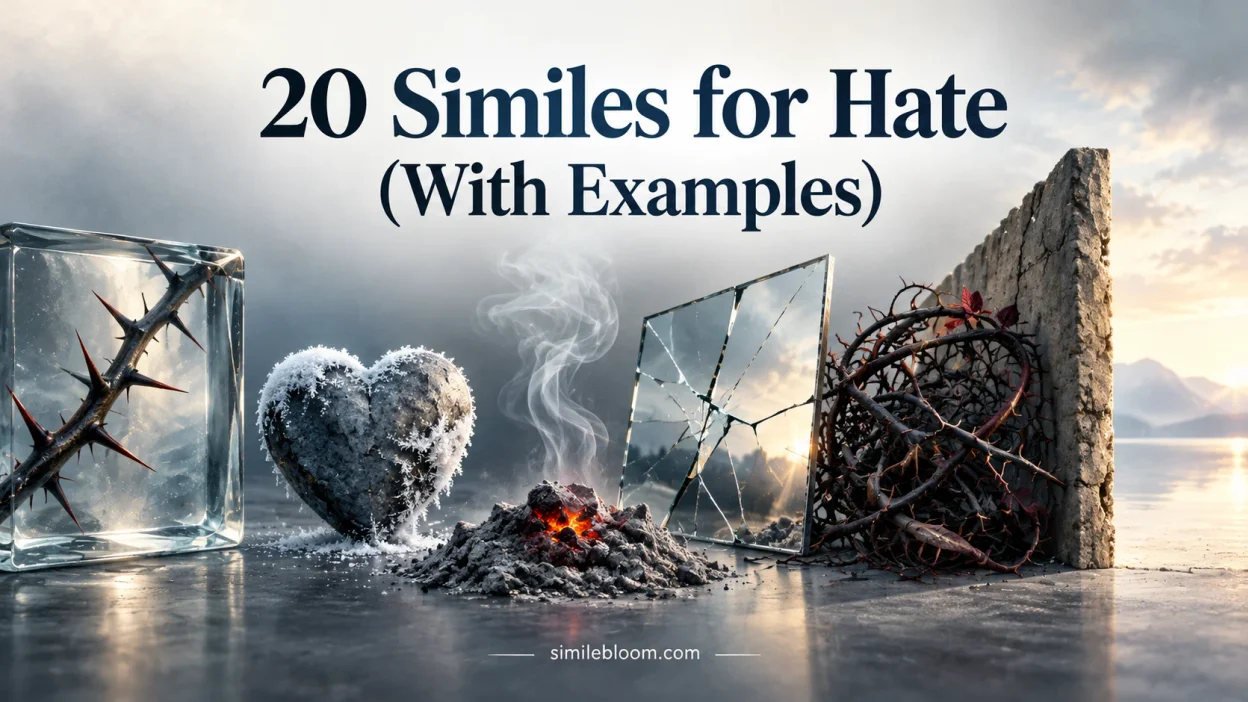
What does hate feel like when ordinary words are not strong enough to express it? Sometimes, it burns like a hidden fire, while other times it lingers like a cold shadow. In this guide to 20 Similes for Hate With Real Examples, you’ll discover vivid comparisons that make hatred, resentment, anger, and deep dislike easier to describe.
Each simile connects an intense emotion with a familiar image, helping you express difficult feelings with greater clarity and precision.Strong figurative language can make English usage more expressive in conversation, storytelling, and formal writing. These comparisons also show how similes create emotional meaning without stating everything directly.
Whether you are writing an essay, developing creative content, or improving your grammar and vocabulary, the examples offer practical ways to understand how context shapes meaning. Clear language also depends on consistency, especially when precise expression matters.
Although terms such as scheduling, time management, business communication, online booking, broadcasting, meetings, calendar, and project management belong to different communication contexts, they share one important quality: effective language must match its purpose.
This article focuses specifically on similes for hate, with realistic examples that show how each expression works naturally. You’ll learn the meaning behind every comparison and see how figurative language can turn a powerful emotion into a clear, memorable image.
What Is a Simile?
A simile is a figure of speech that compares two different things, usually by using “like” or “as.” The comparison helps readers understand an idea by connecting it to a familiar image.
For example:
- The baby slept like a log.
- Her hands were as cold as ice.
In both examples, the meaning is figurative rather than literal. The baby is not actually a wooden log, and the person’s hands are not literally made of ice. The comparison simply helps the reader imagine how deeply or strongly something feels.
Simile vs. Metaphor
A simile makes a comparison openly, often with like or as.
- Simile: His resentment burned like a hidden ember.
- Metaphor: His resentment was a hidden ember.
The simile says one thing is like another. The metaphor directly presents one thing as another to create a figurative comparison.
Both forms of figurative language can make writing more expressive, but they create slightly different effects. A simile often feels more explanatory because it shows readers the connection between the two ideas.
Why Use Similes for Hate?
Hate is not always loud or aggressive. Sometimes it is quiet resentment, while at other times it feels sharp, consuming, distant, or destructive. Similes give writers different ways to express these shades of emotion.
A thoughtful comparison can:
- Express difficult feelings without explaining them at length.
- Create a strong mental picture for the reader.
- Make emotional descriptions more vivid.
- Add personality to personal messages and creative writing.
- Give poetry a more emotional and memorable quality.
- Help describe the difference between anger, resentment, hostility, and hatred.
- Make storytelling more expressive.
- Help readers understand an emotion through imagery rather than direct explanation.
The strongest similes for hate do more than say that hatred is intense. They show what that intensity feels like.
Quick List of 20 Similes for Hate
- Hate is like a thorn buried under the skin.
- Hate is like ice sealing a once-warm heart.
- Hate is like a wildfire fed by dry resentment.
- Hate is like poison slowly spreading through the blood.
- Hate is like a locked door between two hearts.
- Hate is like a storm cloud that refuses to move.
- Hate is like rust eating through iron.
- Hate is like a bitter taste that will not leave the tongue.
- Hate is like a shadow following every step.
- Hate is like a cracked mirror reflecting old wounds.
- Hate is like a stone carried in the chest.
- Hate is like a cage built from old grudges.
- Hate is like a spark hiding beneath cold ashes.
- Hate is like a knife kept sharp by memory.
- Hate is like a vine tightening around a tree.
- Hate is like a winter that arrives without spring.
- Hate is like smoke filling a room without a flame.
- Hate is like a wall built brick by brick.
- Hate is like a wound that keeps reopening.
- Hate is like a bitter river flowing through memory.
Hate Is Like a Thorn Buried Under the Skin
Meaning
This simile describes hate as a painful feeling that remains difficult to remove. Like a thorn under the skin, it may not always be visible, but it continues to cause discomfort.
Detailed Explanation
A thorn creates a small but persistent source of pain. Comparing hate to one suggests that resentment can remain present even when everything looks normal from the outside. The image works especially well for quiet hatred caused by betrayal, disappointment, or unresolved hurt. It emphasizes persistence rather than explosive anger.
Example in a Sentence
- His hatred remained like a thorn buried under the skin, painful whenever the past came up.
- She tried to forgive, but the old resentment felt like a thorn beneath her skin.
3 Other Ways to Say It
- A pain that refuses to disappear
- A lingering source of resentment
- An old hurt that still stings
Tone: Emotional, serious, and reflective.
Best for: Creative writing, personal reflection, poetry, and storytelling.
Hate Is Like Ice Sealing a Once-Warm Heart
Meaning
This simile presents hate as something that creates emotional coldness where affection once existed.
Detailed Explanation
Ice suggests distance, numbness, and a loss of warmth. The phrase “once-warm heart” adds the idea that the hatred may have developed after a relationship or connection changed. It works particularly well when the writer wants to show love turning into resentment rather than hatred appearing suddenly.
Example in a Sentence
- After the betrayal, his affection hardened like ice sealing a once-warm heart.
- Years of disappointment left her feelings as cold as ice over something that had once been warm.
3 Other Ways to Say It
- A heart closed by resentment
- Affection turned cold
- Emotional warmth replaced by bitterness
Tone: Poetic, emotional, and serious.
Best for: Poetry, novels, reflective writing, and relationship-focused storytelling.
Hate Is Like a Wildfire Fed by Dry Resentment
Meaning
This simile compares hate to a rapidly growing fire fueled by unresolved resentment.
Detailed Explanation
A wildfire becomes more powerful when dry material gives it something to consume. Likewise, resentment can feed hatred when disappointments and grievances remain unresolved. The comparison suggests that hate may begin with something small but become increasingly difficult to control. It is especially effective for describing escalating conflict.
Example in a Sentence
- Their years of resentment spread like a wildfire fed by dry grass.
- Every new argument gave his hostility more fuel, like a wildfire finding another field to burn.
3 Other Ways to Say It
- Resentment gaining momentum
- Anger feeding on old grievances
- Hostility growing out of control
Tone: Dramatic and intense.
Best for: Fiction, speeches, essays, and descriptions of escalating conflict.
Hate Is Like Poison Slowly Spreading Through the Blood
Meaning
This simile portrays hate as something harmful that gradually affects a person’s entire emotional state.
Detailed Explanation
Poison does not need to be visible to cause damage. This makes it a useful comparison for hatred that begins quietly and gradually influences thoughts, relationships, and behavior. The word “slowly” is important because the simile focuses on internal damage over time, rather than sudden anger.
Example in a Sentence
- He allowed resentment to grow until it moved through him like poison through the blood.
- Her hatred became like a slow poison, affecting even the memories she once cherished.
3 Other Ways to Say It
- A destructive bitterness
- Resentment spreading inward
- An emotion that slowly corrodes the spirit
Tone: Serious, dark, and reflective.
Best for: Essays, novels, personal writing, and psychological descriptions.
Hate Is Like a Locked Door Between Two Hearts
Meaning
This simile describes hate as an emotional barrier that prevents connection, trust, or reconciliation.
Detailed Explanation
A locked door separates people who might otherwise be able to meet. Similarly, hatred can prevent people from listening to each other or recognizing shared feelings. The image is less violent than some comparisons and focuses instead on distance and emotional separation. It can work especially well when hate develops between people who were once close.
Example in a Sentence
- Their resentment stood like a locked door between two hearts that once trusted each other.
- Years of hostility became a locked door between them, even when both wanted peace.
3 Other Ways to Say It
- An emotional barrier
- A wall between two people
- A closed path to reconciliation
Tone: Sad, caring, and reflective.
Best for: Personal writing, relationship stories, poetry, and speeches.
Hate Is Like a Storm Cloud That Refuses to Move
Meaning
This simile describes persistent hatred that hangs over someone’s thoughts or relationships.
Detailed Explanation
A storm cloud can darken the sky without immediately producing rain or thunder. In the same way, hate can remain present as a heavy emotional atmosphere. The comparison suggests a feeling that lingers and colors everything around it. It is useful when hatred feels more oppressive than explosive.
Example in a Sentence
- His resentment hung over every conversation like a storm cloud that refused to move.
- The old feud remained like a dark cloud above the family.
3 Other Ways to Say It
- A lingering darkness
- A heavy emotional cloud
- Resentment hanging over everything
Tone: Poetic, serious, and atmospheric.
Best for: Storytelling, poetry, essays, and emotional descriptions.
Hate Is Like Rust Eating Through Iron
Meaning
This simile presents hate as something that gradually weakens relationships and emotional strength.
Detailed Explanation
Rust slowly damages iron from within and across its surface. The comparison works because resentment can also develop gradually, often before people realize how much damage it has caused. Unlike wildfire, this image emphasizes slow deterioration rather than sudden destruction. It fits situations where hostility has accumulated over many years.
Example in a Sentence
- Small grudges ate away at their friendship like rust eating through iron.
- His bitterness worked like rust, quietly weakening the trust between them.
3 Other Ways to Say It
- Slowly corroding trust
- Gradual emotional damage
- Bitterness eating away at a relationship
Tone: Serious and reflective.
Best for: Essays, fiction, relationship writing, and social commentary.
Hate Is Like a Bitter Taste That Will Not Leave the Tongue
Meaning
This simile describes hate as a persistent unpleasant feeling that remains after a painful experience.
Detailed Explanation
A bitter taste can linger long after the food or drink is gone. Similarly, resentment may remain even after the original conflict has ended. The comparison is particularly useful for describing memories of betrayal, rejection, or disappointment that continue to affect someone. It focuses on the lasting sensation of emotional bitterness.
Example in a Sentence
- The betrayal left a bitterness that lingered like a taste that would not leave his tongue.
- Even years later, the argument remained like a bitter taste in her memory.
3 Other Ways to Say It
- A lingering bitterness
- An unpleasant memory
- A resentment that stays behind
Tone: Reflective, emotional, and poetic.
Best for: Personal essays, poetry, memoir-style writing, and storytelling.
Hate Is Like a Shadow Following Every Step
Meaning
This simile portrays hate as a persistent emotion that seems impossible to escape.
Detailed Explanation
A shadow follows a person wherever light allows it to appear. This makes it an effective image for resentment that continues to influence thoughts and actions. The comparison does not necessarily suggest open hostility; instead, it highlights emotional persistence. It can describe someone who carries hatred long after the original event.
Example in a Sentence
- His resentment followed him like a shadow through every new relationship.
- She carried the old hatred like a shadow, even when she tried to move forward.
3 Other Ways to Say It
- A feeling that follows you
- An emotion that refuses to fade
- A burden carried everywhere
Tone: Poetic, emotional, and introspective.
Best for: Poetry, novels, personal reflection, and character development.
Hate Is Like a Cracked Mirror Reflecting Old Wounds
Meaning
This simile suggests that hate can distort the way someone sees the present because of painful experiences from the past.
Detailed Explanation
A cracked mirror does not show a clear reflection. Instead, it breaks an image into distorted pieces. Comparing hatred to such a mirror suggests that old wounds can change how a person interprets new situations. The image is useful when exploring resentment, mistrust, and emotional distortion.
Example in a Sentence
- His hatred became like a cracked mirror, making every new kindness look suspicious.
- She viewed their friendship through resentment, like looking into a mirror broken by old wounds.
3 Other Ways to Say It
- A distorted view of the present
- The past coloring everything
- Resentment changing perception
Tone: Thoughtful, psychological, and serious.
Best for: Essays, literary analysis, fiction, and reflective writing.
Hate Is Like a Stone Carried in the Chest
Meaning
This simile describes hate as a heavy emotional burden that a person carries internally.
Detailed Explanation
A stone is heavy, solid, and difficult to carry for long periods. The image suggests that hatred can create emotional weight rather than simply producing anger. It works especially well when someone knows that resentment is exhausting but still struggles to release it. The comparison emphasizes burden, heaviness, and emotional fatigue.
Example in a Sentence
- He carried his resentment like a stone in his chest wherever he went.
- Forgiveness felt impossible while she held that old hatred like a weight inside her.
3 Other Ways to Say It
- A heavy emotional burden
- A weight of resentment
- A heart burdened by bitterness
Tone: Emotional, gentle, and reflective.
Best for: Personal writing, poetry, memoirs, and thoughtful speeches.
Hate Is Like a Cage Built From Old Grudges
Meaning
This simile describes hate as something that can trap a person in past anger and prevent emotional freedom.
Detailed Explanation
A cage limits movement, and old grudges can create a similar emotional restriction. Someone may remain focused on what happened instead of responding freely to the present. The comparison also suggests that hatred can imprison the person who holds it, not only the person who is hated. It is especially useful for discussing resentment and difficulty letting go.
Example in a Sentence
- His old grudges formed a cage around him, trapping him in anger.
- She realized that her hatred had become like a cage built from memories she could not release.
3 Other Ways to Say It
- Trapped in resentment
- Imprisoned by old anger
- Unable to move beyond the past
Tone: Reflective and serious.
Best for: Essays, speeches, poetry, and personal development writing.
Hate Is Like a Spark Hiding Beneath Cold Ashes
Meaning
This simile describes hatred that appears quiet but can return when something awakens it.
Detailed Explanation
Cold ashes may look lifeless, yet a hidden ember can still produce heat or flame. Likewise, a person may seem calm while unresolved resentment remains underneath. A single reminder can bring the emotion back to the surface. This comparison is especially useful for old conflicts and suppressed hostility.
Example in a Sentence
- Their disagreement looked forgotten, but the resentment remained like a spark beneath cold ashes.
- One mention of the betrayal awakened a hatred that had been lying like an ember under ash.
3 Other Ways to Say It
- Hidden resentment
- Anger waiting beneath the surface
- A dormant emotional conflict
Tone: Dramatic, subtle, and poetic.
Best for: Fiction, storytelling, poetry, and descriptions of unresolved conflict.
Hate Is Like a Knife Kept Sharp by Memory
Meaning
This simile presents hate as an emotion that stays painful because memories continually reinforce it.
Detailed Explanation
A knife becomes sharp through repeated sharpening. In this comparison, memory performs a similar role by repeatedly bringing an old injury back into emotional focus. The image suggests that hatred is not merely caused by the original event; it can be maintained through repeated recollection. This makes the simile effective for long-standing resentment.
Example in a Sentence
- Every time he remembered the betrayal, his anger became like a knife sharpened by memory.
- Her resentment stayed sharp, like a blade polished by years of painful recollection.
3 Other Ways to Say It
- Resentment strengthened by memory
- An old wound kept alive
- Bitterness sharpened by the past
Tone: Dramatic, serious, and literary.
Best for: Fiction, poetry, essays, and character descriptions.
Hate Is Like a Vine Tightening Around a Tree
Meaning
This simile describes hate as something that gradually grows stronger and increasingly restricts emotional freedom.
Detailed Explanation
A climbing vine can wrap around a tree slowly until its presence becomes difficult to separate from the trunk. This makes it a strong image for resentment that grows little by little. The comparison emphasizes gradual attachment and increasing restriction rather than sudden rage. It can describe hatred that becomes part of someone’s daily thinking.
Example in a Sentence
- Her resentment grew like a vine tightening around a tree, slowly leaving less room for trust.
- Years of hostility wrapped around their relationship like a vine around an old trunk.
3 Other Ways to Say It
- Resentment taking root
- Bitterness becoming deeply rooted
- Hostility tightening its grip
Tone: Poetic, serious, and reflective.
Best for: Literary writing, essays, poetry, and relationship stories.
Hate Is Like a Winter That Arrives Without Spring
Meaning
This simile portrays hate as a long period of emotional coldness with no visible end.
Detailed Explanation
Winter is associated with coldness, stillness, and the absence of growth. Normally, spring follows it, bringing warmth and renewal. Removing that expectation creates an image of hatred that seems to prevent reconciliation or emotional renewal. The comparison is useful when describing prolonged emotional distance.
Example in a Sentence
- Their hatred felt like a winter that arrived without spring.
- After years of betrayal, the relationship entered a cold season that seemed like winter without an ending.
3 Other Ways to Say It
- Endless emotional coldness
- A relationship without renewal
- A season of lasting bitterness
Tone: Poetic, melancholic, and serious.
Best for: Poetry, novels, reflective essays, and emotional storytelling.
Hate Is Like Smoke Filling a Room Without a Flame
Meaning
This simile describes hostility that becomes noticeable even when its source is not immediately visible.
Detailed Explanation
Smoke can fill a room and make breathing or seeing difficult even when the flame producing it is hidden. Similarly, resentment can affect an atmosphere without anyone openly discussing its cause. The comparison works well for unspoken hostility and tense relationships. It suggests that everyone can feel something is wrong even when nobody names it.
Example in a Sentence
- Resentment filled the meeting like smoke in a room without a visible flame.
- Their silence carried a tension like smoke slowly spreading through the house.
3 Other Ways to Say It
- Unspoken hostility
- Tension filling the atmosphere
- A room heavy with resentment
Tone: Atmospheric, subtle, and serious.
Best for: Storytelling, workplace fiction, social observations, and dramatic writing.
Hate Is Like a Wall Built Brick by Brick
Meaning
This simile describes hate as something that develops gradually through repeated disappointments, arguments, or grudges.
Detailed Explanation
A wall is rarely built in one moment. Each brick adds another layer of separation. In the same way, resentment may grow from many small experiences rather than one dramatic event. The comparison is useful for explaining how emotional distance can develop slowly and almost unnoticed.
Example in a Sentence
- Every argument added another brick to the wall of resentment between them.
- Their hatred grew like a wall built brick by brick, until neither knew how to cross it.
3 Other Ways to Say It
- A barrier built over time
- Gradually increasing emotional distance
- Layers of unresolved resentment
Tone: Reflective, serious, and accessible.
Best for: Essays, speeches, personal writing, and storytelling.
Hate Is Like a Wound That Keeps Reopening
Meaning
This simile compares hate to emotional pain that returns whenever an old injury is remembered or triggered.
Detailed Explanation
A physical wound cannot heal properly if it keeps reopening. The same idea can describe emotional resentment that returns whenever someone revisits a painful event. This comparison focuses on hurt beneath hatred, making it useful when the emotion comes from betrayal, loss, or deep disappointment. It also shows why the same memory can continue to hurt years later.
Example in a Sentence
- Every reminder of the betrayal made his hatred feel like a wound reopening.
- Their repeated arguments kept the old resentment alive like a wound that never fully healed.
3 Other Ways to Say It
- An old pain brought back to life
- A hurt that never fully heals
- Repeated emotional injury
Tone: Emotional, compassionate, and serious.
Best for: Personal essays, poetry, memoirs, and character-driven fiction.
Hate Is Like a Bitter River Flowing Through Memory
Meaning
This simile presents hate as a continuous current of bitterness running through someone’s recollections.
Detailed Explanation
A river keeps moving, carrying everything within its current. This image suggests that hatred can become woven through memories, influencing how someone remembers both painful and ordinary moments. Unlike the image of a sudden fire, this comparison emphasizes continuity and emotional depth. It is particularly effective for reflective or poetic writing.
Example in a Sentence
- A bitter river of resentment seemed to flow through every memory of their friendship.
- His recollections were colored by hatred, like a dark river moving beneath them all.
3 Other Ways to Say It
- Bitterness running through the past
- Resentment woven into memory
- A continuous current of anger
Tone: Poetic, reflective, and literary.
Best for: Poetry, novels, memoirs, and creative essays.
Exercise: Practice Using Similes
Choose the best answer for each question.
What makes “Her resentment was like a thorn beneath her skin” a simile?
A. It gives the resentment a literal physical form.
B. It compares resentment with a thorn using “like.”
C. It describes an actual injury.
D. It uses a proverb to explain resentment.
Which simile best describes hate that develops slowly over many years?
A. Hate is like a locked door between two hearts.
B. Hate is like a storm cloud that refuses to move.
C. Hate is like smoke filling a room without a flame.
D. Hate is like rust eating through iron.
What does “Hate is like a stone carried in the chest” mainly communicate?
A. Emotional heaviness and burden
B. Physical strength
C. Sudden happiness
D. Complete emotional freedom
Which sentence uses a simile correctly?
A. Her hatred was a locked door.
B. Her hatred became resentment.
C. His hatred lingered like a bitter taste.
D. Her hatred destroyed the friendship.
What does “Hate is like a locked door between two hearts” emphasize?
A. Physical travel
B. Emotional separation
C. Personal success
D. Sudden excitement
Which expression is a metaphor rather than a simile?
A. His anger was like a wildfire.
B. Her resentment felt like a heavy stone.
C. Their hatred was a wall between them.
D. His bitterness lingered like smoke.
Which simile best fits hidden resentment that can return suddenly?
A. Hate is like a winter that arrives without spring.
B. Hate is like a spark hiding beneath cold ashes.
C. Hate is like a stone carried in the chest.
D. Hate is like a bitter river flowing through memory.
What does “Hate is like rust eating through iron” suggest?
A. Hatred creates immediate happiness.
B. Hatred is always temporary.
C. Hatred gradually causes damage.
D. Hatred makes relationships stronger.
Which sentence uses figurative rather than literal meaning?
A. The stone was heavy.
B. The wall was made of bricks.
C. The river flowed through the valley.
D. She carried a stone of resentment in her chest.
Which simile is most suitable for describing hatred that creates emotional distance?
A. Hate is like a locked door between two hearts.
B. His hate is like a wildfire fed by dry resentment.
C. Hate is like poison spreading through the blood.
D. Hate is like a knife kept sharp by memory.
What does “Hate is like a wound that keeps reopening” mainly suggest?
A. Hatred can return when old pain is triggered.
B. Hatred always disappears quickly.
C. Hatred is physically visible.
D. Hatred creates instant friendship.
Which sentence contains a clear simile?
A. Her resentment became a prison.
B. His hatred was a shadow.
C. Their bitterness spread like smoke.
D. The argument created resentment.
Which simile focuses most strongly on memory keeping hatred alive?
A. Hate is like ice sealing a once-warm heart.
B. The hate is like a knife kept sharp by memory.
C. Hate is like a wall built brick by brick.
D. Hate is like a storm cloud that refuses to move.
Which statement about similes is correct?
A. Similes must always be traditional sayings.
B. Similes directly state that one thing is another.
C. Similes cannot describe emotions.
D. Similes commonly use “like” or “as” to create a comparison.
Which comparison best describes hatred that feels like a lasting emotional burden?
A. Hate is like a stone carried in the chest.
B. Hate is like smoke filling a room without a flame.
C. Hate is like a spark beneath cold ashes.
D. Hate is like a vine tightening around a tree.
Answers
- B — The phrase uses “like” to compare resentment with a thorn, making it a simile.
- D — Rust damages iron gradually, so the image fits slowly developing resentment.
- A — The stone represents the emotional weight that someone carries.
- C — “Lingered like a bitter taste” uses like to make a direct comparison.
- B — The locked door represents emotional separation between two people.
- C — “Their hatred was a wall” directly identifies one thing with another, making it a metaphor.
- B — A hidden spark beneath ashes represents resentment that appears quiet but can flare up again.
- C — Rust gradually weakens iron, making it an effective image for slow emotional damage.
- D — The stone is not literal; it represents the emotional burden of resentment.
- A — A locked door clearly represents a barrier between people who cannot emotionally connect.
- A — A reopening wound represents old emotional pain returning when something triggers it.
- C — The word “like” creates a clear comparison between bitterness and smoke.
- B — This simile specifically connects hatred with memory sharpening or sustaining emotional pain.
- D — Similes commonly use “like” or “as” to compare different things.
- A — A stone carried in the chest represents a heavy emotional burden.
Read More: 20 Similes for Fast With Real Examples
FAQs
What is a simile for hate?
A simile for hate compares intense dislike or hostility to something familiar using words such as “like” or “as.” For example, “Her hatred burned like a raging fire” compares hate with the destructive intensity of fire.
What is a strong simile for hate?
A strong simile for hate is “His hatred was like a poison spreading through his thoughts.” It suggests that hate can gradually affect a person’s emotions, decisions, and relationships.
How can I describe hate using figurative language?
You can describe hate through images associated with fire, poison, storms, ice, darkness, or sharp objects. These comparisons help readers understand the intensity and emotional effect of hatred without explaining every feeling directly.
What is a creative simile for deep hatred?
A creative simile is “Her deep hatred was as cold as a winter night.” This comparison presents hatred as distant, harsh, and emotionally unforgiving.
Can similes make expressions of hate more powerful?
Yes. A well-chosen simile gives an abstract emotion a clear mental image. Instead of simply saying someone felt intense hatred, you can compare that feeling to something readers can easily imagine.
What are some common things used to compare hate?
Hate is often compared with fire, poison, storms, ice, darkness, thunder, and weapons. The best comparison depends on the particular feeling you want to communicate, such as anger, bitterness, cruelty, or resentment.
What is a simile for hate in creative writing?
In creative writing, you might write, “His hatred spread like wildfire through the quiet town.” This creates a vivid image and suggests that the emotion became increasingly powerful and difficult to control.
What is the difference between a simile and a metaphor for hate?
A simile makes a comparison using “like” or “as,” while a metaphor makes a direct comparison. For example, “Her hate was like ice” is a simile, while “Her hate was ice” is a metaphor.
Can I use similes for hate in formal writing?
Yes, but use them carefully. A suitable simile can strengthen an essay, speech, or other formal writing when it supports the main idea and fits the tone. Avoid overly dramatic comparisons when a straightforward statement would communicate the point better.
How do I choose the best simile for hate?
Think about the exact quality of hate you want to express. Fire can suggest intense anger, ice can suggest emotional coldness, and poison can suggest slow and damaging resentment. Choose the comparison that best matches your intended meaning and context.
Conclusion
Hate can be difficult to describe because it carries different meanings in different situations. A powerful simile gives this complicated emotion a clear and memorable image. From burning fire to spreading poison, these comparisons help readers understand the intensity, coldness, bitterness, or destructive nature of hatred.
The 20 similes for hate with real examples in this guide show how figurative language can make emotional writing more vivid. You can use these expressions in creative writing, essays, stories, speeches, and everyday English usage when a simple description does not fully capture the feeling. However, always choose a comparison that fits your context and intended tone.
Learning how to use similes effectively also strengthens your vocabulary and improves expressive writing. Instead of relying on the same words repeatedly, you can create fresh images that make your message more engaging. With thoughtful word choice and consistent usage, even a difficult emotion like hate can be expressed with clarity, precision, and impact.

Daniel Carter is an English educator and content writer with a strong interest in creative language and literary expression. His work focuses on helping learners understand how similes and other forms of figurative language work in real sentences. At SimileBloom, Daniel develops easy-to-follow explanations and useful examples for improving English writing and communication.



[…] Read More: 20 Similes for Hate With Real Examples […]