
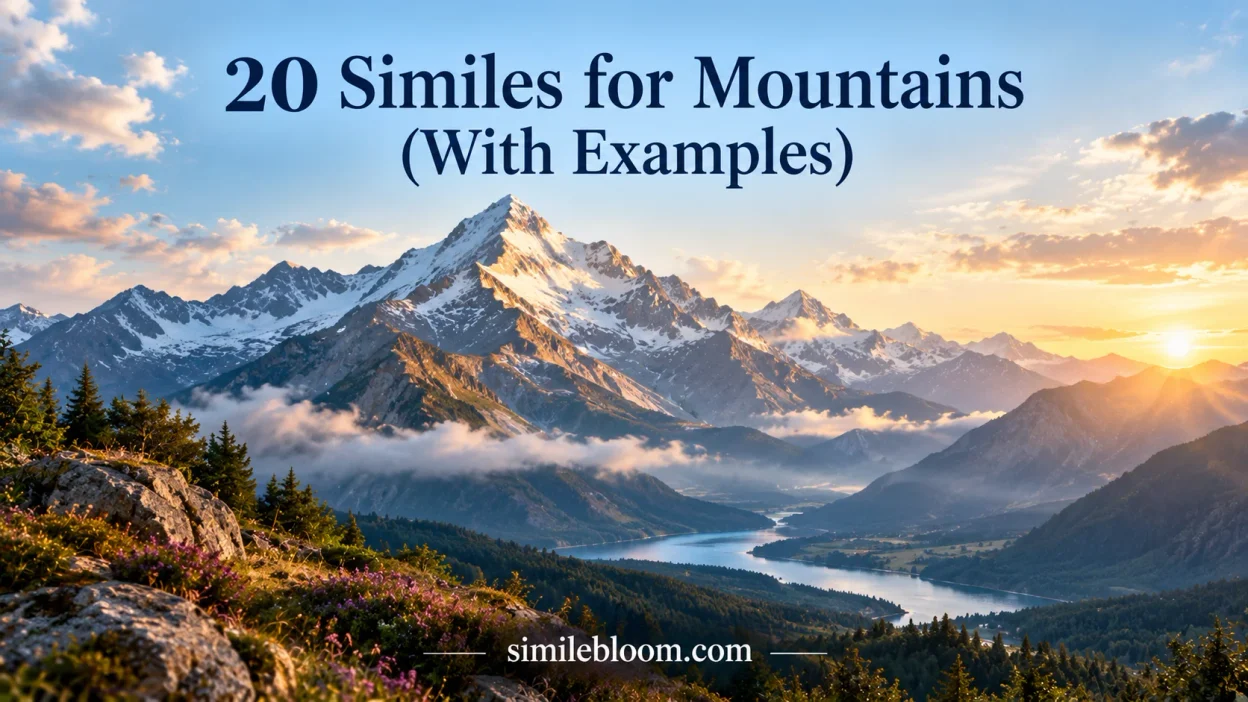
Have you ever looked at a mountain and struggled to capture its grandeur in words? 20 Similes for Mountains With Real Examples gives you vivid ways to describe their height, strength, beauty, and mystery. These comparisons can make ordinary descriptions feel more powerful, visual, and memorable.
Whether you are writing a story, essay, speech, or creative passage, the right simile helps readers picture the scene instantly.Mountains can appear as tall as towers, as strong as giants, or as quiet as sleeping guardians. Each comparison creates a different image and emotional effect.
This collection explains the meaning, context, and real sentence examples behind twenty mountain similes. It also shows how figurative language supports better English usage, grammar, and formal writing without making your sentences sound forced. Clear examples can help students and writers develop stronger expression and greater consistency in their work.
Although similes often appear in creative writing, strong language skills matter across many settings. The same attention to clarity can improve business communication, meetings, project management, and even written content related to scheduling, calendar planning, or online booking.
Similar principles support effective broadcasting and other forms of communication where vivid language keeps audiences engaged. In this guide, you will discover practical mountain comparisons that are easy to understand, remember, and use naturally.
What Is a Simile?
A simile is a figure of speech that compares two different things using comparison words such as “like” or “as.” It helps readers understand an idea by connecting it with something familiar.
For example:
- “Her smile was like sunshine.”
- “He was as quiet as a mouse.”
The literal meaning describes what something actually is. The figurative meaning creates an imaginative comparison. A mountain is not literally a sleeping giant, for example, but calling it one can suggest enormous size, stillness, and hidden power.
Simile vs. Metaphor
A simile usually makes a comparison openly by using words such as like or as.
- Simile: “The mountain stood like a silent guardian.”
- Metaphor: “The mountain was a silent guardian.”
Both sentences create a similar mental picture, but they do so differently. A simile signals the comparison, while a metaphor directly identifies one thing with another.
Why Use Similes for Mountains?
Mountains naturally inspire strong imagery because they combine height, scale, texture, silence, movement, and permanence. Similes allow writers to highlight whichever quality matters most in a particular scene.
A mountain can become a symbol of strength in one sentence and peacefulness in another. It can resemble a wall, a sleeping creature, a fortress, or an ancient witness. These comparisons help readers create mental pictures rather than simply receiving factual descriptions.
Mountain similes are especially useful in creative writing, poetry, storytelling, travel descriptions, speeches, essays, and personal messages. The right comparison can make a landscape feel more emotional and memorable.
Quick List of 20 Similes
- Like a silent giant watching over the land
- Like a wall reaching toward the sky
- As steady as an ancient fortress
- Like a sleeping dragon beneath the clouds
- As grand as a cathedral carved by nature
- Like a wave frozen in stone
- As patient as an old tree
- Like a crown resting on the horizon
- As rugged as an unpolished diamond
- Like a staircase leading into the heavens
- As calm as a monk in meditation
- Like a ship sailing through a sea of clouds
- As immovable as an iron gate
- Like a giant spine across the earth
- As mysterious as a locked ancient book
- Like a watchtower above the wilderness
- As bright as a jewel beneath the morning sun
- Like a sleeping heart beneath the snow
- As enduring as a story passed through generations
- Like a quiet friend who never leaves
Like a silent giant watching over the land
Meaning
This simile describes a mountain as enormous, powerful, and protective. It suggests that the mountain seems to watch over everything around it without moving or speaking.
Detailed Explanation
A mountain and a giant are compared because both can suggest great size and strength. The word “silent” adds a peaceful quality rather than making the image frightening. This comparison works particularly well when a mountain rises above a town, valley, or small group of travelers. It gives the landscape a feeling of protection and quiet authority.
Example in a Sentence
- The mountain stood like a silent giant watching over the land as the village lights began to glow.
- From the valley, the peaks looked like silent giants keeping watch through the night.
3 Other Ways to Say It
- A towering guardian over the valley
- A massive presence above the countryside
- A quiet protector of the land
Best fit: This simile feels protective, poetic, and peaceful, making it useful for storytelling, poetry, and reflective writing.
Like a wall reaching toward the sky
Meaning
This comparison emphasizes the mountain’s height, breadth, and imposing shape. It makes the mountain seem like a huge natural barrier.
Detailed Explanation
A mountain range can resemble a wall because it stretches across the landscape and may block the view beyond it. Adding “reaching toward the sky” emphasizes its impressive vertical height. The image works especially well for rugged mountain ranges viewed from a distance. It can also suggest separation between two places.
Example in a Sentence
- The mountains rose like a wall reaching toward the sky, hiding the valley beyond.
- Across the horizon, the rocky peaks formed a wall against the afternoon clouds.
3 Other Ways to Say It
- A towering natural barrier
- A rocky wall across the horizon
- A massive ridge dividing the landscape
Best fit: This is a strong, visual comparison suited to essays, travel writing, and landscape descriptions.
As steady as an ancient fortress
Meaning
This simile compares a mountain’s stability and strength with an old fortress that has survived for generations.
Detailed Explanation
An ancient fortress suggests something built to withstand storms, conflict, and time. Mountains create a similar impression because they appear firm and deeply rooted in the earth. The comparison gives the landscape a sense of history and resilience. It works particularly well when describing mountains that have weathered harsh conditions.
Example in a Sentence
- The peak remained as steady as an ancient fortress while the storm swept across the valley.
- Against the changing sky, the mountain looked as steady as a fortress from another age.
3 Other Ways to Say It
- Firm as a stone stronghold
- Built to withstand the ages
- Solid and enduring
Best fit: This simile has a serious, inspirational, and powerful tone.
Like a sleeping dragon beneath the clouds
Meaning
This simile presents a mountain as huge, mysterious, and powerful, but temporarily quiet.
Detailed Explanation
A sleeping dragon creates an image of enormous strength hidden beneath stillness. The mountain’s ridges can resemble the back of a resting creature, while clouds may appear to drift around it like mist. This comparison adds imagination without suggesting that the mountain is literally alive. It is especially effective in fantasy-inspired storytelling and dramatic landscape writing.
Example in a Sentence
- Wrapped in mist, the mountain looked like a sleeping dragon beneath the clouds.
- At dawn, the distant ridge resembled a sleeping dragon waiting beneath a blanket of fog.
3 Other Ways to Say It
- A giant creature resting in the mist
- A hidden beast beneath the clouds
- A dormant force in the landscape
Best fit: This simile is dramatic, mysterious, and imaginative, making it excellent for stories and poetry.
As grand as a cathedral carved by nature
Meaning
This simile emphasizes the mountain’s scale, beauty, and awe-inspiring appearance.
Detailed Explanation
A cathedral can create a feeling of wonder through its height, structure, and intricate details. A mountain can produce a similar sense of awe through cliffs, ridges, peaks, and changing light. The phrase “carved by nature” highlights the landscape as a natural work of art. This comparison suits descriptions of especially majestic or visually striking mountains.
Example in a Sentence
- The granite peak was as grand as a cathedral carved by nature.
- Standing beneath the cliffs, we felt as though we had entered a cathedral shaped by wind and stone.
3 Other Ways to Say It
- A natural monument of breathtaking scale
- A masterpiece shaped by the earth
- A majestic sanctuary of stone
Best fit: This expression feels reverent, poetic, and inspirational.
Like a wave frozen in stone
Meaning
This simile describes a mountain as a powerful natural shape that appears to have stopped moving.
Detailed Explanation
A wave normally represents movement, but a mountain can look like an enormous wave that has suddenly become solid. This creates a striking contrast between motion and stillness. The comparison is especially effective for sharp, sweeping ridges and dramatic peaks. It helps readers imagine the mountain’s shape rather than simply its height.
Example in a Sentence
- The ridge rose like a wave frozen in stone above the coastal valley.
- From a distance, the peaks looked like waves that had hardened beneath the sky.
3 Other Ways to Say It
- A frozen surge of rock
- A stone wave against the horizon
- A motionless crest of earth
Best fit: This simile is poetic and visually vivid, especially in descriptive writing.
As patient as an old tree
Meaning
This comparison presents the mountain as quiet, enduring, and willing to remain through changing seasons.
Detailed Explanation
An old tree suggests patience because it grows slowly and survives year after year. Mountains create a similar impression through their stillness and permanence. The comparison shifts attention away from dramatic size and toward quiet endurance. It works beautifully in reflective passages about time, memory, or nature.
Example in a Sentence
- The mountain stood as patient as an old tree, watching summer give way to winter.
- Nothing seemed to hurry the peak; it was as patient as an old tree rooted in the earth.
3 Other Ways to Say It
- Quietly enduring through the years
- Still through every season
- Calmly waiting through time
Best fit: This simile is gentle, reflective, and emotional.
Like a crown resting on the horizon
Meaning
This simile compares a mountain or mountain range to a crown, suggesting beauty, prominence, and distinction.
Detailed Explanation
A crown sits above the head and immediately attracts attention. In the same way, a mountain range can dominate a distant landscape and become its defining feature. The comparison works especially well at sunrise or sunset when peaks appear sharply outlined against the sky. It can give an ordinary landscape a sense of elegance.
Example in a Sentence
- At sunset, the mountains looked like a crown resting on the horizon.
- The distant peaks formed a golden crown above the quiet fields.
3 Other Ways to Say It
- A jeweled edge along the skyline
- The landscape’s natural crown
- A majestic outline above the horizon
Best fit: This simile feels elegant, warm, and poetic.
As rugged as an unpolished diamond
Meaning
This simile highlights a mountain’s rough surface, natural beauty, and hidden value.
Detailed Explanation
An unpolished diamond is valuable even before it has been cut and shaped. Similarly, a rugged mountain may look rough, weathered, and uneven while still possessing remarkable beauty. The comparison is useful when you want to celebrate natural imperfections rather than polished perfection. It can also suggest that beauty becomes more noticeable when you look closely.
Example in a Sentence
- The rocky mountain was as rugged as an unpolished diamond, beautiful in its raw form.
- Its cliffs were rough and uneven, yet they had the appeal of an unpolished diamond.
3 Other Ways to Say It
- Beautiful in its natural roughness
- Raw but striking
- A masterpiece without polish
Best fit: This simile is appreciative and poetic, especially for travel and nature writing.
Like a staircase leading into the heavens
Meaning
This comparison describes a mountain as a series of rising slopes or peaks that seem to lead upward into the sky.
Detailed Explanation
Mountain trails often climb through several levels, creating the impression of natural steps. Comparing them with a staircase makes the climb feel purposeful and almost spiritual. “The heavens” adds a sense of wonder without requiring a literal religious meaning. It can work well when describing a long ascent toward a high summit.
Example in a Sentence
- The winding trail climbed like a staircase leading into the heavens.
- Layer after layer of rock rose before us like steps toward the open sky.
3 Other Ways to Say It
- A natural path toward the sky
- Steps carved into the earth
- A rising road to the clouds
Best fit: This simile is inspirational, adventurous, and poetic.
As calm as a monk in meditation
Meaning
This simile emphasizes the mountain’s deep stillness and peaceful presence.
Detailed Explanation
A monk in meditation is commonly associated with concentration, quietness, and inner peace. A mountain can create a similar atmosphere when the landscape is still and undisturbed. The comparison moves beyond physical appearance and focuses on the emotional atmosphere surrounding the peak. It works best for quiet scenes rather than violent storms or dramatic action.
Example in a Sentence
- The mountain was as calm as a monk in meditation beneath the pale morning sky.
- Nothing disturbed the valley, and the distant peak seemed as calm as someone lost in meditation.
3 Other Ways to Say It
- Deeply peaceful
- Still as a quiet sanctuary
- Wrapped in profound silence
Best fit: This is a peaceful, reflective, and contemplative expression.
Like a ship sailing through a sea of clouds
Meaning
This simile creates the image of a mountain floating or traveling through clouds like a ship moving across water.
Detailed Explanation
Clouds often gather around high peaks and can make the mountain appear to float above a white landscape. Comparing the clouds with a sea adds depth and movement to the scene. The mountain becomes the ship, while the surrounding clouds become its ocean. This creates a dreamlike image that works especially well in scenic descriptions.
Example in a Sentence
- The peak rose like a ship sailing through a sea of clouds.
- From the airplane window, the mountain looked like a lonely ship surrounded by white waves.
3 Other Ways to Say It
- Floating above a sea of mist
- Drifting through clouds
- A vessel above a white ocean
Best fit: This simile is dreamlike, peaceful, and imaginative.
As immovable as an iron gate
Meaning
This simile stresses a mountain’s solid, immovable, and resistant nature.
Detailed Explanation
An iron gate suggests weight, strength, and resistance to movement. A mountain creates an even stronger impression because it appears firmly anchored to the earth. This comparison is useful when a scene focuses on determination, resistance, or stability. It can also be used symbolically to describe something that refuses to change.
Example in a Sentence
- The mountain stood as immovable as an iron gate while fierce winds swept around it.
- The cliffs seemed as immovable as iron, refusing to yield to the weather.
3 Other Ways to Say It
- Firmly rooted in the earth
- Solid against every force
- Unshaken by the storm
Best fit: This simile feels strong, serious, and determined.
Like a giant spine across the earth
Meaning
This simile compares a mountain range to a spine, emphasizing its long, connected shape and structural importance.
Detailed Explanation
A spine supports the human body, and a mountain range can appear to form a supporting line across a landscape. The image is especially suitable for long chains of mountains rather than one isolated peak. It gives the land a sense of structure and physical strength. The comparison can also make a geographical description more memorable.
Example in a Sentence
- The mountain range stretched like a giant spine across the earth.
- Dark ridges ran from north to south like a spine holding the landscape together.
3 Other Ways to Say It
- A backbone of stone
- A long ridge supporting the landscape
- A powerful line across the land
Best fit: This simile is dramatic and geographical, making it useful in essays and descriptive writing.
As mysterious as a locked ancient book
Meaning
This comparison presents a mountain as full of secrets, history, and things waiting to be discovered.
Detailed Explanation
A locked ancient book suggests knowledge that exists but cannot yet be fully understood. Mountains can create the same feeling through hidden valleys, caves, forests, weather, and unexplored paths. The comparison shifts the reader’s attention from appearance to mystery and discovery. It works particularly well when describing remote or mist-covered landscapes.
Example in a Sentence
- The remote mountain was as mysterious as a locked ancient book.
- Mist covered the upper slopes, making the peak seem like an ancient book whose secrets remained hidden.
3 Other Ways to Say It
- Full of hidden stories
- A landscape of unanswered questions
- A silent keeper of secrets
Best fit: This simile is mysterious, literary, and imaginative.
Like a watchtower above the wilderness
Meaning
This simile describes a mountain as a high natural lookout, overlooking the surrounding landscape.
Detailed Explanation
A watchtower is built to provide a broad view from above. A mountain can serve a similar visual role because its height allows people to see forests, valleys, rivers, and distant settlements. The comparison gives the peak a sense of awareness and perspective. It is particularly effective in adventure stories and travel writing.
Example in a Sentence
- The peak stood like a watchtower above the wilderness.
- From the summit, the mountain felt like a natural watchtower overlooking miles of forest.
3 Other Ways to Say It
- A lookout over the wild land
- A natural observation post
- A high guardian of the valley
Best fit: This simile feels adventurous, strong, and descriptive.
As bright as a jewel beneath the morning sun
Meaning
This simile highlights the beauty and brightness of a mountain when sunlight catches its snow, rock, or ice.
Detailed Explanation
A jewel attracts attention because it reflects and holds light. A mountain can create a similar effect when early sunlight touches its snowy summit or exposed stone. The comparison focuses on a moment when the landscape appears especially radiant. It is more about visual beauty than physical size.
Example in a Sentence
- The snowy summit was as bright as a jewel beneath the morning sun.
- When the clouds cleared, the peak flashed like a jewel in the new sunlight.
3 Other Ways to Say It
- Glowing in the early light
- Sparkling like a precious stone
- Radiant beneath the sun
Best fit: This expression is beautiful, warm, and poetic.
Like a sleeping heart beneath the snow
Meaning
This simile suggests that a mountain has a quiet inner presence and hidden life, even when covered in snow.
Detailed Explanation
The heart represents something central, living, and deeply meaningful. By comparing a snow-covered mountain to a sleeping heart, the image suggests that the landscape is quiet rather than lifeless. The snow becomes a peaceful covering that hides the mountain’s rugged form. This comparison works especially well in emotional or reflective writing.
Example in a Sentence
- Beneath the winter snow, the mountain rested like a sleeping heart.
- The white slopes gave the valley a feeling of stillness, as though a sleeping heart lay beneath them.
3 Other Ways to Say It
- Quiet beneath its winter covering
- A hidden pulse in the landscape
- Resting beneath a blanket of snow
Best fit: This simile is tender, emotional, and contemplative.
As enduring as a story passed through generations
Meaning
This simile compares a mountain’s lasting presence with a story that survives as people continue to remember and share it.
Detailed Explanation
Stories passed from one generation to another gain meaning through time. Mountains create a similar sense of continuity because they remain part of the landscape while generations come and go. The comparison connects nature with memory and heritage. It is especially suitable when writing about a mountain that has cultural or personal significance.
Example in a Sentence
- The mountain seemed as enduring as a story passed through generations.
- For the local community, the familiar peak was as enduring as an old family story.
3 Other Ways to Say It
- A lasting symbol of the past
- A landmark remembered through generations
- A timeless presence
Best fit: This simile is emotional, reflective, and meaningful.
Like a quiet friend who never leaves
Meaning
This simile presents a mountain as a constant and dependable presence.
Detailed Explanation
A quiet friend does not need to speak constantly to offer comfort. In the same way, a familiar mountain can become a reassuring part of someone’s surroundings. The comparison focuses on companionship rather than physical appearance. It can be especially moving when writing about home, childhood, memory, or a place someone has repeatedly visited.
Example in a Sentence
- The mountain stood beyond the town like a quiet friend who never leaves.
- Whenever I returned home, the familiar peak was there like an old friend waiting in silence.
3 Other Ways to Say It
- A constant presence in the distance
- A familiar companion
- A silent comfort on the horizon
Best fit: This simile feels warm, personal, nostalgic, and caring.
Exercise: Practice Using Similes
Question 1
Which sentence contains a simile?
A. The mountain was enormous.
B. The mountain rose like a wall toward the sky.
C. The mountain blocked the road.
D. The mountain had snowy peaks.
Question 2
What does “The mountain stood like a silent giant” mainly suggest?
A. The mountain could speak.
B. The mountain was moving quickly.
C. The mountain seemed large and powerful.
D. The mountain was made of metal.
Question 3
Which comparison best describes a mountain that appears peaceful and still?
A. As calm as a monk in meditation
B. Like a racing horse
C. As noisy as a crowded market
D. Like a flashing alarm
Question 4
Which sentence uses figurative rather than literal meaning?
A. Snow covered the mountain.
B. The mountain has steep slopes.
C. The mountain rises above the valley.
D. The mountain looked like a sleeping dragon.
Question 5
Which expression best describes a mountain range stretching across a landscape?
A. Like a small candle
B. Like a giant spine across the earth
C. As soft as cotton
D. Like a narrow stream
Question 6
What comparison is made in “The peak looked like a jewel beneath the morning sun”?
A. The peak is literally a jewel.
B. The peak is being compared with something bright and beautiful.
C. The peak is made from precious stones.
D. The peak is underground.
Question 7
Which sentence is a metaphor rather than a simile?
A. The mountain was like a fortress.
B. The mountain stood as still as stone.
C. The mountain was a fortress above the valley.
D. The mountain looked like a wall.
Question 8
Which simile would best fit a mysterious, mist-covered mountain?
A. Like a locked ancient book
B. Like a cheerful puppy
C. As bright as a lamp
D. Like a busy marketplace
Question 9
What does “like a staircase leading into the heavens” suggest?
A. The mountain has actual stairs made of clouds.
B. The mountain appears to rise upward in stages.
C. The mountain is underground.
D. The mountain is completely flat.
Question 10
Which sentence uses a mountain simile naturally?
A. The mountain was like a silent giant watching over the village.
B. The mountain like silent giant village.
C. Mountain is silent giant watching.
D. The mountain watched the village literally like a person.
Question 11
Which comparison emphasizes endurance over time?
A. Like a flashing star
B. Like a sleeping dragon
C. As enduring as a story passed through generations
D. Like a fast-moving river
Question 12
Which sentence uses “like” to make a clear comparison?
A. The mountain is very tall.
B. The mountain rises above the trees.
C. The mountain looked like a crown on the horizon.
D. The mountain has a rocky summit.
Question 13
Which simile would work best for describing a mountain as a dependable presence?
A. Like a quiet friend who never leaves
B. Like a broken window
C. As loud as thunder
D. Like a rushing river
Question 14
Why are similes useful when describing mountains?
A. They make every sentence literal.
B. They remove imagery from writing.
C. They help readers form vivid mental pictures.
D. They make descriptions shorter in every case.
Question 15
Which sentence contains a comparison between a mountain and a wave?
A. The mountain was covered with snow.
B. The mountain looked like a wave frozen in stone.
C. The mountain stood above the valley.
D. The mountain had a narrow peak.
Answers
- B — “Like a wall toward the sky” clearly compares the mountain with a wall.
- C — The silent giant comparison emphasizes the mountain’s size and power.
- A — A monk in meditation suggests deep calm and stillness.
- D — A mountain is not literally a sleeping dragon, so the comparison is figurative.
- B — A giant spine effectively describes a long mountain range extending across the land.
- B — The jewel comparison highlights the peak’s brightness and beauty.
- C — “The mountain was a fortress” directly identifies the mountain with a fortress, making it a metaphor.
- A — A locked ancient book suggests secrets and mystery, fitting a mist-covered mountain.
- B — The comparison creates an image of a mountain rising upward in a series of natural stages.
- A — The sentence uses the simile naturally and grammatically.
- C — A story passed through generations represents something that continues through time.
- C — “Like a crown” explicitly signals a comparison.
- A — A quiet friend represents constant companionship and familiarity.
- C — Similes help readers create clear mental images by connecting unfamiliar ideas with familiar ones.
- B — The mountain is directly compared with a wave frozen in stone.
Read More: 20 Similes for Moon With Real Examples
FAQs
What is a good simile for a mountain?
A good mountain simile compares the mountain to something familiar while highlighting a specific quality. For example, “The mountain stood like a giant guarding the valley” emphasizes its size and strength.
What are some common similes for mountains?
Common mountain similes describe their height, strength, shape, or appearance. Examples include “as tall as a skyscraper,” “like a sleeping giant,” and “as strong as a fortress.”
How do you describe a mountain using a simile?
Choose one noticeable mountain feature, such as height, shape, color, or power. Then compare it with something readers can easily visualize using like or as.
What is a creative simile for a mountain?
“The mountain rose like a stone crown above the clouds” is a creative simile. It gives the landscape a majestic and almost magical quality.
What simile describes a tall mountain?
You can describe a tall mountain as “as tall as a giant reaching toward the sky.” This comparison emphasizes its impressive height and upward presence.
How can mountain similes improve creative writing?
Mountain similes make descriptions more vivid and engaging. Instead of simply saying that a mountain is large, a writer can create a stronger mental picture through an imaginative comparison.
Can mountain similes be used in essays?
Yes, mountain similes can work well in descriptive and creative essays. However, they should fit the purpose and tone of the writing rather than appear simply to decorate a sentence.
What are some similes for mountains in poetry?
Poetry often uses imaginative comparisons such as “the mountain stood like a silent guardian” or “its snowy peak gleamed like a silver crown.” These images create atmosphere and emotion.
What is a simile for a mountain covered in snow?
A snow-covered mountain can be described as “white as a cloud” or “like a giant covered in a blanket of snow.” The best choice depends on the mood and image you want to create.
Why are similes useful when describing mountains?
Similes help readers visualize mountains more clearly by connecting unfamiliar or impressive features with familiar objects and experiences. They can make descriptions more vivid, memorable, and emotionally expressive.
Conclusion
Mountains have a presence that can be difficult to capture with ordinary words. The right simile for mountains turns their height, strength, beauty, and stillness into images readers can easily imagine. From towering giants to silent guardians, these comparisons give mountain descriptions more depth, emotion, and visual appeal.
The 20 similes for mountains with real examples in this guide offer practical choices for essays, stories, poems, speeches, and everyday English usage. You can use them to describe snowy peaks, rugged slopes, distant ranges, or majestic landscapes with greater precision. Remember that the strongest simile is not always the most complicated one. A simple, natural comparison can leave the clearest impression.
As you practice using mountain similes, focus on meaning, context, and consistency. Choose comparisons that match the mood of your writing instead of adding figurative language just for decoration. With regular practice, you can make your descriptions more vivid while developing stronger English writing and communication skills.

James Anderson is an English teacher and educational writer interested in helping learners develop confident communication skills. He specializes in explaining literary devices and expressive English in straightforward language. His contributions to SimileBloom focus on useful simile examples, explanations, and learning resources that readers can apply in writing and conversation.
[…] Read More: 20 Similes for Mountains With Real Examples […]