
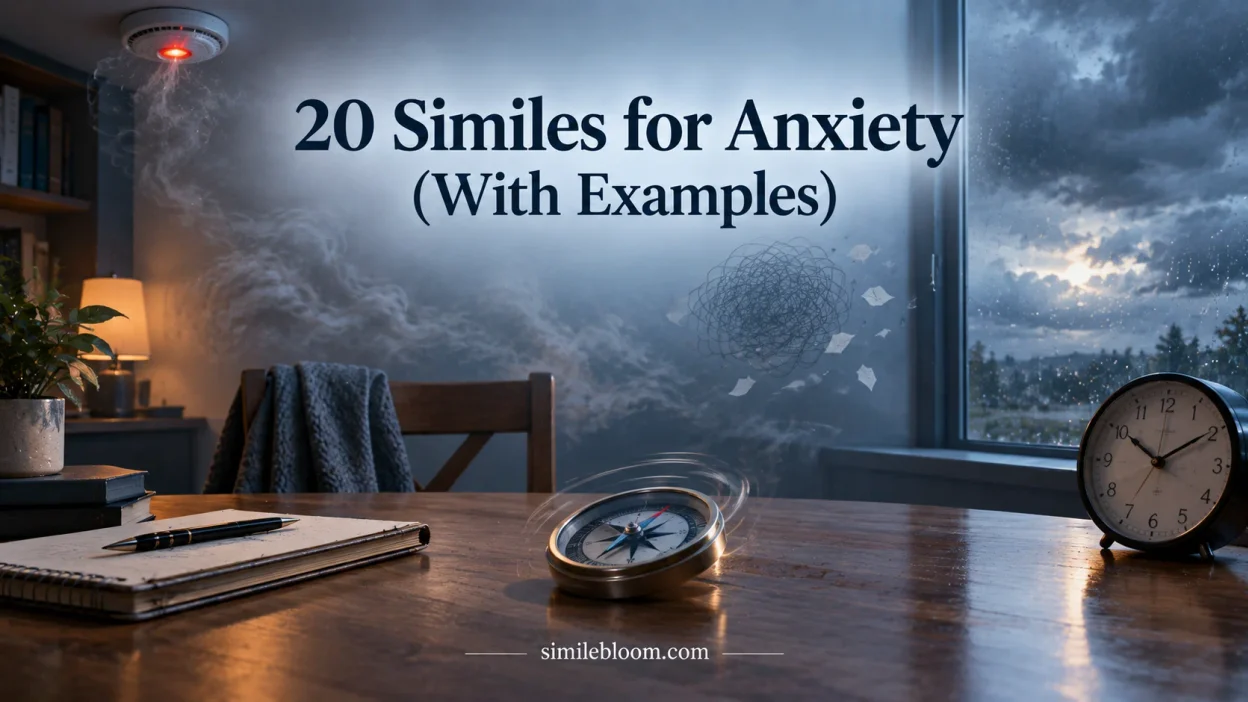
Have you ever felt anxiety building like a storm inside your mind? 20 Similes for Anxiety With Real Examples explores vivid comparisons that make difficult emotions easier to describe. These examples help you express worry, tension, fear, and uncertainty clearly.
Similes can transform ordinary sentences into memorable descriptions. This guide explains how each comparison works through practical examples. It also supports better English usage, grammar, and descriptive writing.
You can use these expressions in conversations, creative writing, and formal writing. Clear language also matters in business communication, meetings, presentations, and everyday professional situations.
Whether anxiety affects scheduling, time management, or project management, the right words can improve communication. The examples focus on natural meaning, context, and consistency, helping you describe anxious feelings with clarity and confidence.
What Is a Simile?
A simile is a figure of speech that compares two different things, usually by using words such as “like” or “as.”
For example:
- The baby’s skin was as soft as silk.
- The old house stood like a forgotten ship.
In the first example, the baby’s skin is not literally silk. The comparison emphasizes its smoothness and softness. In the second, the house is not actually a ship. The comparison creates a mental picture of something large, isolated, and weathered.
A simile therefore has both a literal subject and a figurative comparison. The comparison helps the reader imagine a quality that might otherwise be difficult to describe.
Simile vs. Metaphor
A simile makes a comparison openly, usually with like or as.
- Simile: Her thoughts raced like horses.
- Metaphor: Her thoughts were wild horses.
Both sentences create a similar image, but they do it differently. The simile says one thing is like another, while the metaphor directly describes one thing as another.
This distinction matters when you’re studying figurative language. A comparison does not automatically become a simile simply because it sounds imaginative. A clear comparison using words such as like or as is usually the simplest way to identify a simile.
Why Use Similes for Anxiety?
Anxiety can be difficult to describe because it may involve thoughts, physical sensations, uncertainty, tension, and emotional pressure at the same time. A well-chosen simile gives those experiences a concrete image.
For example, saying “I feel anxious” is clear, but “My thoughts are like birds trapped inside a room” gives the reader a stronger sense of restlessness and mental movement.
Similes for anxiety can help you:
- Express feelings that are difficult to explain directly.
- Create clear mental pictures for readers.
- Add warmth and personality to personal writing.
- Make creative writing more vivid and memorable.
- Describe emotional experiences with greater precision.
- Add depth to poetry, storytelling, essays, and speeches.
- Explain a difficult feeling without relying on the same words repeatedly.
- Show whether the experience feels quiet, overwhelming, sudden, persistent, or exhausting.
Quick List of 20 Similes
- Anxiety is like a smoke alarm with no visible fire.
- Anxiety is like a storm trapped inside a glass house.
- Anxiety is like a radio stuck between stations.
- Anxiety is like carrying a backpack filled with invisible stones.
- Anxiety is like a shadow that grows under bright lights.
- Anxiety is like a clock that never stops ticking.
- Anxiety is like walking across a bridge that keeps moving.
- Anxiety is like a swarm of bees trapped inside your thoughts.
- Anxiety is like a knot pulled tighter every time you think about it.
- Anxiety is like standing at the edge of a door you cannot open.
- Anxiety is as restless as waves during a rough tide.
- Anxiety is as loud as thunder in an otherwise quiet room.
- Anxiety is as fragile as a glass cup balanced on a fingertip.
- Anxiety is as heavy as a coat soaked through with rain.
- Anxiety is like a crowded room inside an empty house.
- Anxiety is like a compass spinning without finding north.
- Anxiety is like running on a treadmill that never reaches anywhere.
- Anxiety is like an unanswered question echoing down a hallway.
- Anxiety is like a tightly wound spring waiting to release.
- Anxiety is like fog covering a road you know is there.
Anxiety Is Like a Smoke Alarm With No Visible Fire
Meaning
This simile describes anxiety as an alarm response that feels intense even when the source of danger is unclear. The smoke alarm represents the mind’s warning system, while the missing fire represents uncertainty about what is causing the fear.
Detailed Explanation
A smoke alarm is designed to demand attention, so its sound can be difficult to ignore. This comparison captures the feeling of being constantly alerted to a possible problem without being able to identify exactly what will happen. It works particularly well when anxiety feels urgent, persistent, or difficult to explain. The image is familiar enough to make an invisible emotional experience easier to understand.
Example in a Sentence
- My anxiety felt like a smoke alarm with no visible fire, demanding my attention all afternoon.
- She described her worry as a smoke alarm with no visible fire, always warning her that something might go wrong.
3 Other Ways to Say It
- My mind keeps sounding an alarm without a clear reason.
- I feel constantly warned about a danger I cannot see.
- My thoughts keep telling me something is wrong.
Tone and context: This is serious and descriptive. It works well in personal writing, essays, storytelling, and conversations about emotional experiences.
Anxiety Is Like a Storm Trapped Inside a Glass House
Meaning
This simile presents anxiety as powerful inner turmoil that feels visible and vulnerable at the same time.
Detailed Explanation
A storm suggests movement, noise, uncertainty, and emotional intensity. A glass house adds another layer because everything feels exposed while there is still a fragile barrier between the person and the outside world. The comparison works when anxiety feels overwhelming internally but difficult for other people to see. It creates a striking contrast between an apparently calm exterior and an unsettled inner world.
Example in a Sentence
- He looked calm during the meeting, but inside, his anxiety was like a storm trapped inside a glass house.
- Her smile stayed steady while her thoughts felt like a storm trapped inside a glass house.
3 Other Ways to Say It
- There was a tempest behind his calm expression.
- I felt shaken inside while trying to look composed.
- My mind was in turmoil beneath a quiet surface.
Tone and context: Poetic, emotional, and reflective. It suits creative writing, poetry, personal essays, and thoughtful messages.
Anxiety Is Like a Radio Stuck Between Stations
Meaning
This simile describes anxiety as mental noise, uncertainty, and thoughts that never settle clearly on one idea.
Detailed Explanation
A radio between stations produces fragments of sound that are difficult to understand. Similarly, anxious thinking can feel crowded with incomplete possibilities, worries, and repeated thoughts. The comparison focuses less on fear itself and more on the difficulty of finding mental clarity. It works especially well when someone’s mind feels busy but cannot settle on a clear conclusion.
Example in a Sentence
- My thoughts were like a radio stuck between stations, filled with pieces of every possible problem.
- Before the interview, her mind sounded like a radio stuck between stations.
3 Other Ways to Say It
- My thoughts were full of static.
- My mind couldn’t settle on one clear thought.
- Everything in my head felt jumbled and noisy.
Tone and context: Casual and relatable. It works naturally in everyday conversation, personal messages, and informal writing.
Anxiety Is Like Carrying a Backpack Filled With Invisible Stones
Meaning
This simile describes anxiety as an unseen burden that becomes increasingly difficult to carry.
Detailed Explanation
The backpack represents an ongoing load, while the invisible stones represent worries that other people may not notice. Unlike a physical backpack, the weight cannot easily be shown or measured. This makes the comparison useful for explaining why someone may feel exhausted even when nothing obvious appears to be wrong. It emphasizes the accumulating nature of worry.
Example in a Sentence
- By the end of the week, my anxiety felt like carrying a backpack filled with invisible stones.
- She went through the day as though she were carrying a backpack filled with invisible stones.
3 Other Ways to Say It
- I was carrying a burden nobody could see.
- Every worry felt like another weight on my shoulders.
- My mind felt heavier with every new concern.
Tone and context: Serious, empathetic, and reflective. It fits personal writing, supportive conversations, essays, and storytelling.
Anxiety Is Like a Shadow That Grows Under Bright Lights
Meaning
This simile shows anxiety as something that can become more noticeable even when circumstances appear positive or safe.
Detailed Explanation
A shadow usually becomes visible because of light, which creates an interesting contrast. The brighter the light, the clearer the shadow may become. Likewise, someone can experience anxiety during moments that appear successful, peaceful, or happy from the outside. This comparison communicates the idea that positive circumstances do not automatically erase difficult feelings.
Example in a Sentence
- Even after everything went well, my anxiety remained like a shadow that grew under bright lights.
- Her worries followed the celebration like a shadow growing beneath the bright lights.
3 Other Ways to Say It
- The worry stayed with me despite the good news.
- My fears lingered beneath an otherwise happy moment.
- The brighter things became, the more aware I was of my unease.
Tone and context: Poetic and emotional. It works particularly well in creative writing and personal reflection.
Anxiety Is Like a Clock That Never Stops Ticking
Meaning
This simile describes anxiety as constant mental pressure and an inability to fully relax.
Detailed Explanation
A ticking clock draws attention to passing time, especially when you’re waiting for something. When anxiety feels like a clock that never stops, every moment can seem to carry another reminder of what might happen next. The comparison captures anticipation and persistent pressure rather than one sudden burst of fear. It can be especially effective when describing worry about deadlines, decisions, appointments, or uncertain outcomes.
Example in a Sentence
- The deadline made my anxiety feel like a clock that never stopped ticking.
- At night, my thoughts became like a clock that never stopped ticking.
3 Other Ways to Say It
- I couldn’t switch off the feeling of urgency.
- My mind kept counting down to something.
- Every minute seemed to carry another worry.
Tone and context: Serious and relatable. It suits essays, workplace writing, conversations, and personal narratives.
Anxiety Is Like Walking Across a Bridge That Keeps Moving
Meaning
This simile presents anxiety as uncertainty and instability while trying to move forward.
Detailed Explanation
A bridge normally provides a stable path from one place to another. If that bridge keeps moving, every step becomes uncertain. This image works when anxiety comes from not knowing whether a decision, relationship, journey, or future situation will remain secure. It emphasizes instability rather than simple fear.
Example in a Sentence
- Starting the new job felt like walking across a bridge that kept moving beneath my feet.
- Her uncertainty was like walking across a bridge that kept moving every time she tried to step forward.
3 Other Ways to Say It
- I felt as though the ground kept shifting.
- Moving forward felt uncertain.
- I couldn’t find anything steady to rely on.
Tone and context: Emotional and serious. It works well in personal essays, storytelling, and conversations about uncertainty.
Anxiety Is Like a Swarm of Bees Trapped Inside Your Thoughts
Meaning
This simile describes anxiety as many restless thoughts buzzing around without settling down.
Detailed Explanation
A swarm of bees creates constant movement and sound, making it difficult to focus on one thing. The comparison turns scattered anxious thoughts into a vivid mental image. It works particularly well when several worries arrive at once rather than forming one clear concern. The image communicates restlessness, distraction, and mental noise.
Example in a Sentence
- Before the presentation, my thoughts were like a swarm of bees trapped inside my head.
- She couldn’t concentrate because her worries felt like a swarm of bees trapped inside her thoughts.
3 Other Ways to Say It
- My mind was buzzing with worries.
- Too many thoughts were flying around at once.
- My head felt crowded with restless concerns.
Tone and context: Vivid and conversational. It works well in everyday speech, creative writing, and personal messages.
Anxiety Is Like a Knot Pulled Tighter Every Time You Think About It
Meaning
This simile describes anxiety as a cycle in which repeated attention can make a worry feel increasingly tense.
Detailed Explanation
A loose knot becomes tighter when you keep pulling at it. This creates a useful image for repetitive worry because thinking about the same concern can sometimes make it feel more complicated or difficult to release. The comparison focuses on mental tension and repetition. It can describe a single worry that gradually becomes more consuming.
Example in a Sentence
- The unanswered email became like a knot pulled tighter every time I thought about it.
- My concern about the decision felt like a knot pulled tighter with every new question.
3 Other Ways to Say It
- The worry became harder to untangle.
- Thinking about it only made the tension grow.
- My concern kept tightening around my thoughts.
Tone and context: Reflective and serious. It works well in essays, personal writing, and thoughtful conversations.
Anxiety Is Like Standing at the Edge of a Door You Cannot Open
Meaning
This simile describes anxiety as being close to an uncertain situation without knowing how to move forward.
Detailed Explanation
A closed door can represent an unknown future, unanswered question, or difficult decision. Standing at its edge suggests that you know something is ahead, but you cannot see what lies beyond it. The image captures the tension between wanting an answer and fearing what the answer might reveal. It is especially useful for describing uncertainty.
Example in a Sentence
- Waiting for the results felt like standing at the edge of a door I could not open.
- Her anxiety was like standing at the edge of a door without knowing what waited behind it.
3 Other Ways to Say It
- I was facing an unknown future.
- I felt stuck outside an unanswered question.
- I couldn’t see what was waiting ahead.
Tone and context: Poetic and thoughtful. It fits creative writing, personal essays, speeches, and reflective messages.
Anxiety Is as Restless as Waves During a Rough Tide
Meaning
This simile compares anxiety with the constant movement and agitation of rough water.
Detailed Explanation
Waves rarely stay still during a rough tide. They rise, fall, collide, and return, creating a sense of continuous motion. This makes the comparison useful for describing anxiety that comes in repeated waves rather than remaining at one steady level. The image suggests restlessness, fluctuation, and emotional movement.
Example in a Sentence
- My thoughts were as restless as waves during a rough tide.
- Her anxiety came and went, as restless as waves during a rough tide.
3 Other Ways to Say It
- My emotions kept rising and falling.
- Worry came in restless waves.
- I couldn’t find a calm place in my thoughts.
Tone and context: Poetic and emotional. It works especially well in poetry, creative writing, and personal reflection.
Anxiety Is as Loud as Thunder in an Otherwise Quiet Room
Meaning
This simile describes anxiety as sudden, powerful, and impossible to ignore against an otherwise calm background.
Detailed Explanation
Thunder can feel startling because its sound interrupts silence. Likewise, an anxious thought can suddenly dominate attention even when everything around you appears peaceful. This comparison focuses on intensity and disruption, rather than constant worry. It is useful for describing a sudden surge of unease.
Example in a Sentence
- One unexpected message made my anxiety as loud as thunder in an otherwise quiet room.
- The thought arrived as loud as thunder in the middle of an otherwise peaceful afternoon.
3 Other Ways to Say It
- The worry broke through my calm.
- One thought suddenly overwhelmed everything else.
- The fear arrived with startling force.
Tone and context: Dramatic and emotional. It suits storytelling, poetry, personal essays, and speeches.
Anxiety Is as Fragile as a Glass Cup Balanced on a Fingertip
Meaning
This simile describes a state of emotional tension in which even a small disturbance can feel significant.
Detailed Explanation
A glass cup balanced on a fingertip requires extreme care because a small movement could make it fall. The comparison creates a sense of vulnerability and caution. It works when anxiety makes someone feel as though they must monitor every word, action, or possibility. The focus is on fragility and hyper-awareness, not necessarily fear alone.
Example in a Sentence
- After the difficult conversation, my sense of calm felt as fragile as a glass cup balanced on a fingertip.
- The peaceful moment seemed as fragile as a glass cup balanced on a fingertip.
3 Other Ways to Say It
- I felt easily unsettled.
- My calm seemed ready to break.
- Everything felt unusually delicate.
Tone and context: Gentle, emotional, and reflective. It fits personal messages, essays, and creative writing.
Anxiety Is as Heavy as a Coat Soaked Through With Rain
Meaning
This simile presents anxiety as exhausting emotional weight that follows you through the day.
Detailed Explanation
A dry coat may feel comfortable, but one soaked with rain becomes cold and heavy. The comparison makes emotional exhaustion easier to imagine because the burden seems to accompany every movement. It works particularly well when anxiety feels draining rather than dramatic. The image emphasizes how persistent worry can affect an ordinary day.
Example in a Sentence
- By evening, my anxiety felt as heavy as a coat soaked through with rain.
- He carried the day’s worries as heavily as a coat soaked through with rain.
3 Other Ways to Say It
- The worry drained my energy.
- I felt weighed down by my thoughts.
- The day’s tension followed me everywhere.
Tone and context: Serious, empathetic, and reflective. It works well in personal writing and emotional storytelling.
Anxiety Is Like a Crowded Room Inside an Empty House
Meaning
This simile describes the contrast between external quietness and internal mental noise.
Detailed Explanation
An empty house should feel spacious and quiet, while a crowded room suggests voices, movement, and activity. Putting these two images together captures the strange experience of having a calm environment while your thoughts feel overwhelmingly busy. It can help explain why someone may look peaceful while experiencing significant inner tension. The central idea is inner noise within outer silence.
Example in a Sentence
- The quiet night felt strange because my mind was like a crowded room inside an empty house.
- Although the office was nearly empty, my thoughts were like a crowded room inside an empty house.
3 Other Ways to Say It
- My surroundings were quiet, but my mind wasn’t.
- There was noise inside me despite the silence around me.
- My thoughts filled the space that silence left behind.
Tone and context: Poetic and introspective. It works especially well in creative writing, poetry, and personal essays.
Anxiety Is Like a Compass Spinning Without Finding North
Meaning
This simile describes anxiety as uncertainty that makes it difficult to decide which direction to take.
Detailed Explanation
A compass is supposed to provide direction, so a spinning compass represents confusion and a lack of certainty. This makes the image especially effective when anxiety is connected to decisions or an unclear future. Instead of focusing on physical fear, it emphasizes indecision and uncertainty. It can describe moments when every possible choice seems difficult.
Example in a Sentence
- My thoughts were like a compass spinning without finding north.
- Choosing between the two options left her feeling like a compass spinning without finding north.
3 Other Ways to Say It
- I couldn’t tell which direction to take.
- I felt completely uncertain about my next step.
- Every option seemed to point somewhere different.
Tone and context: Thoughtful and serious. It fits essays, personal writing, decision-making discussions, and storytelling.
Anxiety Is Like Running on a Treadmill That Never Reaches Anywhere
Meaning
This simile describes anxiety as constant mental effort without a satisfying sense of progress.
Detailed Explanation
A treadmill allows you to keep moving while remaining in the same physical place. This creates a strong image for repetitive worry, especially when someone keeps analyzing the same situation without reaching a conclusion. The comparison captures mental exhaustion, repetition, and frustration. It works particularly well for describing overthinking.
Example in a Sentence
- Trying to predict every possible outcome felt like running on a treadmill that never reached anywhere.
- My mind kept reviewing the conversation, like running on a treadmill that never reached anywhere.
3 Other Ways to Say It
- I kept thinking without getting closer to an answer.
- My thoughts were going in circles.
- I was exhausting myself without making progress.
Tone and context: Serious and relatable. It works naturally in everyday conversation, essays, and personal reflection.
Anxiety Is Like an Unanswered Question Echoing Down a Hallway
Meaning
This simile describes anxiety as uncertainty that keeps returning to your attention.
Detailed Explanation
An unanswered question can remain in your mind, while an echo makes the question seem to return again and again. The hallway adds distance and emptiness, making the image more reflective. This comparison works when anxiety comes from not knowing what will happen or what someone thinks. It captures the persistence of uncertainty without describing anxiety as a constant physical sensation.
Example in a Sentence
- Waiting for her response was like hearing an unanswered question echoing down a hallway.
- The uncertainty remained like an unanswered question echoing down a hallway.
3 Other Ways to Say It
- The unanswered thought kept returning.
- Uncertainty kept ringing in my mind.
- I couldn’t silence the question.
Tone and context: Poetic and introspective. It works well in creative writing, poetry, and reflective essays.
Anxiety Is Like a Tightly Wound Spring Waiting to Release
Meaning
This simile describes anxiety as stored tension that feels ready to burst into action.
Detailed Explanation
A tightly wound spring contains potential movement even when it appears still. That makes it a useful comparison for anxiety that creates physical or emotional tension beneath a calm exterior. The image suggests pressure, restraint, and anticipation. It works particularly well when someone feels tense while trying to remain composed.
Example in a Sentence
- Before I walked onto the stage, my anxiety felt like a tightly wound spring waiting to release.
- He sat quietly, but his nervous energy was like a tightly wound spring waiting to release.
3 Other Ways to Say It
- I felt tense beneath the surface.
- I was holding in a great deal of nervous energy.
- My body felt ready to react.
Tone and context: Dramatic and expressive. It suits storytelling, speeches, creative writing, and personal reflection.
Anxiety Is Like Fog Covering a Road You Know Is There
Meaning
This simile describes anxiety as uncertainty that obscures something familiar or makes the next step difficult to see.
Detailed Explanation
Fog does not necessarily remove the road; it simply makes the road harder to see. This makes the comparison useful for situations where the path forward exists but anxiety makes it feel uncertain or unreachable. The image emphasizes limited visibility rather than actual absence. It can be especially effective when describing uncertainty about the future.
Example in a Sentence
- My future felt like a road hidden by fog; I knew it was there, but I couldn’t see far ahead.
- Anxiety covered my plans like fog covering a road I knew was there.
3 Other Ways to Say It
- I knew the path existed, but I couldn’t see it clearly.
- The future felt blurred.
- Uncertainty made the next step difficult to recognize.
Tone and context: Calm, thoughtful, and poetic. It works well in essays, personal messages, creative writing, and speeches.
Exercise: Practice Using Similes
Choose the best answer for each question.
Which sentence contains a simile?
A. Anxiety filled the room.
B. Anxiety is a storm.
C. Anxiety felt like a storm trapped inside a glass house.
D. Anxiety arrived suddenly.
What does “Anxiety is like a radio stuck between stations” mainly suggest?
A. Anxiety makes people enjoy music.
B. Anxiety can create confusing mental noise.
C. Anxiety always disappears quickly.
D. Anxiety improves concentration.
Which sentence uses figurative rather than literal meaning?
A. The radio was between two stations.
B. The clock showed eight o’clock.
C. She carried a heavy backpack.
D. His thoughts were like bees trapped in his mind.
Which comparison best describes uncertainty about the future?
A. Anxiety is like a compass spinning without finding north.
B. Anxiety is like a warm blanket.
C. Anxiety is like a polished mirror.
D. Anxiety is like a quiet garden.
Which is a metaphor rather than a simile?
A. Her worry moved like a shadow.
B. Her worry was a shadow.
C. Her worry felt like a shadow.
D. Her worry was as quiet as a shadow.
What does the “backpack filled with invisible stones” represent?
A. Physical exercise
B. Hidden emotional burdens
C. A travel adventure
D. A useful possession
Which simile best describes repetitive overthinking?
A. Anxiety is like running on a treadmill that never reaches anywhere.
B. Anxiety is like a bright window.
C. Anxiety is like a clean notebook.
D. Anxiety is like a quiet lake.
Which sentence uses the simile naturally?
A. My anxiety is like a compass spinning without finding north when I don’t know which decision to make.
B. My anxiety is like a compass spinning without finding north because my shoes are blue.
C. My anxiety is like a compass spinning without finding north at breakfast because toast is crunchy.
D. My anxiety is like a compass spinning without finding north, so the weather is delicious.
What does “as heavy as a coat soaked through with rain” emphasize?
A. Happiness
B. Humor
C. Emotional weight and exhaustion
D. Physical speed
Which comparison focuses most strongly on sudden intensity?
A. Anxiety is like fog covering a road.
B. Anxiety is as loud as thunder in a quiet room.
C. Anxiety is like a compass.
D. Anxiety is like a closed door.
What is the main difference between a simile and a metaphor?
A. A simile always has more words.
B. A metaphor can only describe emotions.
C. A simile usually uses comparison words such as “like” or “as.”
D. A metaphor must describe something literally.
Which sentence uses a simile to describe inner tension?
A. My anxiety is a tightly wound spring.
B. My anxiety felt like a tightly wound spring waiting to release.
C. My anxiety disappeared.
D. My anxiety was measured by a spring.
What does “a shadow that grows under bright lights” suggest?
A. Anxiety can remain noticeable even during positive moments.
B. Anxiety always occurs at night.
C. Anxiety is caused by sunlight.
D. Anxiety makes rooms darker.
Which sentence uses literal language rather than a figurative comparison?
A. My thoughts were like a radio stuck between stations.
B. My worry was an unanswered question.
C. The radio was stuck between two stations.
D. My mind was a crowded room.
Which simile best expresses feeling vulnerable and easily unsettled?
A. Anxiety is as fragile as a glass cup balanced on a fingertip.
B. Anxiety is like a compass.
C. Anxiety is like a treadmill.
D. Anxiety is like a radio.
Answers
- C — The sentence uses “like” to compare anxiety with a storm, making it a simile.
- B — A radio between stations creates an image of confusing noise and incomplete thoughts.
- D — Thoughts cannot literally be bees, so the comparison is figurative.
- A — A spinning compass represents uncertainty about direction or the next step.
- B — “Her worry was a shadow” directly identifies one thing as another, making it a metaphor.
- B — The invisible stones represent unseen worries and emotional burdens.
- A — The treadmill comparison captures repetitive thinking without a sense of progress.
- A — This sentence uses the comparison naturally to explain uncertainty about a decision.
- C — The soaked coat represents emotional heaviness and exhaustion.
- B — Thunder breaking through silence creates an image of sudden, powerful disruption.
- C — A simile generally uses comparison words such as “like” or “as.”
- B — The spring comparison represents stored tension and nervous energy.
- A — The growing shadow suggests that anxiety can remain present even when circumstances appear positive.
- C — The radio being stuck between stations is presented as a literal event, not a comparison.
- A — The fragile glass image emphasizes vulnerability and emotional sensitivity.
Read More: 20 Similes for Similes For Depression With Real Examples
FAQs
What is a simile for anxiety?
A simile for anxiety compares anxious feelings to something familiar using words such as “like” or “as.” For example, “Her anxiety felt like a storm gathering overhead.”
Why are similes useful for describing anxiety?
Similes make abstract emotions easier to visualize. Instead of simply saying someone feels nervous, a comparison can show the intensity, pressure, or restlessness behind that feeling.
What is a good simile for intense anxiety?
A strong example is, “His anxiety was like a fire spreading through dry grass.” It suggests that anxious feelings can grow quickly and become difficult to control.
How can I describe nervousness with a simile?
You can compare nervousness to familiar physical experiences. For example, “Her nerves fluttered like birds trapped inside a room.” This creates a clear image of restless emotion.
Can similes for anxiety be used in creative writing?
Yes. Similes for anxiety work especially well in stories, poems, personal essays, and descriptive passages. They help readers connect emotionally with a character’s experience.
What is a simile for overthinking?
A useful example is, “My thoughts raced like cars speeding through a crowded highway.” This comparison emphasizes the rapid and difficult-to-stop nature of overthinking.
What is a simile for anxiety before an important event?
You could write, “Her anxiety was like a drum beating louder with every passing minute.” This works well for situations involving exams, interviews, performances, or presentations.
How do similes make anxiety easier to understand?
Anxiety can be difficult to explain because it involves both thoughts and physical sensations. A well-chosen simile gives readers a familiar image that makes the emotion easier to understand.
Can I use anxiety similes in formal writing?
Yes, but choose them carefully. In formal writing, a simple and purposeful comparison can add clarity. Avoid overly dramatic expressions when writing academic, professional, or business content.
How can I create my own similes for anxiety?
Start by identifying the specific feeling you want to describe, such as fear, tension, racing thoughts, or uncertainty. Then compare it with a familiar experience, object, sound, or natural event. Use “like” or “as” to connect the two ideas naturally.
Conclusion
Finding the right words for anxiety can be challenging, especially when emotions feel complicated or overwhelming. The 20 Similes for Anxiety With Real Examples in this guide show how simple comparisons can turn difficult feelings into clear, memorable descriptions. From racing thoughts to nervous anticipation, each simile gives readers a practical way to communicate emotional experiences.
Using similes effectively can also strengthen your English and make descriptive writing more engaging. Whether you are writing a story, personal reflection, essay, or everyday message, the right comparison can create a stronger mental image. Focus on the feeling you want to express, then choose an image that matches its intensity and context.
Remember that effective figurative language should sound natural rather than forced. With regular practice, you can develop greater confidence in English usage, sentence construction, and creative expression. Use these examples as inspiration, then create your own comparisons to describe anxiety with greater clarity, precision, and emotional depth.

Olivia Parker is an English content writer passionate about vocabulary, creative writing, and figurative language. She creates reader-friendly resources that explain how expressions work and when to use them naturally. At SimileBloom, Olivia provides examples and explanations designed to help learners use similes with greater clarity and confidence.

[…] Read More: 20 Similes for Anxiety With Real Examples […]