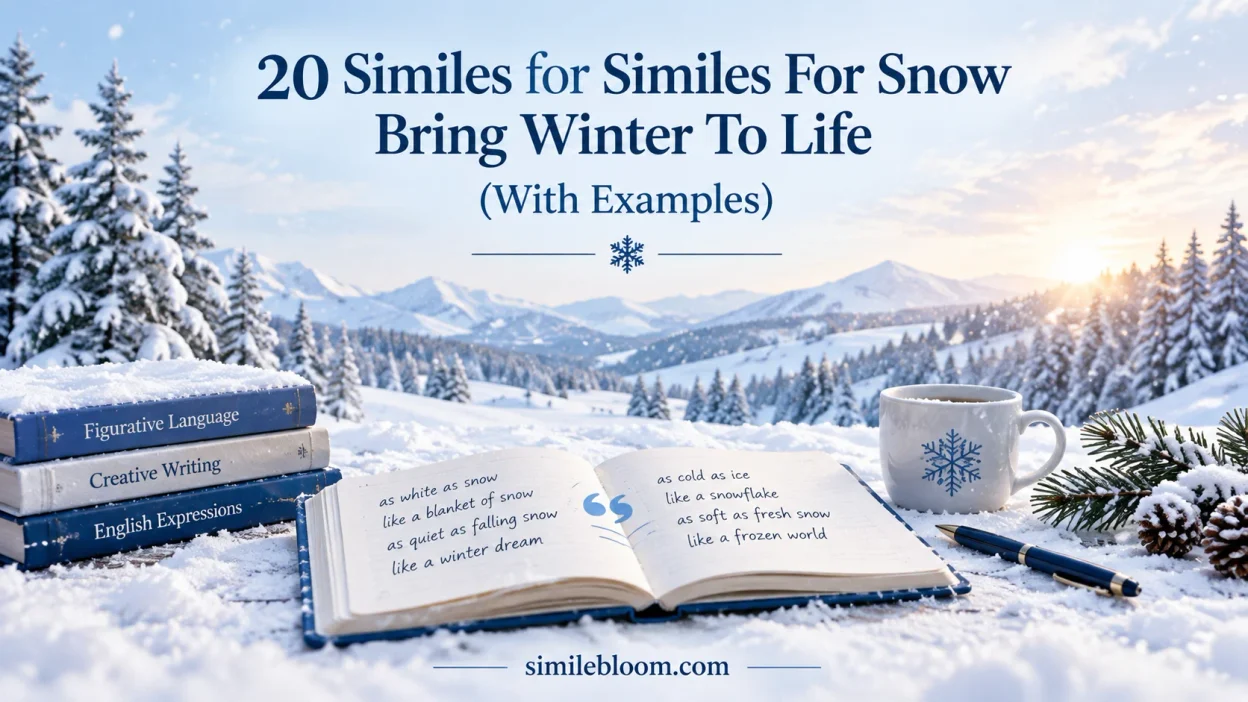
Snow can turn an ordinary winter scene into something quiet, beautiful, and unforgettable. The right comparison helps you show whether snow feels soft, sparkling, heavy, peaceful, or even mysterious.
A simile makes that description more vivid by connecting snow with something readers already understand. Instead of simply saying that snow is white, you can describe it as soft as feathers or bright as glass catching winter sunlight. These comparisons give readers a clearer mental picture and make descriptive writing feel more personal.
In this article, you’ll find 20 creative similes for snow that bring winter scenes to life. Each one includes its meaning, a detailed explanation, natural sentence examples, and alternative ways to express the same idea. You can use them in stories, poems, personal messages, essays, and everyday creative writing.
What Is a Simile?
A simile is a figure of speech that compares two different things using comparison words such as “like” or “as.” The comparison helps readers imagine an idea, object, feeling, or scene more clearly.
For example:
- Her smile was like sunshine after a long storm.
- The child was as quiet as a mouse.
These sentences are not meant literally. A person’s smile is not actually sunshine, and a child is not literally a mouse. The comparisons create a figurative meaning that gives the reader a stronger mental image.
Simile vs. Metaphor
A simile makes a comparison openly, usually with words such as like or as.
- Simile: The snow glittered like diamonds.
- Metaphor: The snow was a blanket over the valley.
The simile says that snow resembles diamonds, while the metaphor directly presents the snow as a blanket. Both forms of figurative language create imagery, but they build the comparison in different ways.
Why Use Similes for Similes For Snow Bring Winter To Life?
Snow can be difficult to describe precisely because its appearance changes with light, weather, temperature, and movement. A carefully chosen simile gives that changing landscape a more recognizable quality.
Similes can help you:
- Express feelings connected with winter.
- Make snowy scenes more vivid and visual.
- Create strong mental pictures.
- Add warmth and personality to communication.
- Make descriptive writing more memorable.
- Give poems and stories a distinctive voice.
- Describe weather and landscapes with greater clarity.
- Turn an ordinary winter observation into creative expression.
The best comparison depends on what you want the reader to notice. Fresh snow may feel delicate and peaceful, while falling snow may seem playful or mysterious.
Quick List of 20 Similes
- Snow was as soft as a feather.
- Snowflakes danced like tiny ballerinas.
- The snow-covered field looked like a blank sheet of paper.
- Fresh snow glittered like scattered diamonds.
- Snow fell like a curtain of white.
- The snow wrapped the trees like a woolen scarf.
- Snowflakes drifted like feathers in the air.
- The snow lay as smooth as silk.
- Snow sparkled like stars under the moon.
- The snow-covered hills looked like waves frozen in time.
- Snow fell as quietly as a whisper.
- The snowstorm roared like an angry sea.
- Snow clung to the branches like powdered sugar.
- The road disappeared like a path beneath a white blanket.
- Snowflakes floated like tiny pieces of lace.
- The winter landscape looked like a painting washed in white.
- Snow shone like silver beneath the morning sun.
- The snow-covered rooftops looked like frosted cakes.
- Snow gathered around the fence like soft cotton.
- The first snowfall felt like winter turning a new page.
Snow Was as Soft as a Feather
Meaning
This simile describes snow as light, delicate, and gentle. It emphasizes the soft texture of newly fallen snow rather than its coldness or weight.
Detailed Explanation
A feather is associated with softness and lightness, so comparing snow with one immediately creates a delicate image. The comparison works especially well for fresh, powdery snow that has not been packed down by footsteps or vehicles. It can make a winter scene feel peaceful rather than harsh. This simile has a gentle and poetic tone, making it useful for stories, poems, personal writing, and descriptions of quiet winter mornings.
Example in a Sentence
- The fresh snow was as soft as a feather beneath my boots.
- She brushed the powder from the windowsill, surprised by how soft as a feather it felt.
3 Other Ways to Say It
- The snow felt soft and delicate.
- The powder was light and velvety.
- Fresh snow rested with a gentle softness.
Snowflakes Danced Like Tiny Ballerinas
Meaning
This simile describes falling snowflakes as graceful and constantly moving. It gives the snowfall a lively, almost playful personality.
Detailed Explanation
Ballerinas move with grace, balance, and carefully controlled motion. Snowflakes can appear to twist, spin, and drift as they move through the air, making the comparison easy to visualize.
Unlike a description that simply says “snow was falling,” this expression emphasizes movement and elegance. It works especially well in creative writing when you want snowfall to feel lively and beautiful.
Example in a Sentence
- Outside the window, snowflakes danced like tiny ballerinas in the evening air.
- Under the streetlamp, the flakes seemed to dance like tiny ballerinas before reaching the ground.
3 Other Ways to Say It
- Snowflakes twirled through the air.
- The flakes spun and drifted gracefully.
- Snow moved in a delicate winter dance.
The Snow-Covered Field Looked Like a Blank Sheet of Paper
Meaning
This simile compares a newly snow-covered field with a clean, untouched sheet of paper. It suggests freshness, emptiness, and possibility.
Detailed Explanation
A blank sheet of paper has no marks on it, just as freshly fallen snow can cover the ground without footprints or tracks. The comparison creates a strong image of purity and untouched space.
It can also suggest that something new is about to happen, because both a blank page and fresh snow invite someone to leave a mark. This makes the simile particularly useful in storytelling and reflective writing.
Example in a Sentence
- At sunrise, the field looked like a blank sheet of paper, untouched by human footsteps.
- The children stared at the snow-covered yard as if it were a blank sheet of paper waiting for footprints.
3 Other Ways to Say It
- The field looked completely untouched.
- The snow created a clean white canvas.
- The ground appeared fresh and unmarked.
Fresh Snow Glittered Like Scattered Diamonds
Meaning
This simile describes snow that sparkles brightly in sunlight or another strong light.
Detailed Explanation
Diamonds are known for catching and reflecting light, while tiny snow crystals can sparkle when sunlight strikes them from different angles. The comparison focuses on brightness and brilliance, not on the shape or texture of the snow.
It works particularly well after a clear winter morning when fresh snow catches the sun. The tone is bright, admiring, and poetic.
Example in a Sentence
- Fresh snow glittered like scattered diamonds across the hillside.
- When the clouds cleared, the frozen field began to sparkle like scattered diamonds.
3 Other Ways to Say It
- The snow sparkled brilliantly.
- Sunlight made the snow shimmer.
- The field was covered in tiny points of light.
Snow Fell Like a Curtain of White
Meaning
This simile compares falling snow to a white curtain descending through the air. It emphasizes how snowfall can partly hide the landscape.
Detailed Explanation
A curtain can hang between you and what lies behind it. Heavy snowfall can have a similar effect by reducing visibility and making buildings, trees, and distant hills appear faint.
The expression is especially effective during steady or heavy snowfall. It gives the scene a sense of movement while also suggesting mystery and distance.
Example in a Sentence
- By late afternoon, snow fell like a curtain of white across the village.
- A thick snowfall descended like a white curtain, hiding the mountains beyond the road.
3 Other Ways to Say It
- Snow veiled the landscape.
- A white sheet of snow obscured the view.
- Snowfall blurred everything in the distance.
The Snow Wrapped the Trees Like a Woolen Scarf
Meaning
This simile describes snow covering tree branches as though they were wrapped in a warm winter scarf.
Detailed Explanation
A woolen scarf is soft, thick, and associated with winter warmth. Snow is obviously cold rather than warm, so the comparison is figurative and focuses on how snow surrounds and covers the trees.
It creates a cozy visual image and gives the landscape a gentle, almost comforting character. This expression fits winter storytelling, seasonal descriptions, and poetic writing.
Example in a Sentence
- Heavy snow wrapped the trees like woolen scarves along the quiet road.
- The garden looked peaceful, with every branch wrapped like a tree in a winter scarf.
3 Other Ways to Say It
- Snow draped the branches.
- The trees were covered in thick snow.
- White snow hugged the bare limbs.
Snowflakes Drifted Like Feathers in the Air
Meaning
This simile highlights the light, slow, floating movement of snowflakes.
Detailed Explanation
A feather can move gently through the air instead of falling straight downward. Snowflakes often behave similarly, especially when there is little wind.
The comparison helps readers picture the flakes floating, turning, and slowly descending. It has a calm and delicate tone and works well when describing light snowfall.
Example in a Sentence
- Snowflakes drifted like feathers in the air above the sleeping town.
- With barely any wind, the flakes floated downward like feathers.
3 Other Ways to Say It
- Snowflakes floated gently downward.
- The flakes drifted softly through the sky.
- Snow moved through the air with a feather-light motion.
The Snow Lay as Smooth as Silk
Meaning
This simile describes a snowy surface that is smooth, even, and undisturbed.
Detailed Explanation
Silk has a famously smooth texture, so comparing snow to silk emphasizes the surface rather than its temperature. Freshly fallen snow can form an even layer that looks almost flawless from a distance. The comparison creates a luxurious and elegant image. It is particularly suitable for descriptions where the snow has not yet been disturbed by people, animals, or vehicles.
Example in a Sentence
- The untouched garden lay as smooth as silk beneath the morning snow.
- Beyond the cabin, the snow looked as smooth as silk, without a single footprint.
3 Other Ways to Say It
- The snow formed a perfectly smooth surface.
- The ground looked soft and even.
- Fresh powder covered the earth in a smooth layer.
Snow Sparkled Like Stars Under the Moon
Meaning
This simile describes snow reflecting moonlight and appearing bright and magical against the darkness.
Detailed Explanation
Stars shine as small points of light against the night sky. Snow crystals can create a similar effect when moonlight reflects across a frozen landscape. The comparison makes the scene feel dreamlike and peaceful without claiming that snow literally shines like stars. It works especially well in nighttime stories, poems, and atmospheric descriptions.
Example in a Sentence
- Under the full moon, the snow sparkled like stars across the quiet field.
- We walked through the garden while the snow shimmered like tiny stars beneath our feet.
3 Other Ways to Say It
- Moonlight made the snow twinkle.
- The snowy ground shimmered in the darkness.
- Tiny crystals caught the moonlight.
Read More: 20 Similes for Being Happy With Examples
The Snow-Covered Hills Looked Like Waves Frozen in Time
Meaning
This simile compares the shapes of snowy hills with ocean waves that have suddenly stopped moving.
Detailed Explanation
Rolling hills can rise and fall in ways that resemble the shape of waves. Covering those hills with snow can make the resemblance even stronger because the white surface smooths out many smaller details. The phrase “frozen in time” adds a sense of stillness and permanence. It is an effective choice for landscape writing because it combines movement, shape, and silence in one image.
Example in a Sentence
- From the cabin window, the snowy hills looked like waves frozen in time.
- Beyond the village, white ridges stretched across the horizon like frozen ocean waves.
3 Other Ways to Say It
- The hills rolled across the horizon like a silent sea.
- Snow formed smooth waves across the landscape.
- The white ridges looked motionless and ocean-like.
Snow Fell as Quietly as a Whisper
Meaning
This simile emphasizes the silence and gentleness of falling snow.
Detailed Explanation
A whisper is extremely soft and difficult to hear from a distance. Snow often falls without making an obvious sound, creating a similar feeling of quietness. The comparison draws attention to the peaceful atmosphere rather than the appearance of the flakes. It works especially well in reflective writing, winter scenes, and descriptions of nighttime snowfall.
Example in a Sentence
- Outside the cabin, snow fell as quietly as a whisper.
- The town slept while the snow descended as quietly as a whisper onto the rooftops.
3 Other Ways to Say It
- Snow fell in complete silence.
- The snowfall was soft and almost soundless.
- The flakes descended with quiet grace.
The Snowstorm Roared Like an Angry Sea
Meaning
This simile describes a snowstorm as powerful, loud, restless, and difficult to ignore.
Detailed Explanation
The comparison changes the mood from peaceful snowfall to dangerous or dramatic winter weather. An angry sea can produce strong waves, powerful winds, and an overwhelming sense of movement. A severe snowstorm can create a similar atmosphere through howling wind, blowing snow, and poor visibility. This is a dramatic expression that fits adventure stories and intense weather scenes better than casual conversation.
Example in a Sentence
- Outside the shelter, the snowstorm roared like an angry sea.
- The wind and snow battered the windows like an angry sea pounding a rocky shore.
3 Other Ways to Say It
- The storm howled around the house.
- Snow and wind raged through the valley.
- The blizzard created a fierce, restless roar.
Snow Clung to the Branches Like Powdered Sugar
Meaning
This simile describes snow resting lightly on tree branches and making them look delicately dusted with white.
Detailed Explanation
Powdered sugar forms a fine white coating over cakes and pastries. Light snow can create a similar appearance when it settles on branches without completely burying them. The comparison gives the trees a delicate, almost edible-looking appearance. It has a playful and charming tone that can work well in family stories, children’s writing, and cheerful winter descriptions.
Example in a Sentence
- Snow clung to the branches like powdered sugar after the overnight flurry.
- The small trees looked as though someone had dusted them with powdered sugar.
3 Other Ways to Say It
- Snow lightly dusted the branches.
- The trees wore a fine white coating.
- A thin layer of snow rested on every limb.
The Road Disappeared Like a Path Beneath a White Blanket
Meaning
This simile describes heavy snow covering a road so completely that its original shape becomes difficult to see.
Detailed Explanation
A blanket can cover the surface beneath it and hide what lies underneath. Deep snowfall can do the same to roads, paths, sidewalks, and fields. The comparison helps readers understand how thoroughly snow can transform a familiar landscape. It works well in storytelling when a character encounters a winter road that has become difficult to recognize.
Example in a Sentence
- After the overnight storm, the narrow road disappeared like a path beneath a white blanket.
- The old walking trail vanished beneath the snow like a hidden path under a blanket.
3 Other Ways to Say It
- Snow covered the road completely.
- The path became almost invisible beneath the snow.
- Heavy snowfall erased the road from view.
Snowflakes Floated Like Tiny Pieces of Lace
Meaning
This simile compares snowflakes with delicate lace, focusing on their intricate appearance and graceful movement.
Detailed Explanation
Lace is known for its fine patterns and delicate structure. Individual snowflakes can also have intricate crystalline shapes, although each snowflake is naturally formed rather than woven. The comparison gives the snowfall an elegant and fragile quality. It is particularly effective in poetry and descriptive passages where visual detail matters.
Example in a Sentence
- The flakes floated down like tiny pieces of lace against the dark sky.
- Each snowflake looked like a tiny piece of lace resting on her glove.
3 Other Ways to Say It
- The snowflakes looked delicate and intricate.
- Tiny crystals drifted through the air.
- The flakes resembled fragile white patterns.
The Winter Landscape Looked Like a Painting Washed in White
Meaning
This simile describes a winter scene as beautiful, still, and dominated by pale colors.
Detailed Explanation
A painting can capture a landscape in a fixed and carefully composed image. When snow covers trees, fields, rooftops, and hills, the landscape may appear similarly still and visually arranged. The phrase “washed in white” emphasizes how snow transforms many different colors into a mostly pale scene. This simile is useful for artistic, reflective, and descriptive writing.
Example in a Sentence
- After the first snowfall, the valley looked like a painting washed in white.
- The village appeared like a winter painting washed in white and silver.
3 Other Ways to Say It
- The landscape looked beautifully transformed by snow.
- Everything appeared painted in shades of white.
- The scene resembled a quiet winter artwork.
Snow Shone Like Silver Beneath the Morning Sun
Meaning
This simile describes snow reflecting sunlight with a bright, cool, metallic appearance.
Detailed Explanation
Silver reflects light strongly, and snow can take on a silvery appearance when sunlight strikes its crystalline surface. The comparison focuses on brightness and reflective quality rather than softness. It can make an ordinary snowy morning sound elegant without exaggerating the scene. This expression works particularly well in descriptive prose and poetry.
Example in a Sentence
- The snow shone like silver beneath the early morning sun.
- Across the frozen lake, the snow glimmered like silver in the sunlight.
3 Other Ways to Say It
- The snow glimmered in the sunlight.
- The white surface reflected the morning light.
- Snow took on a silvery glow.
The Snow-Covered Rooftops Looked Like Frosted Cakes
Meaning
This simile compares snowy rooftops with cakes covered in a layer of white frosting.
Detailed Explanation
The comparison focuses on the thick white layer that snow can create along rooftops. Frosted cakes often look soft, decorative, and inviting, which gives the winter scene a playful and cozy quality. It is less dramatic than comparisons involving storms or darkness. This simile is especially suitable for cheerful winter writing and descriptions of villages or neighborhoods.
Example in a Sentence
- The houses looked like frosted cakes after the overnight snowfall.
- From the hill, every rooftop resembled a cake covered in white icing.
3 Other Ways to Say It
- Snow topped the rooftops like icing.
- The houses looked softly dusted with white.
- White snow covered every roof.
Snow Gathered Around the Fence Like Soft Cotton
Meaning
This simile describes snow accumulating around a fence in a way that looks fluffy, thick, and soft.
Detailed Explanation
Cotton is light, soft, and fluffy, making it a useful comparison for powdery snow that gathers in rounded patches. The image focuses on the texture and shape of accumulated snow rather than its movement. It can make an outdoor winter scene feel gentle and almost tactile. The tone is calm and descriptive, making it useful in storytelling and nature writing.
Example in a Sentence
- Snow gathered around the wooden fence like soft cotton.
- Along the garden wall, piles of powder looked like tufts of white cotton.
3 Other Ways to Say It
- Snow formed fluffy mounds around the fence.
- Soft powder piled up along the posts.
- The snow looked thick and cloud-like.
The First Snowfall Felt Like Winter Turning a New Page
Meaning
This simile compares the first snowfall with starting a fresh page, suggesting change, renewal, and the beginning of a new season.
Detailed Explanation
Turning a new page often represents a fresh beginning. The first snowfall can create the same emotional feeling because it changes familiar surroundings almost instantly. The comparison is less about the physical appearance of snow and more about its emotional effect. It fits reflective writing, seasonal essays, personal messages, and stories about change.
Example in a Sentence
- When the first flakes arrived, it felt like winter turning a new page.
- The quiet snowfall made the whole town seem like a new page waiting to be written.
3 Other Ways to Say It
- The first snow marked a fresh beginning.
- Winter seemed to start a new chapter.
- The snowfall brought a sense of renewal.
Exercise: Practice Using Similes
Test your understanding of similes, figurative meaning, imagery, and descriptive language with these questions.
1. Which sentence contains a simile?
A. The snow covered the road.
B. The snow was a blanket over the road.
C. The snow fell like soft feathers.
D. Snow covered every branch.
2. What does “Snow sparkled like scattered diamonds” suggest?
A. The snow was expensive.
B. The snow was dark.
C. The snow was hard to walk on.
D. The snow reflected light brightly.
3. Which comparison focuses most on the quietness of snowfall?
A. Snow fell as quietly as a whisper.
B. Snow glittered like diamonds.
C. Snow looked like a painting.
D. Snow gathered like cotton.
4. Which sentence is a metaphor rather than a simile?
A. The snow was like a blanket.
B. Snowflakes floated like feathers.
C. The snow was a white blanket.
D. The snow fell as softly as a whisper.
5. What does “The snow lay as smooth as silk” describe?
A. The snow’s even, smooth surface.
B. The loud sound of snowfall.
C. The speed of the storm.
D. The warmth of the snow.
6. Which simile would best fit a peaceful nighttime scene?
A. The snowstorm roared like an angry sea.
B. Snow fell as quietly as a whisper.
C. Snow covered the road like a blanket.
D. Snow looked like frosted cakes.
7. In “Snowflakes danced like tiny ballerinas,” what is being compared?
A. Snowflakes and music.
B. Snowflakes and flowers.
C. Snowflakes and ballerinas.
D. Snowflakes and stars.
8. Which expression best describes heavy snowfall hiding a road?
A. Snow shone like silver.
B. Snowflakes floated like lace.
C. Snow sparkled like diamonds.
D. The road disappeared like a path beneath a white blanket.
9. What is the figurative meaning of “The winter landscape looked like a painting washed in white”?
A. Someone literally painted the landscape.
B. The landscape was beautifully transformed and dominated by snow.
C. The landscape had no snow.
D. The landscape was inside an art gallery.
10. Which sentence uses a simile naturally?
A. The snow is a diamond.
B. The snow sparkled like diamonds in the sunlight.
C. The snow diamonded the field.
D. The snow became a painting.
11. Which comparison would best describe delicate snowflakes?
A. Snowflakes floated like tiny pieces of lace.
B. Snowflakes roared like an angry sea.
C. Snowflakes covered the road like a blanket.
D. Snowflakes looked like waves frozen in time.
12. Which sentence demonstrates literal rather than figurative language?
A. Snow was a white blanket.
B. Snowflakes danced in the sky.
C. The snow covered the garden.
D. Snow sparkled like stars.
13. What idea does “The first snowfall felt like winter turning a new page” communicate?
A. Snowfall damaged a book.
B. Winter was ending.
C. Snow was made of paper.
D. The first snowfall represented a fresh beginning.
14. Which simile creates the most dramatic image of severe winter weather?
A. Snowflakes floated like lace.
B. The snowstorm roared like an angry sea.
C. Snow was as smooth as silk.
D. Snow looked like powdered sugar.
15. Which sentence contains a clear comparison using “like”?
A. The field was white.
B. The snow covered the trees.
C. Snowflakes drifted like feathers in the air.
D. Winter arrived early.
Answers
- C — “Like soft feathers” directly compares snow with feathers, making it a simile.
- D — The diamond comparison suggests that the snow catches and reflects light.
- A — A whisper is extremely quiet, so the comparison emphasizes the silence of snowfall.
- C — “The snow was a white blanket” directly identifies snow as a blanket, making it a metaphor.
- A — Silk is associated with smoothness, so the simile describes the snow’s even surface.
- B — The whisper comparison creates a quiet and peaceful winter atmosphere.
- C — The sentence compares the movement of snowflakes with the graceful movement of ballerinas.
- D — A white blanket can hide what lies beneath it, making this comparison suitable for a snow-covered road.
- B — The expression describes how snow transforms the landscape into something that resembles a white artistic scene.
- B — “Sparkled like diamonds” uses like to create a natural comparison between bright snow and diamonds.
- A — Lace suggests something delicate and intricately patterned, which suits the appearance of snowflakes.
- C — The statement simply describes something that can literally happen: snow can cover a garden.
- D — Turning a page represents change or a fresh beginning, which is the figurative idea behind the comparison.
- B — An angry sea suggests power and turbulence, making it appropriate for a severe snowstorm.
- C — “Like feathers in the air” clearly compares snowflakes with feathers using the comparison word like.
FAQs
What is a simile for snow?
A simile for snow compares snow with another thing using words such as like or as. For example, “The snow was as soft as a feather” compares the softness of snow with that of a feather.
How can similes describe snow more effectively?
Similes can show specific qualities that a basic description may miss. You can use them to describe snow’s texture, movement, brightness, silence, shape, or emotional effect.
What is the difference between a simile and a metaphor when describing snow?
A simile uses an obvious comparison, usually with like or as, such as “Snow sparkled like diamonds.” A metaphor makes the comparison directly, such as “The snow was a blanket.”
Can I create my own similes for snow?
Yes. Think about the specific quality you want to describe first. Then choose something that shares that quality and connect the two with like or as. For example, if you want to show how quietly snow falls, you might compare it with a whisper.
Which simile should I use for creative writing about snow?
Choose a comparison that matches the mood and image you want to create. A feather can suggest softness, diamonds can suggest sparkle, while an angry sea can create a dramatic impression of a powerful storm.
Conclusion
Snow gives writers many opportunities to create vivid figurative language. A simple snowfall can become graceful, mysterious, peaceful, playful, or dramatic depending on the comparison you choose. The similes in this guide show different ways to describe snow and winter scenes without relying on repetitive wording. When writing your own descriptions, focus first on the quality you want readers to notice, whether that is softness, movement, brightness, silence, or change.
Then choose a comparison that naturally supports that idea. Strong descriptive language does not need to be complicated. The most effective simile is often the one that creates a clear picture while still sounding natural. With thoughtful comparisons, similes for snow can bring winter to life and make your writing more memorable.

Daniel Carter is an English educator and content writer with a strong interest in creative language and literary expression. His work focuses on helping learners understand how similes and other forms of figurative language work in real sentences. At SimileBloom, Daniel develops easy-to-follow explanations and useful examples for improving English writing and communication.